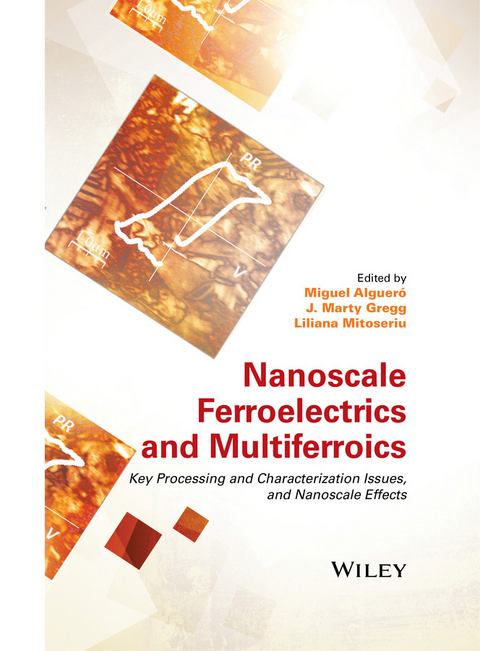
Nanoscale Ferroelectrics and Multiferroics (eBook)
John Wiley & Sons (Verlag)
978-1-118-93570-5 (ISBN)
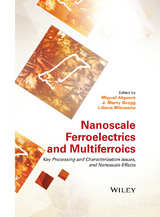
Taking full advantage of the synergies between nanoscale ferroelectrics and multiferroics, the text covers materials nanostructured at all levels, from ceramic technologies like ferroelectric nanopowders, bulk nanostructured ceramics and thick films, and magnetoelectric nanocomposites, to thin films, either polycrystalline layer heterostructures or epitaxial systems, and to nanoscale free standing objects with specific geometries, such as nanowires and tubes at different levels of development.
This set is developed from the high level European scientific knowledge platform built within the COST (European Cooperation in Science and Technology) Action on Single and multiphase ferroics and multiferroics with restricted geometries (SIMUFER, ref. MP0904). Chapter contributors have been carefully selected, and have all made major contributions to knowledge of the respective topics, and overall, they are among most respected scientists in the field.
Dr Miguel Algueró is Senior Researcher at Instituto de Ciencia de Materiales de Madrid (ICMM), of Consejo Superior de Investigaciones Científicas (CSIC), Spain. He is a material scientist with a strong expertise in ferroelectrics, mainly for piezoelectric applications, from which he approached the resurgent field of multiferroics. His research interest covers all ceramics and thin films, processing and properties with an emphasis on nanostructuring issues and size effects at the nanoscale.
Professor J. Marty Gregg holds a chair in the School of Mathematics and Physics at Queen's University Belfast, UK. His current research interests are in the experimental exploration of the behaviour of ferroelectrics at reduced dimensions and in nanoshapes of complex morphology. He has co-organized various symposia including symposa E- Metal Oxide Nanostructures (EMRS, Strasbourg, 2009), Functional Ceramic Materials and Devices (EUROMAT 2009), and the International Symposium on Integrated Ferroelectrics held in Edinburgh in 2010.
Professor Liliana Mitoseriu is based at the Faculty of Physics, University 'Alexandru Ioan Cuza' Iasi, Romania. Prof. Mitoseriu has co-authored 130 peer reviewed papers in the field of ferroelectric and multiferroic oxides. She has written six books for students (in Romanian) and edited two international books addressing modern topics in Electroceramics. She is currently the Chair of the FP7-ESF-COST Action MP0904 Single- and multiphase ferroics and multiferroics with restricted geometries, and the major outputs are presented in this book.
This two volume set reviews the key issues in processing and characterization of nanoscale ferroelectrics and multiferroics, and provides a comprehensive description of their properties, with an emphasis in differentiating size effects of extrinsic ones like boundary or interface effects. Recently described nanoscale novel phenomena are also addressed. Organized into three parts it addresses key issues in processing (nanostructuring), characterization (of the nanostructured materials) and nanoscale effects. Taking full advantage of the synergies between nanoscale ferroelectrics and multiferroics, the text covers materials nanostructured at all levels, from ceramic technologies like ferroelectric nanopowders, bulk nanostructured ceramics and thick films, and magnetoelectric nanocomposites, to thin films, either polycrystalline layer heterostructures or epitaxial systems, and to nanoscale free standing objects with specific geometries, such as nanowires and tubes at different levels of development. This set is developed from the high level European scientific knowledge platform built within the COST (European Cooperation in Science and Technology) Action on Single and multiphase ferroics and multiferroics with restricted geometries (SIMUFER, ref. MP0904). Chapter contributors have been carefully selected, and have all made major contributions to knowledge of the respective topics, and overall, they are among most respected scientists in the field.
Dr Miguel Algueró is Senior Researcher at Instituto de Ciencia de Materiales de Madrid (ICMM), of Consejo Superior de Investigaciones Científicas (CSIC), Spain. He is a material scientist with a strong expertise in ferroelectrics, mainly for piezoelectric applications, from which he approached the resurgent field of multiferroics. His research interest covers all ceramics and thin films, processing and properties with an emphasis on nanostructuring issues and size effects at the nanoscale. Professor J. Marty Gregg holds a chair in the School of Mathematics and Physics at Queen's University Belfast, UK. His current research interests are in the experimental exploration of the behaviour of ferroelectrics at reduced dimensions and in nanoshapes of complex morphology. He has co-organized various symposia including symposa E- Metal Oxide Nanostructures (EMRS, Strasbourg, 2009), Functional Ceramic Materials and Devices (EUROMAT 2009), and the International Symposium on Integrated Ferroelectrics held in Edinburgh in 2010. Professor Liliana Mitoseriu is based at the Faculty of Physics, University "Alexandru Ioan Cuza" Iasi, Romania. Prof. Mitoseriu has co-authored 130 peer reviewed papers in the field of ferroelectric and multiferroic oxides. She has written six books for students (in Romanian) and edited two international books addressing modern topics in Electroceramics. She is currently the Chair of the FP7-ESF-COST Action MP0904 Single- and multiphase ferroics and multiferroics with restricted geometries, and the major outputs are presented in this book.
List of Contributors
Andrew R. Akbashev Drexel University, USA
Miguel Algueró Instituto de Ciencia de Materiales de Madrid (ICMM), Consejo Superior de Investigaciones Científicas (CSIC), Spain
Andreas Amann Tyndall National Institute, University College Cork, Ireland; and School of Mathematical Sciences, University College Cork, Ireland
Harvey Amorín Instituto de Ciencia de Materiales de Madrid (ICMM), Consejo Superior de Investigaciones Científicas (CSIC), Spain
Nicoleta Apostol National Institute of Materials Physics, Romania
Juras Banys Faculty of Physics, Vilnius University, Lithuania
Laurent Bellaiche Physics Department, University of Arkansas, USA
Daniela C. Berger Departement of Inorganic Chemistry, Physical-Chemistry and Electrochemistry, “Politehnica” University of Bucharest, Romania
J.D. Bobic Institute for Multidisciplinary Research, University of Belgrade, Serbia
Alexei A. Bokov Department of Chemistry and 4D LABS, Simon Fraser University, Canada
Andra G. Boni National Institute of Materials Physics, Romania
Mihaela Botea National Institute of Materials Physics, Romania
Iñnigo Bretos Instituto de Ciencia de Materiales de Madrid (ICMM), Consejo Superior de Investigaciones Científicas (CSIC), Spain
Maria Teresa Buscaglia Institute of Energetics and Interphases, National Research Council, Italy
Vincenzo Buscaglia Institute of Energetics and Interphases, National Research Council, Italy
Michael P.D. Campbell School of Maths and Physics, Queen's University Belfast, Northern Ireland, United Kingdom
Arianna Casiraghi NanoSpin, Department of Applied Physics, Aalto University School of Science, Finland
Alichandra Castro CICECO – Aveiro Institute of Materials, Department of Materials and Ceramic Engineering, University of Aveiro, Portugal
Alicia Castro Instituto de Ciencia de Materiales de Madrid (ICMM), Consejo Superior de Investigaciones Científicas (CSIC), Madrid, Spain
Li-Wu Chang School of Maths and Physics, Queen's University Belfast, Northern Ireland, United Kingdom
Cristina Chirila National Institute of Materials Physics, Romania
Frank Clemens Laboratory for High Performance Ceramics, Empa, Swiss Federal Laboratories for Materials Science and Technology, Switzerland
Covadonga Correas Instituto de Ciencia de Materiales de Madrid (ICMM), Consejo Superior de Investigaciones Científicas (CSIC), Spain; and College of Engineering, Swansea University, United Kingdom
Lavinia P. Curecheriu Department of Physics, “Alexandru Ioan Cuza” University, Romania
Nitin Deepak Tyndall National Institute, University College Cork, Ireland
Marco Deluca Materials Center Leoben Forschung GmbH, and Institut für Struktur- und Funktionskeramik, Montanuniversitaet Leoben, Austria
Xiangdong Ding State Key Laboratory for Mechanical Behavior of Materials, Xi'an Jiaotong University, China
Christopher De Dobbelaere Inorganic and Physical Chemistry Group, Institute for Materials Research, Universiteit Hasselt and imec vzw, Division imomec, Belgium
C. Doubrovsky Laboratoire de Physique des Solides, Université de Paris Sud, Campus d'Orsay, France
Ahmad Faraz Tyndall National Institute, University College Cork, Ireland
Liliana P. Ferreira Biosystems and Integrative Sciences Institute, Department of Physics, University of Coimbra, Portugal
Paula Ferreira CICECO – Aveiro Institute of Materials, Department of Materials and Ceramic Engineering, University of Aveiro, Portugal
Pascale Foury-Leylekian Laboratoire de Physique des Solides, Université de Paris Sud, Campus d'Orsay, France
Kévin J. A. Franke NanoSpin, Department of Applied Physics, Aalto University School of Science, Finland
Vladimir M. Fridkin Drexel University, USA; and Russian Academy of Sciences, Moscow, Russian Federation
Huaxiang Fu Physics Department, University of Arkansas, USA
Andreja Gajović Molecular Physics Laboratory, Institute Rudjer Boskovic, Croatia
Corneliu Ghica National Institute of Materials Physics, Romania
Margarida Godinho Biosystems and Integrative Sciences Institute, Department of Physics, Faculty of Sciences, University of Lisbon, Portugal
Martha Greenblatt Department of Chemistry and Chemical Biology, Rutgers, The State University of New Jersey, USA
J. Marty Gregg School of Maths and Physics, Queen's University Belfast, Northern Ireland, United Kingdom
R. Grigalaitis Faculty of Physics, Vilnius University, Lithuania
Sampo J. Hämäläinen NanoSpin, Department of Applied Physics, Aalto University School of Science, Finland
An Hardy Inorganic and Physical Chemistry Group, Institute for Materials Research, Universiteit Hasselt and imec vzw, Division imomec, Belgium
Luminita M. Hrib National Institute of Materials Physics, Romania
Teresa Hungria Instituto de Ciencia de Materiales de Madrid (ICMM), Consejo Superior de Investigaciones Científicas (CSIC), Spain; and Centre de Microcaractérisation Raimond Castaing, UMS 3623, France
Alan J. Hurd Los Alamos National Laboratory, USA
Adelina-Carmen Ianculescu Department of Oxide Materials Science and Engineering, “Politehnica” University of Bucharest, Romania
Alin Iuga National Institute of Materials Physics, Romania
Maksim Ivanov Faculty of Physics, Vilnius University, Lithuania
Ricardo Jiménez Instituto de Ciencia de Materiales de Madrid (ICMM), Consejo Superior de Investigaciones Científicas (CSIC), Spain
Lynette Keeney Tyndall National Institute, University College Cork, Ireland
Michael R. Koblischka Institute of Experimental Physics, Saarland University, Germany
Anjela Koblischka-Veneva Institute of Experimental Physics, Saarland University, Germany
Amit Kumar School of Maths and Physics, Queen's University Belfast, Northern Ireland,United Kingdom
Tuomas H.E. Lahtinen NanoSpin, Department of Applied Physics, Aalto University School of Science, Finland
Diego López González NanoSpin, Department of Applied Physics, Aalto University School of Science, Finland
M. Lourdes Calzada Instituto de Ciencia de Materiales de Madrid (ICMM), Consejo Superior de Investigaciones Científicas (CSIC), Spain
Axel Lubk Triebenberg Laboratory, Technische Universität Dresden, German
Tony Lusiola Laboratory for High Performance Ceramics, Empa, Swiss Federal Laboratories for Materials Science and Technology, Switzerland
Leo J.McGilly Ceramics Laboratory, École Polytechnique Féedérale de Lausanne (EPFL), Switzerland
Raymond G.P. McQuaid School of Maths and Physics, Queen's University Belfast, Northern Ireland, United Kingdom
J. Macutkevic Faculty of Physics, Vilnius University, Lithuania
César Magén Instituto de Nanociencia de Aragón-ARAID, Universidad de Zaragoza, Spain
Tuhin Maity Tyndall National Institute, University College Cork, Ireland
Barbara Mali.c Electronic Ceramics Department, Jo.zef Stefan Institute, Slovenia
Liliana Mitoseriu Faculty of Physics, University “Alexandru Ioan Cuza”, Romania
Evagelia G. Moshopoulou Institute of Nanoscience and Nanotechnology, National Center for Scientific Research “Demokritos”, Greece; and Laboratoire de Physique des Solides, Universitéde Paris Sud, Campus d'Orsay, France
Ivan I. Naumov Carnegie Institution of Washington, USA
Raluca Negrea National Institute of Materials Physics, Romania
Marius Olariu Department of Electrical Measurements & Materials, Technical University Gh. Asachi Iasi, Romania
Leontin Padurariu University “Alexandru Ioan Cuza”, Romania
Katharine Page Spallation Neutron Source, Oak Ridge National Laboratory, USA
Iuliana Pasuk National Institute of Materials Physics, Romania
Martyn E. Pemble Tyndall National Institute, University College Cork, Ireland; and Department of Chemistry, University College Cork, Ireland
Nikolay Petkov Tyndall National Institute, University College Cork, Ireland
M.M. Vijatovic Petrovic Institute for Multidisciplinary Research, University of Belgrade, Serbia
Ioana Pintilie National Institute of Materials Physics, Romania
Lucian Pintilie National Institute of Materials Physics, Romania
Sergei Prosandeev Physics Department, University of Arkansas, USA and Physics Department and Research Institute of Physics, Southern Federal University, Russia
Jesús Ricot Instituto de Ciencia de Materiales de Madrid (ICMM), Consejo Superior de Investigaciones Científicas (CSIC), Spain
Brian J. Rodriguez Conway Institute of Biomolecular and Biomedical Research, University College Dublin, Ireland
Saibal Roy Tyndall National Institute, University College Cork, Ireland
Ekhard. K.H. Salje...
| Erscheint lt. Verlag | 24.3.2016 |
|---|---|
| Sprache | englisch |
| Themenwelt | Naturwissenschaften ► Chemie |
| Technik ► Maschinenbau | |
| Schlagworte | Condensed Matter • dielectric properties • Electrical & Electronics Engineering • Electronic materials • Elektronische Materialien • Elektrotechnik u. Elektronik • Kondensierte Materie • Materials Science • Materialwissenschaften • Microscopy • Multiferroic • Nanopatterning • nanoporous • Nanostructured Materials • Nanotechnologie • nanotubes • Nanowires • Physics • Physik • Polymer Composites • Self-Assembly • spectroscopy • Thin Films |
| ISBN-10 | 1-118-93570-5 / 1118935705 |
| ISBN-13 | 978-1-118-93570-5 / 9781118935705 |
| Informationen gemäß Produktsicherheitsverordnung (GPSR) | |
| Haben Sie eine Frage zum Produkt? |
 EPUB (Adobe DRM)
Größe: 22,9 MB
Kopierschutz: Adobe-DRM
Adobe-DRM ist ein Kopierschutz, der das eBook vor Mißbrauch schützen soll. Dabei wird das eBook bereits beim Download auf Ihre persönliche Adobe-ID autorisiert. Lesen können Sie das eBook dann nur auf den Geräten, welche ebenfalls auf Ihre Adobe-ID registriert sind.
Details zum Adobe-DRM
Dateiformat: EPUB (Electronic Publication)
EPUB ist ein offener Standard für eBooks und eignet sich besonders zur Darstellung von Belletristik und Sachbüchern. Der Fließtext wird dynamisch an die Display- und Schriftgröße angepasst. Auch für mobile Lesegeräte ist EPUB daher gut geeignet.
Systemvoraussetzungen:
PC/Mac: Mit einem PC oder Mac können Sie dieses eBook lesen. Sie benötigen eine
eReader: Dieses eBook kann mit (fast) allen eBook-Readern gelesen werden. Mit dem amazon-Kindle ist es aber nicht kompatibel.
Smartphone/Tablet: Egal ob Apple oder Android, dieses eBook können Sie lesen. Sie benötigen eine
Geräteliste und zusätzliche Hinweise
Buying eBooks from abroad
For tax law reasons we can sell eBooks just within Germany and Switzerland. Regrettably we cannot fulfill eBook-orders from other countries.
 PDF (Adobe DRM)
Kopierschutz: Adobe-DRM
Adobe-DRM ist ein Kopierschutz, der das eBook vor Mißbrauch schützen soll. Dabei wird das eBook bereits beim Download auf Ihre persönliche Adobe-ID autorisiert. Lesen können Sie das eBook dann nur auf den Geräten, welche ebenfalls auf Ihre Adobe-ID registriert sind.
Details zum Adobe-DRM
Dateiformat: PDF (Portable Document Format)
Mit einem festen Seitenlayout eignet sich die PDF besonders für Fachbücher mit Spalten, Tabellen und Abbildungen. Eine PDF kann auf fast allen Geräten angezeigt werden, ist aber für kleine Displays (Smartphone, eReader) nur eingeschränkt geeignet.
Systemvoraussetzungen:
PC/Mac: Mit einem PC oder Mac können Sie dieses eBook lesen. Sie benötigen eine
eReader: Dieses eBook kann mit (fast) allen eBook-Readern gelesen werden. Mit dem amazon-Kindle ist es aber nicht kompatibel.
Smartphone/Tablet: Egal ob Apple oder Android, dieses eBook können Sie lesen. Sie benötigen eine
Geräteliste und zusätzliche Hinweise
Buying eBooks from abroad
For tax law reasons we can sell eBooks just within Germany and Switzerland. Regrettably we cannot fulfill eBook-orders from other countries.
aus dem Bereich