


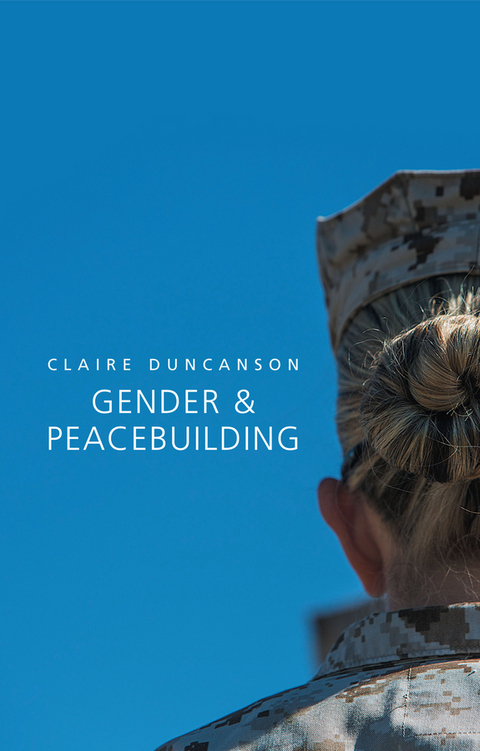
Gender and Peacebuilding (eBook)
John Wiley & Sons (Verlag)
978-0-7456-8255-6 (ISBN)
Gender and Peacebuilding offers a comprehensive and up to date analysis of how and why gender matters in contemporary peace operations. It draws on a wide range of examples from across the world to offer a nuanced account of the UN?s attempts to mainstream gender into peace operations via Security Council Resolution 1325, and assesses the successes and failures of this effort to enhance the participation and protection of women and girls in peacebuilding operations. In presenting this mixed picture of progress and ongoing challenges, the book argues for bold steps forward that will enable peacebuilding to contest the current neoliberal order, address structural inequalities, and bring about feminist visions of peace and security. It is only by focusing attention on the economic empowerment of women and its ability to temper the dangers of neo-liberalism in post-conflict contexts that feminists can hope to achieve these aims.
Timely, critical and engaged, this book provides an invaluable guide to the issues for students of peace and conflict studies, and sets the agenda for future scholarship and advocacy.
Gender and Peacebuilding offers a comprehensive and up to date analysis of how and why gender matters in contemporary peace operations. It draws on a wide range of examples from across the world to offer a nuanced account of the UN's attempts to mainstream gender into peace operations via Security Council Resolution 1325, and assesses the successes and failures of this effort to enhance the participation and protection of women and girls in peacebuilding operations. In presenting this mixed picture of progress and ongoing challenges, the book argues for bold steps forward that will enable peacebuilding to contest the current neoliberal order, address structural inequalities, and bring about feminist visions of peace and security. It is only by focusing attention on the economic empowerment of women and its ability to temper the dangers of neo-liberalism in post-conflict contexts that feminists can hope to achieve these aims. Timely, critical and engaged, this book provides an invaluable guide to the issues for students of peace and conflict studies, and sets the agenda for future scholarship and advocacy.
Mark Alfano is a Postdoctoral Research Associate at the Princeton University Center for Human Values and Center for Health and Wellbeing.
* Abbreviations
* Introduction
* Chapter 1: From gender blind to gender dilemmas
* Chapter 2: Feminist visions of peace
* Chapter 3: Feminist Critiques of Neoliberal Peacebuilding
* Chapter 4: Protection, Participation and Prevention in Practice
* Chapter 5: Gendering Alternatives to Neoliberal Peacebuilding
* Notes
* References
"Gender and Peacebuilding is a well-written and well-argued work which contributes to a better understanding of contemporary gender dilemmas in the field of gender, peace and security. One of its main virtues is Duncanson's capacity to iron out arguments and dilemmas to the point where they become comprehensible to anyone, from undergraduate students to professors."
--Journal of Intervention and Statebuilding
Introduction
Decades of feminist scholarship have demonstrated that war is gendered in its causes and consequences. From the language and policies of state leaders to the strategies and tactics of armed groups in conflict zones, a gendered ideology is at work privileging confrontational and combative approaches to conflicts of interest. War is also experienced differently by different people depending on their gender, ethnic, sexual and class identities. At the start of 2014, humanitarian organizations appealed for aid to help 52 million people in conflict zones in urgent need of assistance and protection. By the end of the year, the number had gone up by almost 50 per cent to 76 million (UN 2015). Overwhelmingly, these people are civilians, and the majority are women and girls. Wars wrench civilians from their ‘everyday productive activities, rites and celebrations and pitch them into states of violent turmoil, confused movement, precarious existence and deep grief unrelieved by the normal symbols of mourning’ (Turshen 2015). An increasingly common feature of wars is sexual violence, both that perpetrated by armed groups as a deliberate strategy and as part of a more generalized trend in the context of a conflict-ridden society undergoing socioeconomic stress (True 2012: 126). Sexual violence is more commonly inflicted upon women and girls (Cohen and Nordås 2014: 421). Women are also affected by war in particular ways because of their designated role in nearly all societies as the main carers of the young, the old and the vulnerable – a job made particularly challenging in wartime (Sjoberg 2014: 34–8).
As such, feminists have argued, it is crucial to include women and gendered analyses within attempts to build peace. Peace processes are underway in many conflict-affected areas today, but women and gender analyses are rarely central to these processes. This is despite the extensive architecture that has been built up at the United Nations (UN) to tackle the challenges that women in conflict-affected areas face in building peace, from their exclusion from formal ‘Track 1’1 negotiations to the ongoing insecurities – physical violence and lack of access to basic needs – which undermine their peacebuilding potential. In October 2000, in recognition of the impact of war on women and the role women could and should be playing to bring about sustainable peace, the United Nations Security Council (UNSC) adopted Resolution 1325 (hereafter 1325), which called for an understanding of gender to be ‘mainstreamed’ into peace operations. Since then, 1325 has been complemented by a series of further Security Council Resolutions, which strengthen the Women, Peace and Security (WPS) architecture around the ‘3 Ps’: the protection of women and girls from gender-based violence in armed conflict, particularly rape and other forms of sexual abuse, and an end to impunity for these crimes; the participation of women in all aspects of peacebuilding at every level in national and regional institutions, including in significant posts at the UN itself; and the mainstreaming of gender into mechanisms for the prevention of armed conflict. In addition, in 2005 the UN created a Peacebuilding Commission (UNPBC) whose formative resolutions reaffirm ‘the important role of women in the prevention and resolution of conflicts and in peacebuilding…stressing the importance of their equal participation and full involvement in all efforts for the maintenance and promotion of peace and security and the need to increase their role in decision-making with regard to conflict prevention and resolution and peacebuilding’ (UNSC 2005: Article 15). More recently, and as a significant boost to the WPS agenda, the Committee on the Elimination of Discrimination Against Women adopted its general recommendation on women in conflict prevention, conflict and post-conflict situations, General Recommendation 30 (CEDAW 2013). By placing the implementation of the Security Council WPS agenda within the broader framework of the implementation of the Convention on the Elimination of Discrimination Against Women (CEDAW), this move provides the steel girders to the architecture that promotes women's rights in conflict prevention, conflict and post-conflict situations.
Fifteen years down the line from 1325, we are now at a crucial juncture from which to assess the difference made by this considerable WPS architecture. Has it enabled feminist activists and women's organizations around the world to realize their visions of peace? In preparation for the Security Council's 15-year-on High-Level Review of the implementation of 1325, the Secretary-General commissioned a Global Study to highlight examples of good practice, implementation gaps and challenges, and priorities for action. Although this book is not linked formally to the High-Level Review and Global Study, its timeliness means it serves as a useful parallel assessment of the WPS architecture, one which is more wide ranging in scope. Its focus is not restricted to implementation of the WPS agenda but asks a series of broader questions. Have efforts to build peace in conflict-affected areas around the world created the sort of peace envisioned by feminists? What sort of peace is that? If the WPS agenda is not succeeding, how should feminists proceed? Given that 1325 is a relatively brief document, the product of negotiation, compromise and diplomacy, it does not cover all the goals that feminists might wish for – and the same is true of the subsequent resolutions and institutions. As such, it is important to place 1325 and the WPS agenda in this wider context.
This book thus has two main aims. Firstly, it seeks to map the literature, setting out the various feminist positions on the WPS agenda in ways which should be useful for anyone seeking to understand fully the multifaceted ways gender is relevant to peacebuilding. Secondly, it aims to set the agenda for future feminist scholarship and activism in the field. It argues that there is a need for more feminist focus on the political economy of peacebuilding: specifically, naming neoliberal policies as part of the problem in post-conflict contexts and, more importantly, identifying solutions. I will come back to elaborate on these aims and the particular contributions of the book at the end of this introductory chapter. Firstly, however, as is traditional, here I set out some definitions and background to the key concepts of peacebuilding and gender.
What is peacebuilding?
Peacebuilding can be conceived of in both narrow and broad terms. It can be defined narrowly as the UN's efforts to assist countries recently emerging from conflict and refer to only those operations which the UNPBC currently has on its agenda (Burundi, Sierra Leone, Guinea, Guinea-Bissau, Liberia and the Central African Republic). Indeed, it can be defined as an exclusively post-conflict exercise, beginning only when fighting has stopped (Paris 2004: 39). Alternatively, it can be defined extremely broadly, drawing on the conceptual origins in early conflict resolution theory, as any endeavour aiming to create sustainable peace by addressing the ‘root causes’ of violent conflict (Galtung 1996; Lederach 1998).
This book takes something of a middle ground, not limiting itself to strictly post-conflict countries on the UNPBC's agenda but also not attempting to cover all attempts to resolve conflict at every level, from community to society to international, around the world. It focuses on cases where the international community has intervened in order to assist states on the path to peace. Along with assessing the role of the UN and the donor community, which includes international financial institutions (IFIs) and governments, it pays close attention to activities at the grassroots in these sites of intervention, and the interaction between initiatives at different levels. As such, the book discusses interventions variously described as post-conflict reconstruction, humanitarian missions, transitional justice, state building, international administrations and peacebuilding missions. International interventions may be either ‘post-settlement’ (e.g. Burundi) or ‘post-invasion’ (e.g. Afghanistan) (Paris 2004). Or, indeed, given that the ‘post’ is often difficult to determine, especially for women, intervention may take place while conflict is ongoing. I adopt a broad definition of the term peacebuilding, discussing all types and phases of international intervention aimed at political, legal, economic and social transformation of a war-torn state, in order to grasp the full range of challenges faced by those seeking peace and an end to gendered inequalities and oppressions.
The international community's focus on peacebuilding resulted from the recognition that one of the flaws of traditional peacekeeping operations was that they did not address the underlying causes of conflict; nor did they do enough to assist in building the institutions, broadly conceived, which would make peace sustainable. Peacebuilding can thus be seen as a more ambitious project than traditional peacekeeping. In his 1992 ‘Agenda for Peace’, then-Secretary-General of the United Nations Boutros Boutros-Ghali insisted that, having overcome the ‘immense ideological barrier’ that characterized the era of Cold War, the organization must ‘stand ready to assist in peacebuilding in its different contexts: rebuilding the institutions and infrastructures of nations torn...
| Erscheint lt. Verlag | 11.3.2016 |
|---|---|
| Reihe/Serie | Gender and Global Politics |
| Hot Spots in Global Politics Series | Hot Spots in Global Politics Series |
| Sprache | englisch |
| Themenwelt | Naturwissenschaften |
| Sozialwissenschaften ► Politik / Verwaltung ► Europäische / Internationale Politik | |
| Sozialwissenschaften ► Politik / Verwaltung ► Politische Theorie | |
| Sozialwissenschaften ► Soziologie ► Gender Studies | |
| Schlagworte | conflict • Conflict Resolution • Feminism • Gender • Gender & Politics • Geschlechterfragen u. Politik • Internationale Beziehungen • International Relations • Kriegs- u. Friedensforschung • Peace • Peacebuilding • Peacekeeping • Peace operations • Political Science • Politik • Politikwissenschaft • security • UN • United Nations • war • War & Peace Studies • Women |
| ISBN-10 | 0-7456-8255-3 / 0745682553 |
| ISBN-13 | 978-0-7456-8255-6 / 9780745682556 |
| Informationen gemäß Produktsicherheitsverordnung (GPSR) | |
| Haben Sie eine Frage zum Produkt? |
 EPUB (Adobe DRM)
Kopierschutz: Adobe-DRM
Adobe-DRM ist ein Kopierschutz, der das eBook vor Mißbrauch schützen soll. Dabei wird das eBook bereits beim Download auf Ihre persönliche Adobe-ID autorisiert. Lesen können Sie das eBook dann nur auf den Geräten, welche ebenfalls auf Ihre Adobe-ID registriert sind.
Details zum Adobe-DRM
Dateiformat: EPUB (Electronic Publication)
EPUB ist ein offener Standard für eBooks und eignet sich besonders zur Darstellung von Belletristik und Sachbüchern. Der Fließtext wird dynamisch an die Display- und Schriftgröße angepasst. Auch für mobile Lesegeräte ist EPUB daher gut geeignet.
Systemvoraussetzungen:
PC/Mac: Mit einem PC oder Mac können Sie dieses eBook lesen. Sie benötigen eine
eReader: Dieses eBook kann mit (fast) allen eBook-Readern gelesen werden. Mit dem amazon-Kindle ist es aber nicht kompatibel.
Smartphone/Tablet: Egal ob Apple oder Android, dieses eBook können Sie lesen. Sie benötigen eine
Geräteliste und zusätzliche Hinweise
Buying eBooks from abroad
For tax law reasons we can sell eBooks just within Germany and Switzerland. Regrettably we cannot fulfill eBook-orders from other countries.


