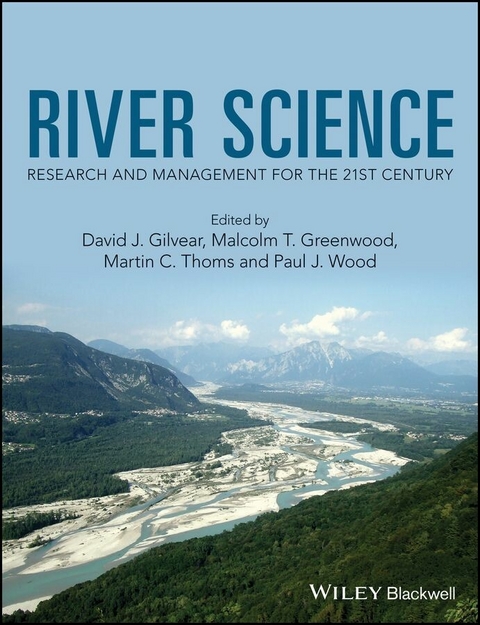
River Science (eBook)
John Wiley & Sons (Verlag)
978-1-118-64350-1 (ISBN)
River Science is a rapidly developing interdisciplinary field at the interface of the natural sciences, engineering and socio-political sciences. It recognises that the sustainable management of contemporary rivers will increasingly require new ways of characterising them to enable engagement with the diverse range of stakeholders.
This volume represents the outcome of research by many of the authors and their colleagues over the last 40 years and demonstrates the integral role that River Science now plays in underpinning our understanding of the functioning of natural ecosystems, and how societal demands and historic changes have affected these systems. The book will inform academics, policy makers and society in general of the benefits of healthy functioning riverine systems, and will increase awareness of the wide range of ecosystem goods and services they provide.
David Gilvear is a Professor of River Science at the University of Plymouth, UK. His river research has been at the hydrology, geomorphology and ecology interface within a geographically-led space-time framework - inspired by his PhD supervisor, Professor Petts. The majority of research has been in response to catchment specific, national or global issues in river management and as such he has worked with industry, environmental bodies and regulatory authorities.
Malcolm Greenwood is an ecologist, with a special interest in entomology, and is now retired from Loughborough University. He has worked closely with Professor Petts over many years, bringing together the biological principles appropriate to our understanding of contemporary and palaeo river systems, including the changes brought about by river engineering and management practices.
Martin Thoms is a Professor of River Science at the University of New England, Armidale, Australia. He believes the most exciting research is undertaken at boundaries - the boundaries between different disciplines, the science-management-policy boundary and the boundaries between rivers and their floodplains. His research in this domain has occurred in both national and international settings.
Paul Wood is Professor of Ecohydrology at Loughborough University, UK. His research encompasses the disciplines of hydrology, ecology, geomorphology and environmental management to address contemporary questions in River Science. His research is centred on environmental flows and the effects of disturbances in surface and groundwater dominated systems.
David Gilvear is a Professor of River Science at the University of Plymouth, UK. His river research has been at the hydrology, geomorphology and ecology interface within a geographically-led space-time framework - inspired by his PhD supervisor, Professor Petts. The majority of research has been in response to catchment specific, national or global issues in river management and as such he has worked with industry, environmental bodies and regulatory authorities. Malcolm Greenwood is an ecologist, with a special interest in entomology, and is now retired from Loughborough University. He has worked closely with Professor Petts over many years, bringing together the biological principles appropriate to our understanding of contemporary and palaeo river systems, including the changes brought about by river engineering and management practices. Martin Thoms is a Professor of River Science at the University of New England, Armidale, Australia. He believes the most exciting research is undertaken at boundaries - the boundaries between different disciplines, the science-management-policy boundary and the boundaries between rivers and their floodplains. His research in this domain has occurred in both national and international settings. Paul Wood is Professor of Ecohydrology at Loughborough University, UK. His research encompasses the disciplines of hydrology, ecology, geomorphology and environmental management to address contemporary questions in River Science. His research is centred on environmental flows and the effects of disturbances in surface and groundwater dominated systems.
List of contributors, ix
Preface, xiii
Ken J. Gregory
1 An introduction to river science: research and applications, 1
Martin C. Thoms, David J. Gilvear, Malcolm T. Greenwood and Paul J. Wood
Part 1 Fundamental principles of river science
2 An ecosystem framework for river science and management, 15
Michael D. Delong and Martin C. Thoms
3 Fine sediment transport and management, 37
Desmond E. Walling and Adrian L. Collins
4 Linking the past to the present: the use of palaeoenvironmental data for establishing reference conditions for the Water Framework Directive, 61
Ian Foster and Malcolm T. Greenwood
5 Achieving the aquatic ecosystem perspective: integrating interdisciplinary approaches to describe instream ecohydraulic processes, 84
John M. Nestler, Claudio Baigún and Ian Maddock
6 Measuring spatial patterns in floodplains: A step towards understanding the complexity of floodplain ecosystems, 103
Murray Scown, Martin C. Thoms and Nathan R. De Jager
7 Trees, wood and river morphodynamics: results from 15 years research on the Tagliamento River, Italy, 132
Angela M. Gurnell
8 The Milner and Petts (1994) conceptual model of community structure within glacier-fed rivers: 20 years on, 156
Alexander M. Milner
9 Remote sensing: mapping natural and managed river corridors from the micro to the network scale, 171
David J. Gilvear, Peter Hunter and Michael Stewardson
10 Monitoring the resilience of rivers as social-ecological systems: a paradigm shift for river assessment in the twenty-first century, 197
Melissa Parsons, Martin C. Thoms, Joseph Flotemersch and Michael Reid
Part 2 Contemporary river science
11 Faunal response to fine sediment deposition in urban rivers, 223
Paul J. Wood, Patrick D. Armitage, Matthew J. Hill, Kate L. Mathers and Jonathan Millett
12 Characterising riverine landscapes; history, application and future challenges, 239
Victoria S. Milner, David J. Gilvear and Martin C. Thoms
13 Thermal diversity and the phenology of floodplain aquatic biota, 259
Jack A. Stanford, Michelle L. Anderson, Brian L. Reid, Samantha D. Chilcote and Thomas S. Bansak
14 Microthermal variability in a Welsh upland stream, 279
Laura Gangi, David M. Hannah and Markus Weiler
15 River resource management and the effects of changing landscapes and climate, 295
James A. Gore, James Banning and Andrew F. Casper
16 River restoration: from site-specific rehabilitation design towards ecosystem-based approaches, 313
Jenny Mant, Andy Large and Malcolm Newson
17 Ecosystem services of streams and rivers, 335
J. Alan Yeakley, David Ervin, Heejun Chang, Elise F. Granek, Veronica Dujon,Vivek Shandas and Darrell Brown
18 Managing rivers in a changing climate, 353
Robert L. Wilby
19 Conclusion: The discipline of river science, 372
David J. Gilvear, Malcolm T. Greenwood, Martin C. Thoms and Paul J. Wood
Index, 379
Preface
Ken J. Gregory
Visiting Professor University of Southampton and, Emeritus Professor University of London, London, UK
When I was appointed to the Chair of Physical Geography in the University of Southampton in 1976 I asked my Exeter research students if they wished to move with me or preferred to stay at the University of Exeter. The one research student who decided to move was Geoff Petts – surprising in some ways because he had already completed two years research so the move would be for his final writing-up year. Although I thought that it was a good idea to get experience of two universities, I had not influenced Geoff's decision, but later realised that this was typical of his subsequent career – the ability to see the potential as opportunities became available.
A foundation
Geoff had graduated from the University of Liverpool in 1974 with a joint honours degree in Physical Geography and Geology. The NERC studentship at the University of Exeter that we had obtained for research on river channel adjustments downstream from reservoirs was the second of a series awarded for investigations of river channel adjustments arising from a range of different causes. The empirical approach employed used field measurements of channel capacities downstream from dams in 13 areas throughout England and Wales to compare with the dimensions of unregulated channels. At that time there had been comparatively few such investigations, and indeed the effects of human activity on river channels had not been explicitly explored until classic papers by Wolman (1967a,b; see Gregory, 2011), although scour below dams had been surveyed by engineers as a necessary input to dam construction. The Tone had been investigated (Gregory and Park, 1974) but the results obtained by Geoff from a range of UK areas greatly extended understanding of changes that could occur. Areas studied included the Derbyshire Derwent where, in addition to comparing the size of channels downstream from reservoirs with channel size along unregulated rivers showing that capacities were reduced to c. 40% of the expected size, Geoff also demonstrated how a bench formed within the channel had produced the reduction in capacity and that dendrochronology could be used to date trees that had grown on the benches. This allowed confirmation that the reductions in capacity had occurred at dates corresponding to reservoir construction.
This research (Petts, 1978) was one of a series of NERC studentship investigations which deliberately focused on the national picture so that instead of concentrating on a single field area, then very popular with the growth of process-based investigations, the intention was to address large-scale problems by employing empirical measurements from several different areas of Britain. Such an approach was demanding for a research student, but Geoff demonstrated his ability to apply himself to the opportunity, assembling the literature context from the international publications, undertaking field surveys upstream and downstream from reservoirs in different areas of the country, then proceeding to identify the significance of event effectiveness, of sediment availability, of vegetation indicators, culminating in establishing the appropriate elements of a general model including relaxation paths of complex response. This resulted in an impressive array of papers dealing with the channel change effects downstream of the Derwent dams (Petts, 1977), with the application of complex response to channel morphology adjustments (Petts, 1979), with the range of channel changes in regulated rivers (Petts, 1982) and with implications for stream habitats (Petts, 1980a) introducing a link with aquatic ecology that was subsequently to feature throughout Geoff's later research. At a time when specific applications of research results were not often considered, he appreciated the potential significance of the research results for management (Petts, 1980b) which were considered in relation to long-term consequences (Petts, 1980c).
Having established his publication record so effectively, Geoff then had the vision to produce a book Impounded Rivers (Petts, 1984a) – which he described as the ‘outcome of seven years of research and discussion with friends and professional colleagues’. This book was notable in that it contained hydrology, water quality, morphological effects, ecological aspects including vegetation and macroinvertebrates as well as fisheries, thus providing a truly multi-disciplinary approach to management problems and prospects that were the subject for the final chapter. This book demonstrated the value of providing a context and approach, which we would now refer to as holistic, to succeed the preceding engineering emphasis. In the final part of the preface to his book, Geoff made a plea for a long-term perspective in river management (Petts, 1984a, xv), a theme which he has pursued in much of his later work.
Explanation of the detail of his early research is necessary because it shows how these foundations were fundamental for the way in which he has been able to develop his career. After gaining his PhD he was first appointed in 1977 to the Dorset Institute of Higher Education (later to become part of the University of Bournemouth), but then in 1979 was appointed as lecturer in geography University of Loughborough where he remained until 1994, being senior lecturer (1986–89), Professor of Physical Geography (1989–94) and head of Geography (1991–94). In 1994 he was appointed Professor of Physical Geography University of Birmingham becoming Director of Environmental Science and Management (1994–97), he founded the University's Centre for Environmental Research and Training (CERT) in 1996, became Director of Environmental Science and Training in 1997, Head of the School of Geography and Environmental Science from 1998–2001, and then Pro-Vice Chancellor from 2001–07. With this background and progression it was perhaps inevitable that a move to lead an institution would follow, and in 2007 Geoff became Vice Chancellor and Rector of the University of Westminster. On taking up his post he said ‘I am particularly looking forward to working in partnership with staff, students and other stakeholders to grow the University’s contributions to the emerging economic, social and environmental demands of urban life in London and other cities across the globe'.
Research development and impacts
A career involving progressively greater amounts of administration, at Loughborough, Birmingham and Westminster, could have led to a decline of further research, publication and scientific impact, but Geoff has proved to be one of those individuals who maintains his academic contacts. His contributions can be encapsulated in terms of his developing research on flow regulation, the books and contributions in edited volumes that he has produced, and the establishment of the journal Regulated Rivers. Furthermore, by pursuing these three themes he has produced enlightening general perspectives, has established collaboration with many other scientists, including many international colleagues, especially European.
Research on flow regulation continued with investigations of a number of other areas leading to the context of flow regulation impacts, progressing research towards other themes. Further investigations of morphological change included the lowland English river Ter, Essex (Petts and Pratts, 1983) and the Rheidol in Wales (Petts and Greenwood, 1985). Whereas ecological changes had previously often been analysed independently from morphological changes, Geoff was involved in research combining the two (e.g., Petts and Greenwood, 1985) and also provided important dimensions such as timescales for ecological change (Petts, 1987). Although changes in water quality and reduced sediment transport downstream of dams had previously been investigated, Geoff was involved with analysis of monitored results from a controlled release from Kielder reservoir on the North Tyne (Petts et al., 1985), analysed sedimentation along the Rheidol (Petts, 1984) and bar development along the North Tyne (Petts and Thoms,1987). Although ecology and its relation to morphological changes had been major sections of his book (Petts, 1984) other aspects were subsequently explored including invertebrate faunas (Petts and Greenwood, 1985), the macroinvertebrate response and physical habitat change to river regulation on the River Rede (Petts, Armitage and Castella, 1993), and the effects of water abstractions on invertebrate communities in UK streams (Castella et al., 1995). Such specific investigations allowed elaboration of more general ecological concerns such as a perspective on the abiotic processes sustaining the ecological integrity of running waters (Petts, 2000), dams and geomorphology (Petts and Gurnell, 2005), a scientific basis for setting minimum ecological flows (Petts et al., 1995), and reservoir operating rules to sustain environmental flows in regulated rivers (Yin, Xin'an et al., 2011).
Flow regulation research led to evaluations of water resources such as the case of Lake Biwa, Japan (Petts, 1988), in turn leading naturally to concern for management problems such as the management of fish populations in Canada (Petts et al., 1989), advancing science for water resources management (Petts et al., 2006), linking hydrology and biology for assessing water needs for riverine ecosystems (Petts et al., 2006), the role of ecotones in aquatic landscape management (Petts, 1990), and sustaining the ecological integrity of large floodplain rivers (Petts,...
| Erscheint lt. Verlag | 2.3.2016 |
|---|---|
| Sprache | englisch |
| Themenwelt | Naturwissenschaften ► Geowissenschaften ► Hydrologie / Ozeanografie |
| Technik | |
| Schlagworte | Ãkologie / Aquatische Lebensräume • aquatic ecology • Biowissenschaften • earth sciences • Fluvial Hydrology & Limnology • fluvial science • Geowissenschaften • hydrogeology • Hydrologie der Flüsse u. Binnengewässer • Hydrologie der Flüsse u. Binnengewässer • Hydrology • Life Sciences • Limnology • Ökologie / Aquatische Lebensräume • River Management • River Science • Sedimentologie u. Stratigraphie • Sedimentology & Stratigraphy • watershed • watershed maintenance |
| ISBN-10 | 1-118-64350-X / 111864350X |
| ISBN-13 | 978-1-118-64350-1 / 9781118643501 |
| Informationen gemäß Produktsicherheitsverordnung (GPSR) | |
| Haben Sie eine Frage zum Produkt? |
 EPUB (Adobe DRM)
Kopierschutz: Adobe-DRM
Adobe-DRM ist ein Kopierschutz, der das eBook vor Mißbrauch schützen soll. Dabei wird das eBook bereits beim Download auf Ihre persönliche Adobe-ID autorisiert. Lesen können Sie das eBook dann nur auf den Geräten, welche ebenfalls auf Ihre Adobe-ID registriert sind.
Details zum Adobe-DRM
Dateiformat: EPUB (Electronic Publication)
EPUB ist ein offener Standard für eBooks und eignet sich besonders zur Darstellung von Belletristik und Sachbüchern. Der Fließtext wird dynamisch an die Display- und Schriftgröße angepasst. Auch für mobile Lesegeräte ist EPUB daher gut geeignet.
Systemvoraussetzungen:
PC/Mac: Mit einem PC oder Mac können Sie dieses eBook lesen. Sie benötigen eine
eReader: Dieses eBook kann mit (fast) allen eBook-Readern gelesen werden. Mit dem amazon-Kindle ist es aber nicht kompatibel.
Smartphone/Tablet: Egal ob Apple oder Android, dieses eBook können Sie lesen. Sie benötigen eine
Geräteliste und zusätzliche Hinweise
Buying eBooks from abroad
For tax law reasons we can sell eBooks just within Germany and Switzerland. Regrettably we cannot fulfill eBook-orders from other countries.
aus dem Bereich