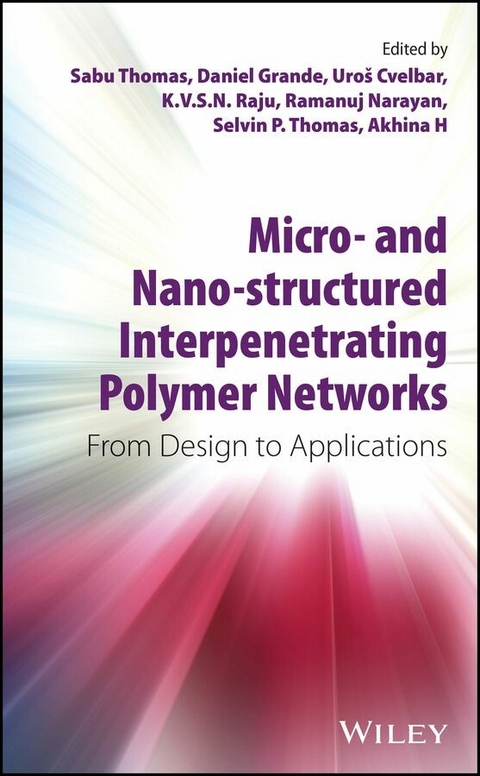
Micro- and Nano-Structured Interpenetrating Polymer Networks (eBook)
John Wiley & Sons (Verlag)
978-1-119-13896-9 (ISBN)
This book examines the current state of the art, new challenges, opportunities, and applications of IPNs. With contributions from experts across the globe, this survey is an outstanding resource reference for anyone involved in the field of polymer materials design for advanced technologies.
• Comprehensively summarizes many of the recent technical research accomplishments in the area of micro and nanostructured Interpenetrating Polymer Networks
• Discusses various aspects of synthesis, characterization, structure, morphology, modelling, properties, and applications of IPNs
• Describes how nano-structured IPNs correlate their multiscale structure to their properties and morphologies
• Serves as a one-stop reference resource for important research accomplishments in the area of IPNs and nano-structured polymer systems
• Includes chapters from leading researchers in the IPN field from industry, academy, government and private research institutions
Prof. Dr. Sabu Thomas teaches at Mahatma Gandhi University's School of Chemical Sciences and International and Inter University Centre for Nanoscience and Nanotechnology.
Dr. Daniel Grande is a CNRS senior researcher based at the East-Paris Institute of Chemistry and Materials Science belonging to both CNRS and the 'Université Paris-Est Créteil.'
Dr. Uros Cvelbar is a researcher at Slovenia's Jozef Stefan Institute.
Dr. K.V.S.N. Raju and Dr. Ramanuj Narayan are scientists working with the Indian Institute of Chemical Technology's Polymers and Functional Materials Division.
Dr. Selvin P. Thomas iis an assistant professor in Chemical Engineering in the Yanbu Research Center of the Royal Commission for Yanbu Colleges and Institutes (RCYCI).
Akhina H is a senior research fellow(CSIR) at International and Inter University Centre for Nanoscience and Nanotechnology at Mahatma Gandhi University.
This book examines the current state of the art, new challenges, opportunities, and applications of IPNs. With contributions from experts across the globe, this survey is an outstanding resource reference for anyone involved in the field of polymer materials design for advanced technologies. Comprehensively summarizes many of the recent technical research accomplishments in the area of micro and nanostructured Interpenetrating Polymer Networks Discusses various aspects of synthesis, characterization, structure, morphology, modelling, properties, and applications of IPNs Describes how nano-structured IPNs correlate their multiscale structure to their properties and morphologies Serves as a one-stop reference resource for important research accomplishments in the area of IPNs and nano-structured polymer systems Includes chapters from leading researchers in the IPN field from industry, academy, government and private research institutions
Prof. Dr. Sabu Thomas teaches at Mahatma Gandhi University's School of Chemical Sciences and International and Inter University Centre for Nanoscience and Nanotechnology. Dr. Daniel Grande is a CNRS senior researcher based at the East-Paris Institute of Chemistry and Materials Science belonging to both CNRS and the "Université Paris-Est Créteil." Dr. Uros Cvelbar is a researcher at Slovenia's Jozef Stefan Institute. Dr. K.V.S.N. Raju and Dr. Ramanuj Narayan are scientists working with the Indian Institute of Chemical Technology's Polymers and Functional Materials Division. Dr. Selvin P. Thomas iis an assistant professor in Chemical Engineering in the Yanbu Research Center of the Royal Commission for Yanbu Colleges and Institutes (RCYCI). Akhina H is a senior research fellow(CSIR) at International and Inter University Centre for Nanoscience and Nanotechnology at Mahatma Gandhi University.
1
MICRO- AND NANO-STRUCTURED INTERPENETRATING POLYMER NETWORKS: STATE OF THE ART, NEW CHALLENGES, AND OPPORTUNITIES
Jose James1, George V. Thomas1, Akhina H.2 and Sabu Thomas2,3
1 Research and Post-Graduate Department of Chemistry, St. Joseph’s College, Moolamattom, Kerala, India
2 International and Interuniversity Centre for Nanoscience and Nanotechnology, Mahatma Gandhi University, Kottayam, Kerala, India
3 School of Chemical Sciences, Mahatma Gandhi University, Kottayam, Kerala, India
1.1 INTRODUCTION
Polymer mixtures are materials that play a significant role in modern industry. The preparation and properties of multicomponent polymeric systems are of great practical and academic interest. They provide a convenient route for the modifications of properties to meet specific needs. Interpenetrating polymer networks (IPNs) are one of the most rapidly growing areas in polymer material science. The golden history of IPN had begun with its discovery by Aylsworth in 1914 [1].
IUPAC Compendium of chemical terminology defines IPNs as polymers comprising two or more networks that are at least partially interlaced on a molecular scale but not covalently bonded to each other and cannot be separated unless chemical bonds are broken [1, 2]. IPNs are a combination of incompatible polymer networks, at least one of which is synthesized and/or crosslinked in the presence of the other [3, 4] (Figure 1.1).
FIGURE 1.1 Schematic representation of component networks and IPN.
Source: Klempner et al. [3]. Reproduced with permission of the American Chemical Society
Figure 1.2 shows a schematic representation of mechanical blends, graft copolymers, block copolymers, semi-IPNs, and full-IPNs.
FIGURE 1.2 Schematic representation of (a) mechanical blends, (b) graft copolymers, (c) block copolymers, (d) semi-IPNs, and (e) full-IPNs.
Source: Sperling and Mishra [5]. Reproduced with permission of John Wiley & Sons
IPNs are in fact a special class of polymer blends. The two characteristic features of IPNs that distinguishes itself from the other types of multiphase polymer systems are as follows: (1) IPNs swell but do not dissolve in solvents and (2) creep and flow are suppressed in IPNs [5].
While the science of IPNs began with the work of Millar in 1960 [6], the first publication on the subject came through a patent by Aylsworth in 1914 [1]. Since then, IPNs have been the subject of extensive study by investigators looking into the synthesis, morphology, properties, and applications of these materials. Table 1.1 summarizes the history of IPNs and related materials [7, 8].
TABLE 1.1 History of IPN
| Year | Event | First Investigators |
| 1914 | IPN-type structure | J. W. Aylsworth |
| 1927 | Graft copolymers | I. Ostromislensky |
| 1951 | IPNs | J. J. Staudinger and H. M. Hutchinson |
| 1952 | Block copolymers | A. S. Dunn and H. W. Melville |
| 1960 | Homo-IPNs | J. R. Millar |
| 1969 | Sequential IPNs | L. H. Sperling |
| 1969 | Latex IPNs | K. C. Frisch, D. Klempner, and H. L. Frisch |
| 1971 | Simultaneous IPNs | L. H. Sperling and R. R. Arnts |
| 1974 | IPN nomenclature | L. H. Sperling |
| 1977 | Thermoplastic IPNs | S. Davison and W. P. Gergen |
1.2 TYPES OF INTERPENETRATING POLYMER NETWORKS
Figure 1.3 classifies the following types of IPNs [1, 9]: semi-IPN, sequential IPN, simultaneous IPN, and full-IPN. They are grouped based on chemical bonding and rearrangement pattern.
FIGURE 1.3 Classifications of IPNs.
Source: Shivashankar, http://www.ijppsjournal.com/. Used under CC-BY-4.0 http://creativecommons.org/licenses/by/4.0/
1.2.1 Full-Interpenetrating Polymer Networks
They comprise two or more polymer networks, which are at least partially interlocked on a molecular scale but not covalently bonded to each other and cannot be separated unless chemical bonds are broken. It can be represented as in Figure 1.4a.
FIGURE 1.4 (a) Full-IPN. (b) Semi-IPN.
Source: Sperling and Mishra [6]. Reproduced with permission of Taylor & Francis
1.2.2 Sequential Interpenetrating Polymer Networks
This type of IPN involves the preparation of a polymer network I followed by the in situ polymerization of monomer II along with crosslinker and activator, which are then swollen into the network I.
1.2.3 Simultaneous Interpenetrating Networks
In simultaneous interpenetrating networks (SINs), the monomers along with the crosslinkers and activators of both networks are mixed. The reactions are carried out simultaneously; however, they are noninterfering types of reactions such as chain and step polymerization reactions.
1.2.4 Latex Interpenetrating Polymer Networks
These IPNs are made in the form of lattices, frequently with a core and shell structure.
1.2.5 Gradient Interpenetrating Polymer Networks
Gradient IPNs are materials in which the overall composition or crosslink density of the material varies from location to location on the macroscopic level. For example, a film can be made with network I predominantly on one surface, network II on the other surface, and a gradient in composition throughout the interior.
1.2.6 Thermoplastic Interpenetrating Polymer Networks
Thermoplastic IPN materials are hybrids between polymer blends and IPNs that involve physical crosslinks rather than chemical crosslinks. Thus, these materials flow at elevated temperatures, similar to the thermoplastic elastomers, and at use temperature, they are crosslinked and behave like IPNs.
1.2.7 Semi-Interpenetrating Polymer Networks
In semi-IPNs, only one component of the assembly is crosslinked leaving the other in linear form. They are also called pseudo-IPNs. It can be depicted as in Figure 1.4b.
Mishra and Sperling [6] investigated semi-IPNs composed of poly(ethylene terephthalate) and castor oil. They found that bond interchange between these two materials played a major role in initial miscibility and morphology. The semi-IPNs displayed much better mechanical properties than the individual component materials did.
1.3 SYNTHESIS OF INTERPENETRATING POLYMER NETWORKS
The IPN synthesis techniques can be summarized as follows.
1.3.1 Sequential Interpenetrating Polymer Networks
This technique involves the sequential addition of selective crosslinkers to a homogenous mixture of two polymers in solution or in melt form [6]. They are in fact synthesized by a two-step process. In the first step, polymerization of first mixture (consisting of monomer, crosslinking agent, and initiator or catalyst) forms a network I. This network is swollen with the second combination of monomer and crosslinking agent and polymerized to form an IPN, that is, the polymer-2 is polymerized and crosslinked in situ in network I [6]. The route can be represented as in Figure 1.5.
FIGURE 1.5 Schematic representation of sequential IPN synthesis.
Source: Sperling [1]. Reproduced with permission of Springer
Nitrile butadiene rubber/poly(ethylene oxide) (NBR/PEO) IPNs prepared by Goujon et al. successfully employed the sequential route for IPN synthesis [10]. Here, IPNs were prepared from NBR and PEO using a two-step process. The NBR network was obtained by dicumyl peroxide crosslinking at high temperature and pressure. A free radical copolymerization of poly(ethylene glycol) methacrylate and dimethacrylate led to the formation of the PEO network within the NBR network. It can be depicted as in Figure 1.6.
FIGURE 1.6 Outline of NBR/PEO IPN synthesis. (a) NBR network synthesis and (b) PEO network synthesis within NBR network.
Source: Goujon et al. [10]. Reprinted with permission of the American Chemical Society
Sequential IPNs based on a nitrile–phenolic blend and poly(alkyl methacrylate) were prepared and characterized by Samui et al. [11]. The IPNs were not fully compatible but exhibited higher tensile strength compared to corresponding nitrile–phenolic blends. The strength increased with the increase in the concentration of poly(alkyl methacrylate).
1.3.2 Simultaneous Interpenetrating Networks
In SINs, a polymer is synthesized (from the monomer) and simultaneously crosslinked within the network of another polymer to give rise to an interpenetrating network [12]. Here, an IPN is formed by polymerizing two different monomers and crosslinking agent pairs together in one step. The key to the success of this process is that the two components must polymerize by reactions that will not interfere with one another....
| Erscheint lt. Verlag | 8.3.2016 |
|---|---|
| Sprache | englisch |
| Themenwelt | Naturwissenschaften ► Chemie ► Organische Chemie |
| Naturwissenschaften ► Chemie ► Technische Chemie | |
| Technik ► Maschinenbau | |
| Technik ► Umwelttechnik / Biotechnologie | |
| Schlagworte | eco-friendly green IPNs • full IPNs • Interpenetrating Polymer Networks • IPNs • Materials Science • Materialwissenschaften • meso- and nano-porous networks from IPN systems • Nanomaterialien • nanomaterials • Nanotechnologie • nanotechnology • Polymernetzwerk • Polymer Science & Technology • Polymerwissenschaft • Polymerwissenschaft u. -technologie • porous networks • preparation of micro- • semi-IPNs • soft matter |
| ISBN-10 | 1-119-13896-5 / 1119138965 |
| ISBN-13 | 978-1-119-13896-9 / 9781119138969 |
| Informationen gemäß Produktsicherheitsverordnung (GPSR) | |
| Haben Sie eine Frage zum Produkt? |
 EPUB (Adobe DRM)
Kopierschutz: Adobe-DRM
Adobe-DRM ist ein Kopierschutz, der das eBook vor Mißbrauch schützen soll. Dabei wird das eBook bereits beim Download auf Ihre persönliche Adobe-ID autorisiert. Lesen können Sie das eBook dann nur auf den Geräten, welche ebenfalls auf Ihre Adobe-ID registriert sind.
Details zum Adobe-DRM
Dateiformat: EPUB (Electronic Publication)
EPUB ist ein offener Standard für eBooks und eignet sich besonders zur Darstellung von Belletristik und Sachbüchern. Der Fließtext wird dynamisch an die Display- und Schriftgröße angepasst. Auch für mobile Lesegeräte ist EPUB daher gut geeignet.
Systemvoraussetzungen:
PC/Mac: Mit einem PC oder Mac können Sie dieses eBook lesen. Sie benötigen eine
eReader: Dieses eBook kann mit (fast) allen eBook-Readern gelesen werden. Mit dem amazon-Kindle ist es aber nicht kompatibel.
Smartphone/Tablet: Egal ob Apple oder Android, dieses eBook können Sie lesen. Sie benötigen eine
Geräteliste und zusätzliche Hinweise
Buying eBooks from abroad
For tax law reasons we can sell eBooks just within Germany and Switzerland. Regrettably we cannot fulfill eBook-orders from other countries.
aus dem Bereich