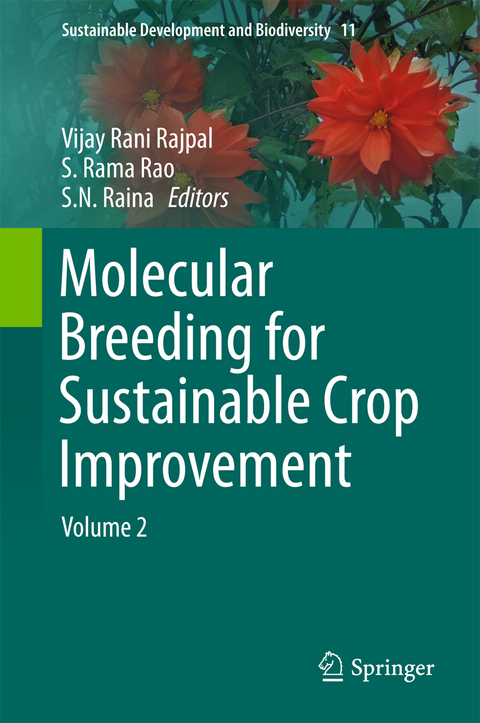
Molecular Breeding for Sustainable Crop Improvement (eBook)
478 Seiten
Springer International Publishing (Verlag)
978-3-319-27090-6 (ISBN)
This book provides comprehensive and latest insights on the evolutionary genesis of diversity, access and its utilization in the evolution of various crop species. A comprehensive account of various crops, origin, exploitation of the primary, secondary and tertiary gene pools through breeding, biosystematical, cytogenetical and molecular phylogenetical relationships, and genetic enhancement through biotechnological interventions among others have been provided as the necessary underpinnings to consolidate information on the effective and sustainable utilization of the related genetic resources. The book stresses upon the importance of wild germplasm exploration, characterization and exploitation in the assimilation of important crop species. The book is especially intended for students and scientists working on the genetic improvement of crop species. Plant Breeders, Geneticists, Taxonomists, Molecular Biologists and Plant Biotechnologists working on crop species are going to find this book very useful.
Raina’s quality research is evidenced by his publications in journals of international repute like Gene, AOB Plants, Applied Biochemistry and Biotechnology, Molecular Breeding, Molecular Phylogenetics and Evolution, Theoretical and Applied Genetics, Genome, Plant Breeding, Euphytica, Genetica, Heredity, Journal of Heredity, Cytogenetic and Genome Research, Methods in Cell Science, In Vitro Cell. Dev. Biol. – Plants, Plant Systematics and Evolution, Molecular Phylogenetics and Evolution, Caryologia, Genetic Resources and Crop Evolution, Plant Cell Reports, Annals of Botany among others. He has 135 publications, including 111 research papers, and 20 book chapters. The impact factor of his published papers ranges from 0.5 to 4.5 and the citation index touches nearly 2000. Raina has given invited seminars and keynote addresses in scientific forums in many countries, and has chaired symposia, seminars and scientific sessions in national and international conferences. He is a Fellow of National Academy of Sciences (F.N.A.Sc), India, and is credited with 17 M.Phil and 23 Ph.D. thesis Dr Rani has published 20 research papers in international peer reviewed journals like Plant Cell Reports, Genome, Genetica, Plant Systematics and Evolution, In Vitro Cellular Developmental Biology (IVCDB) Plant , Genetic Resources and Crop Evolution, Applied Biochemistry and Biotechnology . In addition, she has contributed five review papers in books published from Springer Verlag and Kluwer Acad. Publ. and CRC Press Ltd. Dr Rani has presented her research as an invited speaker in many national and international conferences. She is a member of International Society of Plant Morphologists and NewYork Academy of Sciences, USA Rao's research activity has been published (and still is) in international renowned journals.
Preface.- 1. Use of alien genetic variation for wheat
improvement; P.K. Gupta.- 2.
Quantitative trait loci mapping in plants: concepts and approaches; D. Sehgal.- 3. Developing and deploying
abiotic stress tolerant maize varieties in the tropics: challenges and
opportunities; B.M. Prasanna.- 4.
Harnessing apomixes for heterosis breeding in crop improvement; V. Bhat.- 5. Status and opportunities of
molecular breeding approaches for genetic improvement of tea; R. Kumar Sharma.- 6. Molecular
cytogenetic approaches in exploration of important chromosomal landmarks in
plants; Y. Mukai.- 7. Technological
advances in studying gene pool diversity and its exploitation; S. Goel.- 8. Introgression and
exploitation of QTL for yield and yield components from related wild species
into rice cultivars; K. Neelam.- 9. A
molecular phylogenetic framework for Timothy (Phleum pratense L.) improvement; A. Stewart.- 10. Genetic improvement of basmati rice – The journey
from conventional to molecular breeding; A.K.
Singh.- 11. Genetic diversity and
coffee (Coffea sps) improvement in
India; R.K. Aggarwal.- 12.
Introgression and exploitation of biotic stress tolerance from related wild
species in wheat cultivars; P. Chhuneja.- 13. Genetic improvement of
sugarcane through conventional and molecular approaches; S. Kumar.- 14. Germline
transformation for crop improvement; R.
Tandon.- 15. Advances in molecular breeding of pearl millet; D. Sehgal.- 16. Molecular marker-based
selection tools in spring bread wheat improvement: CIMMYT experience and
prospects; S. Dreisigacker.- Index.
| Erscheint lt. Verlag | 2.2.2016 |
|---|---|
| Reihe/Serie | Sustainable Development and Biodiversity | Sustainable Development and Biodiversity |
| Zusatzinfo | XI, 478 p. 56 illus., 12 illus. in color. |
| Verlagsort | Cham |
| Sprache | englisch |
| Themenwelt | Naturwissenschaften ► Biologie ► Ökologie / Naturschutz |
| Technik | |
| Schlagworte | Crop improvement • genetic diversity • Molecular Breeding • Molecular DNA markers • Molecular marker assisted selection • systematic botany |
| ISBN-10 | 3-319-27090-7 / 3319270907 |
| ISBN-13 | 978-3-319-27090-6 / 9783319270906 |
| Informationen gemäß Produktsicherheitsverordnung (GPSR) | |
| Haben Sie eine Frage zum Produkt? |
 PDF (Wasserzeichen)
DRM: Digitales Wasserzeichen
Dieses eBook enthält ein digitales Wasserzeichen und ist damit für Sie personalisiert. Bei einer missbräuchlichen Weitergabe des eBooks an Dritte ist eine Rückverfolgung an die Quelle möglich.
Dateiformat: PDF (Portable Document Format)
Mit einem festen Seitenlayout eignet sich die PDF besonders für Fachbücher mit Spalten, Tabellen und Abbildungen. Eine PDF kann auf fast allen Geräten angezeigt werden, ist aber für kleine Displays (Smartphone, eReader) nur eingeschränkt geeignet.
Systemvoraussetzungen:
PC/Mac: Mit einem PC oder Mac können Sie dieses eBook lesen. Sie benötigen dafür einen PDF-Viewer - z.B. den Adobe Reader oder Adobe Digital Editions.
eReader: Dieses eBook kann mit (fast) allen eBook-Readern gelesen werden. Mit dem amazon-Kindle ist es aber nicht kompatibel.
Smartphone/Tablet: Egal ob Apple oder Android, dieses eBook können Sie lesen. Sie benötigen dafür einen PDF-Viewer - z.B. die kostenlose Adobe Digital Editions-App.
Buying eBooks from abroad
For tax law reasons we can sell eBooks just within Germany and Switzerland. Regrettably we cannot fulfill eBook-orders from other countries.
aus dem Bereich