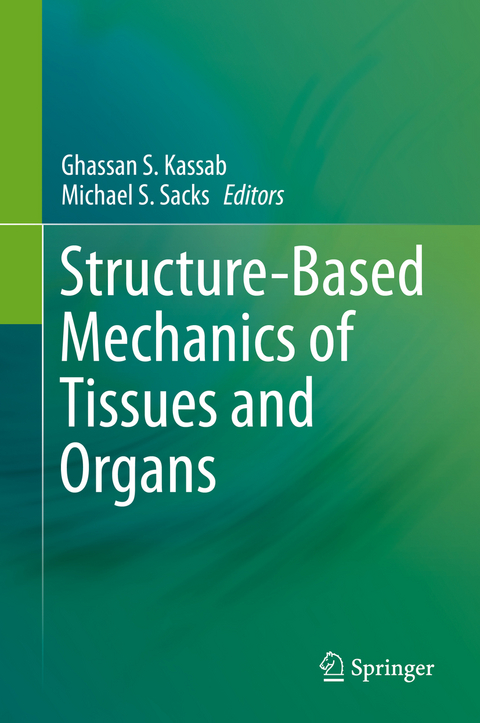
Structure-Based Mechanics of Tissues and Organs (eBook)
XXXIV, 469 Seiten
Springer-Verlag
978-1-4899-7630-7 (ISBN)
This book portrays the commonality of tissue micro-structure that dictates physiological function in various organs (microstructure-function relation). Tissue and organ models are used to illustrate physiological functions based on microstructure. Fiber scale properties such as orientation and crimp are described in detail. Structurally-based constitutive models are given throughout the book, not only to avoid ambiguities in material characterization, but also to offer insights into the function, structure, and mechanics of tissue components. A statement of future directions of the field is also given, including how advancements, such as state-of-the-art computational modeling and optical measurements of tissue/cells structures, are taking structure-based modeling to the next level.
This book also:
Provides a comprehensive view of tissue modeling across multiple systems
Broadens readers’ understanding of state-of-the-art computational modeling and optical measurements of tissue/cells structures
Describes in detail fiber scale properties such as orientation and crimp
Chapter 1 The Influence of Microstructure on Neural Tissue Mechanics.- Chapter 2 Modeling a Collagenous Tissues Using Distributed Fiber Orientations.- Chapter 3 Emergent Behaviors in Cell Mechanics.- Chapter 4 Histomechanical Modeling of the Wall of Abdominal Aortic Aneurysm.- Chapter 5 The Biomechanics of Fat: From Tissue to a Cell Scale.- Chapter 6 Glaucoma and Structure-Based Mechanics of the Lamina Cribrosa at Multiple Scales.- Chapter 7 From Stress-Strain Relations to Formulation of Growth and Remodeling Theories: A Historical Reflection on Microstructurally-Motivated Constitutive Relations.- Chapter 8 Relationship Between Structure and Mechanics for Membranous Tissues.- Chapter 9 Structure-Function Relations in the Coronary Vasculature.- Chapter 10 Biomechanical Basis of Myocardium/Vessel Interaction: Implications for Patho-Physiology and Therapy.- Chapter 11 Microstructure-Based Constitutive Models for Coronary Artery Adventitia.- Chapter 12 Structural-Based Models of Ventricular Myocardium.- Chapter 13 Structure-Based Constitutive Model of Coronary Media.- Chapter 14 Biomechanics of the Cornea and Sclera.- Chapter 15 Mechanical Modeling of Skin.- Chapter 16 Undesirable Anisotropy in a Discrete Fiber Bundle Model of Fibrous Tissues.- Chapter 17 Structural Models as Applied to Engineered Tissue Scaffolds.- Chapter 18 Finite Element Implementation of Structural Models.- Chapter 19 A Microvascular Model in Skeletal Muscle Fascia.- Chapter 20 Network Approaches to the Mechanical Failure of Soft Tissues: Implications for Disease and Tissue Engineering.
| Erscheint lt. Verlag | 28.1.2016 |
|---|---|
| Zusatzinfo | XXXIV, 469 p. 169 illus., 98 illus. in color. |
| Verlagsort | New York |
| Sprache | englisch |
| Themenwelt | Informatik ► Grafik / Design ► Digitale Bildverarbeitung |
| Medizin / Pharmazie ► Pflege | |
| Medizin / Pharmazie ► Physiotherapie / Ergotherapie ► Orthopädie | |
| Naturwissenschaften ► Biologie | |
| Technik ► Bauwesen | |
| Technik ► Maschinenbau | |
| Schlagworte | Cell structures • Computational • Fiber scale properties • Modeling • systems biology • Tissues |
| ISBN-10 | 1-4899-7630-2 / 1489976302 |
| ISBN-13 | 978-1-4899-7630-7 / 9781489976307 |
| Informationen gemäß Produktsicherheitsverordnung (GPSR) | |
| Haben Sie eine Frage zum Produkt? |
 PDF (Wasserzeichen)
DRM: Digitales Wasserzeichen
Dieses eBook enthält ein digitales Wasserzeichen und ist damit für Sie personalisiert. Bei einer missbräuchlichen Weitergabe des eBooks an Dritte ist eine Rückverfolgung an die Quelle möglich.
Dateiformat: PDF (Portable Document Format)
Mit einem festen Seitenlayout eignet sich die PDF besonders für Fachbücher mit Spalten, Tabellen und Abbildungen. Eine PDF kann auf fast allen Geräten angezeigt werden, ist aber für kleine Displays (Smartphone, eReader) nur eingeschränkt geeignet.
Systemvoraussetzungen:
PC/Mac: Mit einem PC oder Mac können Sie dieses eBook lesen. Sie benötigen dafür einen PDF-Viewer - z.B. den Adobe Reader oder Adobe Digital Editions.
eReader: Dieses eBook kann mit (fast) allen eBook-Readern gelesen werden. Mit dem amazon-Kindle ist es aber nicht kompatibel.
Smartphone/Tablet: Egal ob Apple oder Android, dieses eBook können Sie lesen. Sie benötigen dafür einen PDF-Viewer - z.B. die kostenlose Adobe Digital Editions-App.
Buying eBooks from abroad
For tax law reasons we can sell eBooks just within Germany and Switzerland. Regrettably we cannot fulfill eBook-orders from other countries.
aus dem Bereich