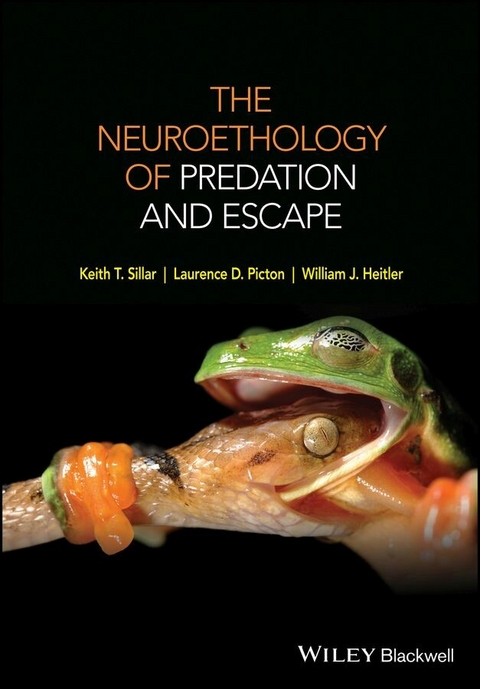
The forces of natural selection have been a primary driver in the evolution of adaptive animal behaviours. On the one hand animals must evade predation in order to survive and pass on their genes; on other hand, and for the same underlying reasons, animals must also be capable of successfully capturing prey. This situation has led to an evolutionary arms race in which predator and prey are locked in the battle to survive. A common strategy in each situation is to enhance the speed of response, resulting in the evolution of neural, muscular and biomechanical designs that produce supremely fast and eye-catching behavioral responses.
The aim of this book is to illuminate the design principles of escape and predatory behaviours using a series of case histories from different animal groups and to emphasize the convergent evolution of neural circuitry that optimizes the chances of survival. Using these case histories the authors describe sensory mechanisms that aid prey and predator detection, central neural circuit designs that increase speed of response and neuromuscular and biomechanical properties that aid the performance of escape and predatory movements.
Keith T. Sillar is Professor and Head of theSchool of Psychology & Neuroscience at the University of St Andrews, in Scotland. His research interests include neurology, neuroscience and amphibian neurology. Along with Dr Heitler, he teaches an exchange course on neuroethology in the US.
Dr William J Heitler is a reader at the School of Biology, University of St Andrews in Scotland, where his research interests include the neurology of crayfish and other crustacea, and escape behavior as well as more general neurology and neuroscience. He teaches an exchange course on neuroethology in the US in conjunction with Professor Sillar.
Laurence Picton is at the School of Psychology and Neuroscience at University of St Andrews, Scotland.
THE NEUROETHOLOGY OF PREDATION AND ESCAPE To eat and not get eaten is key to animal survival, and the arms race between predators and prey has driven the evolution of many rapid and spectacular behaviours. This book explores the neural mechanisms controlling predation and escape, where specialisations in afferent pathways, central circuits, motor control and biomechanics can be traced through to natural animal behaviour. Each chapter provides an integrated and comparative review of case studies in neuroethology. Ranging from the classic studies on bat biosonar and insect counter-measures, through to fish-eating snails armed with powerful neurotoxins, the book covers a diverse and fascinating range of adaptations. Common principles of biological design and organization are highlighted throughout the text. The book is aimed at several audiences: for lecturers and students. This synthesis will help to underpin the curriculum in neuroscience and behavioural biology, especially for courses focusing on neuroethology for postgraduate students. The sections devoted to your area of specialism will give a flying start to your research reading, while the other chapters offer breadth and insights from comparative studies for academic researchers. The book will provide a valuable resource and an enjoyable read Above all, we hope this book will inspire the next generation of neuroethologists.
Keith T. Sillar School of Psychology and Neuroscience, University of St Andrews, Scotland, UK Laurence D. Picton School of Psychology and Neuroscience, University of St Andrews, Scotland, UK William J. Heitler School of Biology, University of St Andrews, Scotland, UK
General Introduction
‘… In the primeval struggle of the jungle, as in the refinements of civilised warfare, we see in progress a great evolutionary armament race— whose results, for defence, are manifested in such devices as speed, alertness, armour, spinescence, burrowing habits, nocturnal habits, poisonous secretions, nauseous taste; and for offense, in such counter-attributes as speed, … ambush, allurement, visual acuity, claws, teeth, stings, … [and] poison fangs.’ – Cott (1940), cited in Dawkins and Krebs (1979) as the first ever use of the arms-race analogy applied to predator-prey interactions.
For any animal, there is a strong selection pressure to eat and not get eaten. All living organisms need energy to survive, and animals get their energy from food. Broadly speaking, food comes in one of two forms; plants, in which case the eater is a herbivore, or other animals, in which case the eater is a carnivore. The great advantage to being a carnivore is that the food comes pre-processed into a high-energy form almost guaranteed to be suitable for the eater’s requirements; carnivores are made of meat and their food is made of meat - what could be a better match? From the carnivore’s perspective someone else had to do the hard work of finding an edible plant, overcoming whatever defences the plant may have had, harvesting the plant, evolving and maintaining the long and complex gut necessary for converting the plant cellulose into useful animal material, and so on. All the carnivore has to do is eat the animal that ate the plant. However, this is not a trivial matter.
Some carnivores are scavengers; they eat animals that are already dead, either from natural causes, or as a result of another animal’s actions. The advantage for the scavenger is that its food puts up no resistance! This is true in both the short and long term. Dead food cannot fight back in the short term, and there is usually no long-term selective pressure on an animal to develop mechanisms to prevent it from being scavenged after death1. Some of the structures that an animal has evolved which help to protect it while alive (such as a thick hide) persist after death and might make things difficult for a scavenger but, in principle, there is no evolutionary arms race between scavengers and their food. However, there is a lot of competition for dead meat. Other scavengers will want a piece of the action, so there is both an evolutionary and, often, a real-time race between scavengers. The first scavenger on the scene is likely to get the best pickings. This being the case, there is strong selection pressure on a scavenger to help things along a bit by arriving before the food is actually dead. This crosses the bridge between scavenging and predation2.
One of the main characteristics of predation is that predators have a detrimental effect on the fitness of their individual prey. As Joe Fetcho (1991) eloquently and succinctly put it, ‘Being eaten alive abruptly ends all chances of future reproduction and is not favourable from an evolutionary viewpoint’.
However, starving to death is not good news from an evolutionary (or personal) perspective either. We are thus confronted with the absolute inevitability of an evolutionary arms race between predators and their prey. The pressure of the race is not equally balanced between competitors, since predators will usually live to fight another day if they fail in any particular attack, while failure of a prey’s defence system is likely to be fatal to that individual3. Nor does predation always seriously damage individual prey fitness; predators will often target old or diseased prey that may have little chance of further reproduction anyway. And, of course, in the long term, predation is a major drive for prey evolution by weeding out less fit individuals.
Ecological factors tend to stabilise the situation so, if a prey species starts to lose the arms race, then its population decline puts resource pressure on its predators, whose population may then decline in response, thus relieving pressure on the prey, and so on. There is a huge ecological literature on such matters (see, for example, Barbosa and Castellanos, 2005). Nonetheless, if the arms race becomes too weighted to one side or the other, then the losing side is likely to drop out of both the race, and existence, by becoming extinct (possibly taking its competitor with it, if there is strong ecological coupling between them). It is, therefore, true to say that a snapshot of extant life on Earth today shows us the suite of animals who are still active competitors in the race between predators and prey.
A vast range of adaptations has evolved in both predators and prey in their endless struggle with each other. If we take an apex predator (i.e. one sitting on top of the food chain, that is not itself subject to predation), such as a lion or a polar bear, then size and strength and teeth and claws come to mind. On the prey side, too, size and strength are primary defences – nothing (except, occasionally, humans) predates on large, healthy adult elephants or whales. At the other end of the size scale, we have the gossamer delicacy of a spider’s web, beautiful to the human observer and lethal to the flies it entraps. And there is cryptic and warning colouration; on the one hand, camouflage that makes a prey virtually undetectable to its predators, and on the other, garish colours that broadcast the presence of the wearer with such brazen confidence that the would-be predator suspects that the prey has an alternative defence such as poison.
And then there are the fakers – the prey that pretend to be poisonous but are not, and which mimic the warning colours of their more honest neighbours. Life is a struggle, and almost any adaptation of any animal has some role in the conflict between predator and prey. Even an extreme adaptation that apparently handicaps its owner may, in fact, act as an honest signal to advertise superior fitness. This can put off predators that then look for easier targets, while simultaneously attracting mates who fancy enhancing their offspring’s life chances with a share of such an obviously superior set of genes.
What this book is about
What is neuroethology? The term refers to the study of the neural control of natural animal behaviour from a comparative biological perspective. Behaviour arises from the activity of the nervous system and neuroethology, therefore, includes the analysis of neural circuits and their modulation from the lowest molecular level through to the highest systems level. What distinguishes neuroethology from straight neuroscience, however, is that this analysis is always considered in terms of the natural function of the output, and that function is necessarily constrained by both the biology of the individual and the biological and physical characteristics of the environment in which it operates. These, in turn, are constrained by the developmental and evolutionary history of the animals (and plants) involved. A neuroethologist is, therefore, interested in how and why animals in their natural environment respond to natural stimuli in the way that they do. The ‘how’ is the main concern of the neuro bit of the word, which refers to the neural mechanisms of behaviour, and the ‘why’ is the main concern of the ethology bit of the word, which refers to the study of behaviour that a free animal displays in the wild. The animals can include everything from jellyfish to humans, which makes it a pretty broad topic.
This book is about the neuroethology of some of the fascinating and spectacular adaptations within the subject of predation, predator avoidance and escape. For the predator, the first and most essential stage in the hunt for food is usually detection, closely followed by localisation in 3D space. For a predator to launch a successful attack, it must not only know that a prey item is out there, but must also know precisely where ‘there’ is. In cases such as the auditory system of the owl, we have a detailed knowledge of how this is accomplished within the bird’s brain. For prey, early detection is equally important, but localisation perhaps less so. The prey needs to know the approximate direction of danger, so that it does not flee directly into its jaws, but it does not usually need really precise information. In fact, there is plenty of evidence to show that some randomness in escape is a real advantage to the prey. If even the prey does not know in advance exactly where it is going, then the predator certainly cannot second-guess it and get there first to welcome it.
The next crucial stage is decision. Both attack and escape are expensive and potentially dangerous. For the predator, a failed attack both costs energy and reveals its presence, thus reducing the chance of a successful second try. For prey, keeping still might be the best tactic unless and until it is sure that it has been spotted and an attack is imminent (Broom and Ruxton, 2005). Many predators have sensory systems that are highly tuned to detect movement, and premature escape may simply draw attention to the prey. Furthermore, escape costs energy, and it also incurs an opportunity cost, in that it interrupts whatever else the prey might be getting on with, which could have been something really useful, like mating or eating. In relatively simple systems, such as the crayfish escape tail-flip, we are starting to gain some insight...
| Erscheint lt. Verlag | 23.2.2016 |
|---|---|
| Sprache | englisch |
| Themenwelt | Naturwissenschaften ► Biologie ► Ökologie / Naturschutz |
| Naturwissenschaften ► Biologie ► Zoologie | |
| Technik | |
| Schlagworte | Ãkologie u. Biologie der Organismen • animal behavior • Animal behaviour • Behavior & Behavioral Ecology • Biomechanics • Biowissenschaften • Ecology & Organismal Biology • Escape • Evolution, Ethology • Life Sciences • Neural Circuits • Neuroethologie • neuroethology • Neuroscience • Ökologie u. Biologie der Organismen • predation • startle • Verhaltensneurologie • Verhalten, Verhaltensökologie • Verhalten, Verhaltensökologie • Zoologie / Verhaltensforschung |
| ISBN-13 | 9781118527238 / 9781118527238 |
| Informationen gemäß Produktsicherheitsverordnung (GPSR) | |
| Haben Sie eine Frage zum Produkt? |
 EPUB (Adobe DRM)
Kopierschutz: Adobe-DRM
Adobe-DRM ist ein Kopierschutz, der das eBook vor Mißbrauch schützen soll. Dabei wird das eBook bereits beim Download auf Ihre persönliche Adobe-ID autorisiert. Lesen können Sie das eBook dann nur auf den Geräten, welche ebenfalls auf Ihre Adobe-ID registriert sind.
Details zum Adobe-DRM
Dateiformat: EPUB (Electronic Publication)
EPUB ist ein offener Standard für eBooks und eignet sich besonders zur Darstellung von Belletristik und Sachbüchern. Der Fließtext wird dynamisch an die Display- und Schriftgröße angepasst. Auch für mobile Lesegeräte ist EPUB daher gut geeignet.
Systemvoraussetzungen:
PC/Mac: Mit einem PC oder Mac können Sie dieses eBook lesen. Sie benötigen eine
eReader: Dieses eBook kann mit (fast) allen eBook-Readern gelesen werden. Mit dem amazon-Kindle ist es aber nicht kompatibel.
Smartphone/Tablet: Egal ob Apple oder Android, dieses eBook können Sie lesen. Sie benötigen eine
Geräteliste und zusätzliche Hinweise
Buying eBooks from abroad
For tax law reasons we can sell eBooks just within Germany and Switzerland. Regrettably we cannot fulfill eBook-orders from other countries.
aus dem Bereich