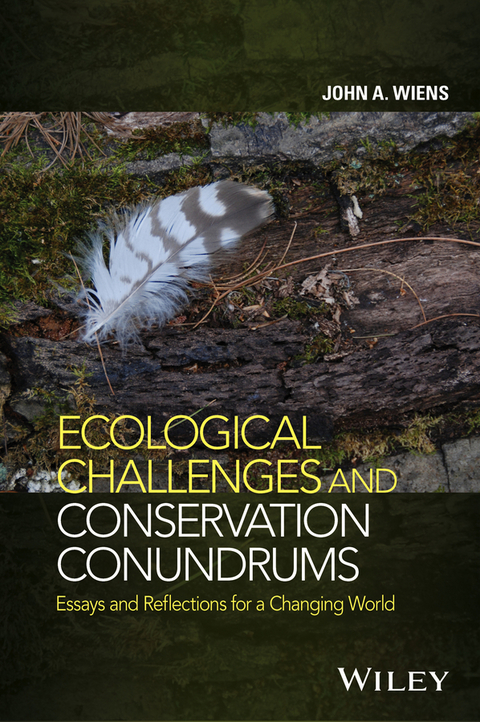
Ecological Challenges and Conservation Conundrums (eBook)
John Wiley & Sons (Verlag)
978-1-118-89509-2 (ISBN)
Professor John Wiens, PRBO Conservation Science, California, USA Professor Wiens is currently Chief Conservation Science Officer at PRBO Conservation Science, California, and a visiting faculty member of the University of Western Australia in Perth, where he collaborates with colleagues on restoration ecology. He held positions at Oregon state University, the University of New Mexico and Colorado State University before leaving academia in 2002 to join The Nature Conservancy as Lead Scientist. He has published over ten books and 250 scientific papers. At PRBO Professor Wiens develops guidance for assessing how landscapes are likely to change and how management practices can help to mitigate or adapt to the changes.
Acknowledgments
Preamble Why This Book?
Essay 1 How Did I Get Here?
Essay 2 Found! The Survivor in the Swamps (2005)
Essay 3 In Defense of Footnotes (2014)
Part I The Challenge
Chapter 1 Conservation and Change
Chapter 2 A Digression on Paradigms
Essay 4 The Power of Paradigms (2014)
Essay 5 Patterns, Paradigms, and Preconceptions (2013)
Essay 6 Fat Times, Lean Times, and Competition Among Predators (1993)
Chapter 3 Equilibrium, Stability, and Change
Essay 7 From Our Southern Correspondent(s) (2011)
Essay 8 Boom and Bust: Lessons from the Outback (2014)
Chapter 4 A Digression on Disturbance
Essay 9 Oil, Oil, Everywhere (2010)
Part II The Forces of Change
Chapter 5 Climate Change and Sea-level Rise
Essay 10 Polar Bears, Golden Toads, and Conservation Futures (2008)
Chapter 6 Land-use Change
Essay 11 Will Land-use Change Erode Our Conservation Gains? (2007)
Essay 12 Landscape Ecology: The Science and the Action (1999)
Chapter 7 Distributional Changes: Invasive Species
Chapter 8 Social, Cultural, and Political Change
Essay 13 Wildlife, People, and Water: Who Wins? (2012)
Chapter 9 Population Growth
Chapter 10 Linkages among Changes
Part III Some Conservation Conundrums
Chapter 11 Variation and History
Essay 14 The Eclipse of History? (2008)
Essay 15 From Our Southern Correspondent(s): Which History? (2013)
Chapter 12 A Digression on Baselines and Targets
Essay 16 Shooting at a Moving Target (2011)
Chapter 13 Ecological Thresholds
Essay 17.Tipping Points in the Balance of Nature (2010)
Chapter 14 Ecological Resilience
Chapter 15.Dealing with Novelty
Essay 18 Black Swans and Outliers (2012)
Essay 19 Moving Outside the Box (2009)
Chapter 16 Uncertainty: A Boon or a Bane?
Essay 20 Taking Risks with the Environment (2012)
Essay 21 Uncertainty and the Relevance of Ecology (2008)
Chapter 17 Prioritization and Triage
Essay 22 Talking about Triage in Conservation (2015)
Chapter 18 Protected Areas: Where the Wild Things Are
Essay 23 Build it and They will Come (2013)
Essay 24 The Dangers of Black-and-White Conservation (2007)
Chapter 19 Ecosystem Services and the Value of Nature
Essay 25 What's so New About Ecosystem Services? (2007)
Part IV Doing Conservation
Chapter 20 What is it We are Trying to Conserve?
Essay 26 Be Careful What You Wish For (2014)
Essay 27 Are Bird Communities Real? (1980)
Essay 28 A Metaphor Meets an Abstraction: The Issue of Ecosystem Health (2015)
Chapter 21 Numbers, Numbers, Numbers
Essay 29 Is 'Monitoring' a Dirty Word? (2009)
Essay 30 The Place of Long-term Studies in Ornithology (1984)
Essay 31 What Use is Small Data in a Big Data World? (2013)
Chapter 22 A Digression on Words
Essay 32 Word Processing versus Writing (1983, 2011)
Chapter 23 Debates in Ecology and Conservation
Essay 33 On Skepticism and Criticism in Ornithology (1981)
Essay 34 The Demise of Wildness? (2007)
Chapter 24 What Lies Behind the Debates? Philosophy, Values, and Ethics
Chapter 25 A Digression on Advocacy in Conservation
Essay 35 Scientific Responsibility and Responsible Ecology (1997)
Part V Concluding Comments
Chapter 26 Whither Ecology and Conservation in a Changing World?
Essay 36 It Was the Best of Times, It Was the Worst of Times (2009)
Essay 37 Being Green Isn't Easy (2010)
Essay 38 Stewart Udall and the Future of Conservation (2010)
References
Scientific Names
Index
Chapter 1
Conservation and change
In 1862, early in the Civil War and 1 month before signing the Emancipation Proclamation, Abraham Lincoln sent his annual message to the Congress. His concluding words encapsulate the challenge facing conservation and the essential theme of this book:
The dogmas of the quiet past, are inadequate to the stormy present. The occasion is piled high with difficulty, and we must rise – with the occasion. As our case is new, so we must think anew, and act anew.
Conservation is at a crossroads. Change is everywhere. Habitat is being lost to crop production, draining of wetlands, and development at an alarming rate and fragmentation is leaving isolated remnants of habitat scattered like broken glass across a kitchen floor. The combination of climate change and sea-level rise threatens to overwhelm all other sources of environmental change. Protecting the natural world and conserving the richness of biological diversity require that we rethink what has worked in the past and consider fresh approaches.
The context in which conservation is conducted is also changing. How people use lands and waters is undergoing transformation as the tentacles of urbanization reach farther into the rural countryside and population and economic growth increase the demands for goods and services. Economic globalization has created a web of interdependencies, so what happens in one place immediately sends waves across the globe. Changing societal attitudes about the environment, the natural world, and conservation are intertwined with changing political and cultural forces.
How should conservation, and its ecological underpinnings, adjust to this interwoven mélange of change? How can ecological science be applied to advance the conservation of biological diversity—species, ecosystems, habitats, landscapes—in short, “nature”? Answering such questions requires that we consider the ambiguity about what “conservation” really means. For many people, the word conjures up images of pandas, tigers, polar bears, gorillas, and the like—the charismatic animals favored as icons by large conservation organizations. Others equate it with solar energy, clean water, or anything green. “Conservation” means different things to different people.
Faced with ambiguity, one can always turn to the Oxford English Dictionary. The online dictionary offers two definitions: “preservation, protection, or restoration of the natural environment, natural ecosystems, vegetation, and wildlife,” and “prevention of excessive or wasteful use of a resource.”1 These definitions mirror two distinctly different perspectives on conservation that have both historical and philosophical roots.
The first definition guides the work of most conservation biologists, conservation organizations, and environmentalists. It is grounded in the natural philosophies of Ralph Waldo Emerson and Henry David Thoreau, the activism of John Muir, and, later, in the land ethic of Aldo Leopold.2 To these writers, nature has standing in and of itself—what environmental ethicists term intrinsic value. Consequently, people have a moral imperative to preserve and protect nature and wilderness.3 This preservationist philosophy underlies the work of many nongovernmental conservation organizations. The view that nature has intrinsic value also motivates environmental activists, who use lobbying, litigation, and education to defend the environment.
The second Oxford definition reflects a quite different perspective, following the utilitarian philosophies of John Stuart Mill and others. Nature is something to be used by people, and “conservation” means wise use and development of natural resources, not setting them aside in parks or wilderness. Nature's values are instrumental, determined by their value to people. Only people have intrinsic value, giving them moral primacy over everything else. This view was perhaps most forcefully advanced in conservation by Gifford Pinchot in the first part of the 20th century. It was put into practice in the 1930s, when the ravages of the drought that led to the Dust Bowl4 prompted the formation of the Soil Erosion Service (now the Natural Resources Conservation Service). Other federal and state agencies in the United States have a similar responsibility to protect and manage resources for productive uses by people.
Both perspectives—the preservationist/idealist and the utilitarian/pragmatist—are embodied in laws and regulations that govern how or whether species or other natural resources are to be protected, managed, or used. Some laws and regulations in the United States, such as the Endangered Species Act (passed in 1973), give priority to protection (and are viewed by developers as impeding progress or putting fish above people). Others, such as the General Mining Act (1872) or the Taylor Grazing Act (1934), give priority to the extraction or use of resources (and are an anathema to conservationists, who think that regulations encourage degradation of the environment). Policy and regulations are inseparable from politics, of course, and therefore tend to vary depending on whether (politically) the environment is accorded intrinsic or instrumental value (although politicians do not normally think in such philosophical terms).
Science also plays a role in supporting both perspectives. Conservation science uses the tools of science—study design, sampling, statistics, modeling, hypothesis formulation, and the like—to protect and preserve species and places and to manage natural resources so that they can be used by people. Although it draws largely from the biological sciences, especially ecology, more broadly it includes elements of economics, sociology, political science, and other applied disciplines.
The different perceptions of “conservation” lead people to be concerned about different aspects of change. To those who think of conservation as wise use, changes in the economics of supply and demand may be most important. To environmentalists, changing policies and societal attitudes that affect their advocacy positions may hold the greatest sway. To those concerned about the persistence of biological diversity, changes in land uses may be paramount. These different perspectives can lead to different attitudes about how conservation should adjust to changing circumstances. However, the dimensions of change intersect and blend together, as do the preservationist/idealist and utilitarian/pragmatist perspectives. To be effective, conservation needs to consider all of them.
A central thesis of this book is that traditional approaches to conservation are inadequate for dealing with the challenges of a changing world—the “stormy present” or the even stormier future. Although conservation and its ecological foundations are rooted in the past, they are not locked into the past; both have been changing, of course. The past emphasis of conservation on the protection of pretty places, preservation of charismatic species, and restoration of damaged ecosystems has expanded. Conservation research and applications have been transformed by new technologies; benefits to people—ecosystem services—are receiving increasing attention; and climate change has been part of the discussion for some time.5 Ecology has also changed, moving from assumptions about equilibrium, community assembly, and orderly succession to consider nonequilibrium concepts, neutral models of community dynamics, and ideas about ecosystem resilience.6
Beneath these changes, however, there remains a resistant core. Conservation of threatened species or habitats is still dominated by the “protected areas paradigm,” the expectation that protecting critical places will return disproportionate conservation benefits. Organizations such as Conservation International, for example, have emphasized protecting “hotspots” of global biodiversity, a limited number of areas that contain a substantial share of the earth's species.7 Many restoration projects still have the goal of returning a degraded place to a former “natural” state. Notions of feedback control and broad-scale stability still hold sway over a good deal of ecological thinking. I'll have more to say about this in Chapter 3.
If conservation needs to adapt to changes in the environment and societal context, how should it change? I'll reflect on several emerging (or emerged) avenues of change in the essays and chapters that follow, but I can summarize them here.8 To move forward, conservation needs to:
- Recognize that nature is dynamic; stability is a myth, and extreme events may have unexpected consequences.
- Deal with places in their broader landscape context; protected areas are not isolated from their surroundings.
- Consider the effects of scale; the structure and dynamics of ecological systems differ depending on the scale in time or space, so conservation is also scale-dependent—what works at one scale may not work at another.
- Embrace uncertainty; change begets uncertainty, which only increases as we peer into the future.
- Move beyond a focus on “nature” untrammeled by people to include people and the places they live and work; people as part of nature, and nature as part of people.
- Re-evaluate the targets of conservation; are they genetically distinct populations, species, metapopulations, community structure, ecosystem function, something else, or all of...
| Erscheint lt. Verlag | 22.2.2016 |
|---|---|
| Sprache | englisch |
| Themenwelt | Naturwissenschaften ► Biologie ► Ökologie / Naturschutz |
| Technik | |
| Schlagworte | Ãkologie • Ãkologie u. Biologie der Organismen • Biowissenschaften • climate change • conservation • Conservation Science • earth science • Ecology • Ecology & Organismal Biology • global change • Life Sciences • Naturschutzbiologie • Ökologie • Ökologie u. Biologie der Organismen • organismal biology |
| ISBN-10 | 1-118-89509-6 / 1118895096 |
| ISBN-13 | 978-1-118-89509-2 / 9781118895092 |
| Informationen gemäß Produktsicherheitsverordnung (GPSR) | |
| Haben Sie eine Frage zum Produkt? |
 EPUB (Adobe DRM)
Kopierschutz: Adobe-DRM
Adobe-DRM ist ein Kopierschutz, der das eBook vor Mißbrauch schützen soll. Dabei wird das eBook bereits beim Download auf Ihre persönliche Adobe-ID autorisiert. Lesen können Sie das eBook dann nur auf den Geräten, welche ebenfalls auf Ihre Adobe-ID registriert sind.
Details zum Adobe-DRM
Dateiformat: EPUB (Electronic Publication)
EPUB ist ein offener Standard für eBooks und eignet sich besonders zur Darstellung von Belletristik und Sachbüchern. Der Fließtext wird dynamisch an die Display- und Schriftgröße angepasst. Auch für mobile Lesegeräte ist EPUB daher gut geeignet.
Systemvoraussetzungen:
PC/Mac: Mit einem PC oder Mac können Sie dieses eBook lesen. Sie benötigen eine
eReader: Dieses eBook kann mit (fast) allen eBook-Readern gelesen werden. Mit dem amazon-Kindle ist es aber nicht kompatibel.
Smartphone/Tablet: Egal ob Apple oder Android, dieses eBook können Sie lesen. Sie benötigen eine
Geräteliste und zusätzliche Hinweise
Buying eBooks from abroad
For tax law reasons we can sell eBooks just within Germany and Switzerland. Regrettably we cannot fulfill eBook-orders from other countries.
aus dem Bereich