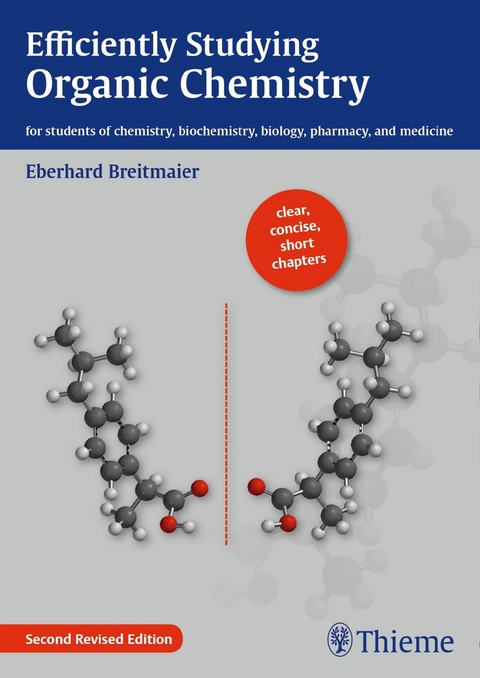
Efficiently Studying Organic Chemistry (eBook)
Thieme (Verlag)
978-3-13-240265-2 (ISBN)
16 Additions to Alkenes
Additions of molecules such as HX or X2 to the CC double bond are typical reactions of alkenes and the reverse of eliminations (▶ Chapters 11.1, ▶ 11.2, ▶ 15.1).
16.1 Addition of Hydrogen (Catalytic Hydrogenation)
Catalytic hydrogenation of alkenes to provide alkanes involves the addition of hydrogen to a CC double bond in the presence of a group 10 metal (Ni, Pd, Pt) as catalyst. As illustrated in ▶ Fig. 12.1, the catalyst decreases the activation barrier of hydrogenation and thus the reaction proceeds more rapidly. The hydrogen molecule, activated at the surface of the catalyst, collides as a whole with the CC double bond, forming a cyclic transition state to induce a four-center reaction. Thus, after having added from one side of the CC double bond, both hydrogen atoms are attached at the same side of the CC double bond meaning that they will adopt a syn arrangement (syn- or cis- addition). This stereospecificity, however, is undetectable in open-chain alkanes because of free rotation about the CC single bond arising from the hydrogenation.
16.2 Addition of Bromine (Bromination)
The addition of brownish-red bromine to an alkene giving an α,β-dibromoalkane decolorizes the solution and thereby indicates the presence of a CC double bond. The mechanism of bromination starts with a polarization of the bromine molecule upon collision with the alkene, resulting in a transition state which is converted into an intermediate three-membered cyclic bromonium ion with loss of a bromide anion. This bromide anion adds from the backside of the bulky bromonium ion (anti- or trans- addition), opening the strained three-membered ring to yield an α,β-dibromoalkane.
The stereospecificity of this reaction is not detectable for open-chain alkenes because of free rotation about the newly formed CC single bond, so that 2,3-dibromobutane is obtained by bromination of both configurational isomers of 2-butene:
Chlorination of alkenes also follows the mechanism of bromination, involving an intermediate three-membered halonium ion. Fluorine is too reactive for a controlled reaction: all bonds are attacked and thus mixtures of compounds are produced. Iodinations proceed too slowly to be of synthetic significance.
16.3 Electrophilic Addition of Hydrogen Halide (Hydrohalogenation)
Hydrogen halides (HCl, HBr, HI) add to alkenes yielding alkyl halides. This reaction, called hydrohalogenation of alkenes, follows a stepwise ionic mechanism involving the proton of the hydrogen halide as an electrophile: In the first step, the electrophilic proton adds to the CC double bond (electrophilic addition), thus generating an intermediate carbenium ion which reacts with the halide anion in a fast reaction of the ions to produce the haloalkane (alkyl halide).
Ethene (H2C=CH2) is readily hydrochlorinated to give chloroethane (H3C−CH2−Cl). Hydrohalogenation of an unsymmetrically substituted alkene, such as propene in the simplest case, may produce two structural isomers of the resulting alkyl halides, with different positions of the halogens, called regioisomers. Thus, hydrobromination of propene may produce the regioisomers 2-bromopropane and 1-bomopropane:
The regioselectivity of hydrohalogenation, favoring one and discriminating against the other product, is predicted by the MARKOVNIKOV rule: Electrophilic addition preferentially involves the most stable carbenium ion. Since the relative stability of radicals (▶ Chapter 13.2) as well as of carbenium ions increases with increasing alkylation, the 2-propyl cation is more stable than the 1-propyl cation. As a result, hydrobromination of propene predominantly yields 2-bromopropane (isopropyl bromide).
16.4 Electrophilic Addition of Water (Hydration)
Water adds to the CC double bond of alkenes in the presence of an acid to give alcohols (▶ Chapter 33.3.3). This hydration of alkenes, the reverse of dehydration of alcohols to alkenes (▶ Chapters 15.1.2, ▶ 36.1), also proceeds as an electrophilic addition, because the electrophilic proton of the acid adds to the double bond in the first and slow step. Water adds to the resulting intermediate carbenium ion to give an intermediate oxonium ion which deprotonates to yield the alcohol.
Again, MARKOVNIKOV´s rule predicts the regioselectivity of hydration taking into account the relative stabilities of the intermediate carbenium ions. Thus, hydration of methylpropene (isobutene) almost exclusively yields 2-methyl-2-propanol (t- butyl alcohol) because the t- butyl cation is much more stable and longer-living than the isomeric methylpropyl cation with a terminal positive charge.
16.5 Halohydrin Formation
Halohydrins (2-haloalcohols) are formed by addition of halogen and water to alkenes. For example, 2-bromoethanol (ethylene bromohydrin) is obtained by reacting ethene, bromine and water.
Halohydrin formation involves an electrophilic addition of the positive halogen end of hypohalous acid to the double bond. The resulting intermediate ion pair, a β-halocarbenium ion and hydroxide anion, quickly reacts to provide the halohydrin:
16.6 Hydroboration
Diborane, B2H6, adds to alkenes. The monomer borane, BH3, is assumed to act as the reactive compound. This addition, referred to as hydroboration, involves a four-center mechanism, with electrophilic addition of ⊕BH2 and nucleophilic addition of the hydride part of borane occurring simultaneously. A trialkylborane is produced in three successive steps.
The addition is controlled by the spatial requirements of groups (thus said to be stereocontrolled) so that the bulkier BH2 attacks at the less hindered part of the alkene. Methylpropene (R = CH3), as an example, exclusively reacts to provide triisobutylborane.
16.7 Dihydroxylations
cis-Dihydroxylation with Osmium Tetroxide or Potassium Permanganate
Osmium tetroxide or potassium permanganate undergo a [3+2]-cycloaddition (2 atoms of the alkene, and 3 of the oxide) with alkenes.Cyclic esters (osmates and manganates) are the primary products, liberating 1,2-diols (alcohols with two adjacent hydroxy groups) with syn arrangement of OH groups upon hydrolysis.
trans-Dihydroxylation with Peroxy Acids Involving Oxiranes
Peroxy acids convert alkenes into oxiranes (epoxides, PRILEZHAEV epoxidation), a process which involves a [2+1]-cycloaddition (2 for two carbon atoms of the alkene, 1 for the adding oxygen of the peroxy acid). The oxirane ring is opened upon protonation and backside attack of water (similar to the opening of bromonium ions described ▶ Chapter 16.2), yielding 1,2-diols with OH groups arranged anti to each other.
The stereospecificity of these dihydroxylations is not detectable for non-cyclic alkenes due to free rotation about the newly formed CC single bond, and both cis- and trans-2-butene are dihydroxylated to yield 2,3-butanediol:
16.8 1,3-Dipolar Cycloaddition of Ozone (Ozonolysis)
Canonical formulas depict ozone as a 1,2- and 1,3-dipole. As a 1,3-dipole, ozone adds to alkenes, and this kind of [2+3]-cycloaddition is called a 1,3-dipolar cycloaddition. An initially formed five-membered primary ozonide rearranges to the corresponding ozonide. In the presence of a reducing reagent, water cleaves the ozonide to yield carbonyl compounds (aldehydes or ketones, ▶ Chapters 47, ▶ 48).
The resulting carbonyl compounds permit reconstruction of the original alkene for structure elucidation. Acetone (propanone) and butanal as products of ozonolysis and subsequent hydrolysis, for example, identify 2-methyl-2-hexene as the original alkene.
Chapter 16 permits answers to the following:
(16.1) Suggest the preparation of (a) 2,3-dimethylpentane and (b) 2,3-dibromohexane from appropriate alkenes.
(16.2) What is an electrophilic addition? Write mechanisms for bromination and hydrobromination of alkenes.
(16.3) What products are obtained by hydrobromination of (a) 2-methyl-2-butene and (b) 1-hexene?
(16.4) What products arise from (a) hydration and (b) hydroboration of 2-methyl-1-butene?
(16.5) Which methods can be used to prepare 1,2-diols from alkenes? Formulate general reaction...
| Erscheint lt. Verlag | 24.2.2016 |
|---|---|
| Verlagsort | Stuttgart |
| Sprache | englisch |
| Themenwelt | Naturwissenschaften ► Chemie ► Organische Chemie |
| Technik | |
| Schlagworte | aldehydes • aldoses • Alkaloids • Alkanes • Alkenes • alkyl halides • Alkynes • amines • Amino Acids • arbohydrates • atomic orbitals • benzene • benzenoid aromatics • carbonyl reactions • carboxylic acids • configurational isomers • covalent bonding • cycloalkanes • cycloalkenes • Dienes • diols • ethers • fused aromatic heterocycles • heteroalicycles • heterocumulenes • Hybridization • hydrogen molecule • Ketones • ketoses • Lipids • Mass Spectrometry • NMR spectroscopy • Nucleic acids • Oligosaccharides • Organic Chemistry • organic chemistry basics • organic chemistry textbook • organometal compounds • Organosulfur Compounds • Peptides • Phenols • polyketides • Polymerization • Polymers • polysaccharides • Porphyrinoids • proteins • quinones • Six-Membered Aromatic Heterocycles • Steroids • synthesis of alkenes • Terpenes • triols |
| ISBN-10 | 3-13-240265-6 / 3132402656 |
| ISBN-13 | 978-3-13-240265-2 / 9783132402652 |
| Informationen gemäß Produktsicherheitsverordnung (GPSR) | |
| Haben Sie eine Frage zum Produkt? |
 PDF (Wasserzeichen)
DRM: Digitales Wasserzeichen
Dieses eBook enthält ein digitales Wasserzeichen und ist damit für Sie personalisiert. Bei einer missbräuchlichen Weitergabe des eBooks an Dritte ist eine Rückverfolgung an die Quelle möglich.
Dateiformat: PDF (Portable Document Format)
Mit einem festen Seitenlayout eignet sich die PDF besonders für Fachbücher mit Spalten, Tabellen und Abbildungen. Eine PDF kann auf fast allen Geräten angezeigt werden, ist aber für kleine Displays (Smartphone, eReader) nur eingeschränkt geeignet.
Systemvoraussetzungen:
PC/Mac: Mit einem PC oder Mac können Sie dieses eBook lesen. Sie benötigen dafür einen PDF-Viewer - z.B. den Adobe Reader oder Adobe Digital Editions.
eReader: Dieses eBook kann mit (fast) allen eBook-Readern gelesen werden. Mit dem amazon-Kindle ist es aber nicht kompatibel.
Smartphone/Tablet: Egal ob Apple oder Android, dieses eBook können Sie lesen. Sie benötigen dafür einen PDF-Viewer - z.B. die kostenlose Adobe Digital Editions-App.
Buying eBooks from abroad
For tax law reasons we can sell eBooks just within Germany and Switzerland. Regrettably we cannot fulfill eBook-orders from other countries.
aus dem Bereich