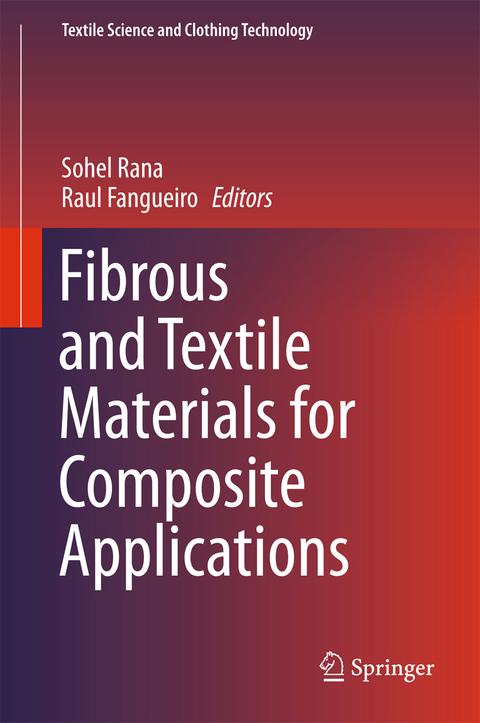
Fibrous and Textile Materials for Composite Applications (eBook)
XI, 394 Seiten
Springer Singapore (Verlag)
978-981-10-0234-2 (ISBN)
This book focuses on the fibers and textiles used in composite materials. It presents both existing technologies currently used in commercial applications and the latest advanced research and developments. It also discusses the different fiber forms and architectures, such as short fibers, unidirectional tows, directionally oriented structures or advanced 2D- and 3D-textile structures that are used in composite materials. In addition, it examines various synthetic, natural and metallic fibers that are used to reinforce polymeric, cementitious and metallic matrices, as well as fiber properties, special functionalities, manufacturing processes, and composite processing and properties. Two entire chapters are dedicated to advanced nanofiber and nanotube reinforced composite materials. The book goes on to highlight different surface treatments and finishes that are applied to improve fiber/matrix interfaces and other essential composite properties.
Although a great deal of information about fibers and textile structures used for composite applications is already available, this is the only book currently available that discusses all types of fibers and structures used to reinforce polymers, cement, metal or soil to improve their general performance and multi-functional behaviors. As such, it fills an important gap in the available literature and provides a valuable resource for a wide range of students and researchers from academia and industry.
This bookfocuses on the fibers and textiles used in composite materials. It presentsboth existing technologies currently used in commercial applications and thelatest advanced research and developments. It also discusses the differentfiber forms and architectures, such as short fibers, unidirectional tows,directionally oriented structures or advanced 2D- and 3D-textile structures that are used in composite materials. In addition, it examinesvarious synthetic, natural and metallic fibers that are used to reinforcepolymeric, cementitious and metallic matrices, as well as fiber properties,special functionalities, manufacturing processes, and composite processing andproperties. Two entire chapters are dedicated to advanced nanofiber andnanotube reinforced composite materials. The book goes on to highlightdifferent surface treatments and finishes that are applied to improvefiber/matrix interfaces and other essential composite properties. Although a great deal of information about fibers and textilestructures used for composite applications is already available, this is theonly book currently available that discusses all types of fibers and structuresused to reinforce polymers, cement, metal or soil to improve their generalperformance and multi-functional behaviors. As such, it fills an important gapin the available literature and provides a valuable resource for a wide rangeof students and researchers from academia and industry.
Preface 7
Contents 9
About the Editors 10
1 Introduction to Composite Materials 11
Abstract 11
1 Types of Composites 14
2 Fundamental Aspects 15
3 Types of Matrix 20
3.1 Polymer Matrix 20
3.1.1 Polyester Resin 21
3.1.2 Epoxy Resins 21
3.1.3 Vinyl Ester Resins 23
3.1.4 Phenolic Resins 23
3.1.5 Polyimide Resins 24
3.1.6 Thermoplastics 24
3.2 Metal Matrix 24
3.2.1 Aluminium Alloys 25
3.2.2 Magnesium Alloys 25
3.2.3 Titanium Alloys 25
3.2.4 Intermetallic Compounds 26
3.3 Ceramic Matrix 26
3.3.1 Alumina 27
3.3.2 Silicon Carbide 27
3.3.3 Silicon Nitride 27
3.3.4 Glass 28
3.3.5 Cements 28
4 Types of Reinforcement 28
4.1 Glass Fibres 29
4.2 Carbon Fibres 30
4.3 Polyethylene Fibre 31
4.4 Aramid Fibre 32
4.5 Ceramic Fibres 32
4.6 Whiskers 33
4.7 Nanofibres 34
5 Manufacturing Techniques 35
5.1 Manufacturing of PMCs 35
5.1.1 Hand Lay-up 36
5.1.2 Resin Transfer Moulding (RTM) 37
5.1.3 Resin Infusion/Vacuum Bag Moulding 37
5.1.4 Autoclave Process 37
5.1.5 Compression Moulding 38
5.1.6 Filament Winding 38
5.1.7 Pultrusion 39
5.1.8 Injection Moulding 39
5.1.9 Reinforced Reaction Injection Moulding (RRIM) 39
5.1.10 Thermoforming 40
5.2 Manufacturing of MMCs 40
5.2.1 Stir Casting 40
5.2.2 Melt Infiltration 41
5.2.3 Powder Metallurgy Technique 41
5.3 Manufacturing of CMCs 42
5.3.1 Compaction and Sintering 42
5.3.2 Reaction Bonding 43
5.3.3 Directed Oxidation 43
5.3.4 Polymer Infiltration and Pyrolysis (PIP) 43
5.3.5 Chemical Vapour Infiltration 43
6 Applications 44
6.1 Applications of PMCs 45
6.2 Applications of MMCs 46
6.3 Applications of CMCs 47
7 Conclusion 47
References 48
2 Essential Properties of Fibres for Composite Applications 49
Abstract 49
1 Introduction 49
2 Geometrical Properties 50
2.1 Cross-Section 51
2.2 Fiber Length 52
2.3 Fiber Fineness 52
3 Fiber Structure 53
3.1 Description of Structures 53
3.2 Structure Analysis by X-Ray Diffraction 55
3.3 Other Techniques for Structure Analysis 57
4 Mechanical Properties 58
4.1 Tensile Properties 58
4.2 Tensile Test Methods 58
4.3 Effect of Fibre Length and Diameter 59
4.4 Bending Properties 60
5 Surface Properties 61
5.1 Surface Area and Surface Roughness 61
5.1.1 BET Surface Area Measurements (Named After Stephen Brunauer, Paul Hugh Emmet and Edward Teller) 62
5.1.2 Atomic Force Microscopy (AFM) 63
5.2 Chemical Functionalities 63
5.2.1 X-Ray Photoelectron Spectroscopy (XPS) 64
5.2.2 ToF-SIMS (Time-of-Flight Secondary Ion Mass Spectroscopy) 65
5.3 Surface Energy and Wettability 65
5.3.1 Surface Energy and Contact Angle 66
5.3.2 Measurement of Surface Energies and Wetting Behavior 67
5.4 Adhesion to Matrix 68
5.4.1 Load Transfer and Critical Fiber Length 68
5.4.2 Overview on Measurement Methods for Fiber Matrix Adhesion 69
5.4.3 Roving Tests 70
5.4.4 Single Filament Tests 71
6 Physical Properties 73
6.1 Density 73
6.2 Thermal Properties 75
6.2.1 Phase Transitions 75
6.2.2 Heat Capacity 76
6.2.3 Thermal Conductivity 76
6.3 Thermomechanical Properties 77
6.4 Electrical Properties 77
6.4.1 Electrical Conductivity 78
6.4.2 Dielectrical Constant 78
7 Durability 79
References 80
3 Fiber Architectures for Composite Applications 84
Abstract 84
1 Introduction 85
2 Types of Advanced Architectures 86
2.1 2D Architectures 86
2.2 Three Dimensional (3D) Architectures 90
2.3 Hybrid and Multi-layer Architectures 98
2.4 Auxetic Structures 99
3 Production Techniques 101
3.1 Weaving Technology 101
3.2 Braiding Technology 107
3.3 Non-Woven Technology 114
3.4 Knitting Technology 117
4 Properties of Advanced Architectures 120
4.1 2D Architectures 120
4.2 3D Architectures 122
5 Examples of Application 133
5.1 Structural Components 133
5.2 Ballistic Applications 133
5.3 Space and Aerospace Applications 134
5.4 Automotive Applications 134
5.5 Medical Applications 135
5.6 Sports Applications 135
6 Conclusions 135
References 136
4 Synthetic Fibres for Composite Applications 144
Abstract 144
1 Overview on Synthetic Fibers 144
2 Carbon Fibres 145
2.1 Fibre Manufacturing 146
2.1.1 PAN-Based Carbon Fibres: Precursor 147
2.1.2 PAN-Based Carbon Fibres: Thermal Conversion 148
2.1.3 PAN-Based Carbon Fibres: Surface Treatment 149
2.1.4 Pitch-Based Carbon Fibres 150
2.1.5 Cellulose-Based Carbon Fibres 151
2.1.6 Alternative Precursors 151
2.2 Fibre Structure 152
2.3 Fibre Properties 153
2.3.1 Mechanical Properties 153
2.3.2 Electrical Properties 154
2.4 Carbon Fibre Producers 154
2.5 Application in Composites 154
2.5.1 Aerospace Applications 156
2.5.2 Automotive Applications 156
2.5.3 Application in Wind Energy 156
2.5.4 Other Applications 157
2.5.5 Carbon Fibre Demand 157
3 Glass and Basalt Fibers 158
3.1 Fiber Properties 159
3.2 Fiber Manufacturing 160
3.2.1 Raw Material 160
3.2.2 Melting Process 160
3.2.3 Fiber Forming 162
3.2.4 Sizing and Surface Treatment 162
3.3 Fiber Structure 163
3.4 Application in Composites 164
3.5 Special Fibers: Basalt Fibers 165
4 Ceramic Fibers 166
4.1 Fiber Properties 166
4.2 Fiber Manufacturing 167
4.2.1 Sol Gel Process 168
4.2.2 Polymers Precursor Process 168
4.2.3 CVD Chemical Vapor Deposition Process 169
4.3 Application in Composites 170
5 Polymeric Fibres 171
5.1 Aramide Fibres 171
5.1.1 Fibre Material and Manufacturing 172
5.1.2 Fibre Properties 172
5.1.3 Aramide Fibre Market 172
5.1.4 Application in Composites 173
5.2 Ultra High Molecular Weight Polyethylene (UHMWPE) 173
5.2.1 Fibre Material and Manufacturing 174
5.2.2 Fibre Properties 174
5.2.3 Application of UHMWPE 174
5.3 Other Types of Polymeric Fibres 174
References 176
5 Natural Fibers for Composite Applications 180
Abstract 180
1 Introduction 180
2 Characteristics of Selected Vegetable Fiber 184
2.1 Flax fiber 184
2.2 Hemp Fibers 186
2.3 Jute 187
2.4 Kenaf 188
2.5 Sisal 189
2.6 Abaca 190
2.7 Coir 190
3 Vegetable Fiber Textiles as Reinforcement of Structural Composites 192
4 Fabrication of Natural Fiber Composites 196
4.1 Fabrication Techniques 198
4.2 Natural Fiber Surface Modification 200
5 Properties of Natural Fiber Composites 203
6 Vegetable Fibers Based Composites Application 204
7 Conclusions 209
References 209
6 Metallic Fibers for Composite Applications 214
Abstract 214
1 Introduction 214
2 Types of Metallic Fibers 216
3 Properties of Metallic Fibers 219
4 Types of Matrix 222
4.1 Polymers Matrix Composites 222
4.2 Thermoplastics 223
4.3 Thermosets 224
4.4 Metal Matrix Composites (MMC) 225
4.5 Ceramic Matrix Composites 227
5 Fabrication Technique 227
6 Properties of Composites 231
7 Examples of Application 234
8 Conclusion 236
References 237
7 Carbon Nanofibres and Nanotubes for Composite Applications 240
Abstract 240
1 Introduction 240
2 Synthesis and Properties of Carbon Nanotubes and Nanofibers 243
3 Carbon Nanotube and Nanofiber Polymer Composites: Properties and Applications 245
4 Preparation of Nanocomposites 250
4.1 General Preparation Methods 250
4.2 Carbon Nanotube and Nanofiber Functionalization for Interfacial Enhancement 251
4.3 Melt Mixing Methods 252
5 Conclusions 264
References 264
8 Natural Nanofibres for Composite Applications 270
Abstract 270
1 Introduction 270
2 Cellulose and Cellulose Nanofibres 273
3 Chitin and Chitin Nanofibres 277
4 High-Performance Nanocomposites Based on Cellulose and Chitin 284
4.1 Structural Applications 285
4.2 Functional Composites 288
4.2.1 Tissue Engineering Applications 288
4.2.2 Wound Dressing and Drug-Delivery Systems 292
4.2.3 Electronics 295
4.2.4 Cosmetics 297
4.2.5 Absorbents 298
5 Conclusions 299
Acknowledgments 300
References 300
9 Surface Preparation of Fibres for Composite Applications 309
Abstract 309
1 Introduction 309
2 Surface Coatings 310
2.1 Electrodeposition 311
2.2 Chemical Vapor Deposition 311
2.3 Metallorganic Deposition 312
2.4 Vacuum Deposition 312
2.5 Future Fibre-Coating Technology 313
3 Plasma Surface Modification 313
4 Chemical Surface Modification 315
4.1 Alkaline Treatment 315
4.2 Silane Treatment 317
4.3 Acetylation Treatment 317
4.4 Benzoylation Treatment 318
4.5 Peroxide Treatment 318
5 Mechanical Surface Treatment 319
6 Nano-Coatings 320
7 Conclusions 320
References 321
10 Reinforcements and Composites with Special Properties 324
Abstract 324
1 Introduction 324
2 Piezoresistive and Self-Sensing Behavior 325
2.1 Theory of Conduction Mechanism 326
2.2 Metal-Polymer Composites as Piezoresistive Sensor 328
2.3 Carbon Fibres and Carbon Black Composites as Piezoresistive Sensor 328
2.4 Carbon Nanotube (CNT) as Piezoresistive Sensor 330
2.5 Conductive Polymer Composites as Strain Sensor 332
2.6 Carbon Nanotubes for Structural Health Monitoring (SHM) 333
2.7 Piezo-Resistive and Self-Sensing Behavior of Engineered Cementitious Composites 334
2.8 Piezoresistive Micro-Cantilever Biochemical Sensor 335
2.9 Polymeric Filaments for Piezo-Electric Sensor 335
3 Self-Healing Characteristics 336
3.1 Self-Healing of Thermoplastic Materials 337
3.1.1 Self-Healing by Molecular Interdiffusion 337
3.1.2 Photo-Induced Self-Healing 339
3.1.3 Self-Healing by Recombination of Chain Ends 340
3.1.4 Self-Healing by Reversible Bond Formation 341
3.1.5 Self-Healing of Ionomers 341
3.1.6 Living Polymer Approach of Self-Healing 343
3.1.7 Self-Healing by Nanoparticles 343
3.2 Self-Healing of Thermoset Materials 343
3.2.1 Self-Healing by Microencapsulation 344
3.2.2 Hollow Fiber Approach of Self-Healing 345
3.2.3 Self-Healing of Thermally Reversible Cross Linked Polymers 346
3.2.4 Self-Healing via Inclusion of Thermoplastic Additives 346
3.2.5 Self-Healing via Chain Rearrangement 347
3.2.6 Self-Healing of Hydrogels 347
3.2.7 Self-Healing by Incorporating Water Absorbable Materials 348
3.2.8 Self-Healing via Passivation 348
3.3 Other Approaches 348
4 Heating Properties 351
4.1 Metal Fibres and Wires Used in Composites for Heat Generation 351
4.2 Conductive Polymer Coated Composites for Heat Generation 351
4.3 Composites for Induction Heating 356
5 Electromagnetic Shielding 356
5.1 Mechanism of Electromagnetic Shielding 357
5.2 Electromagnetic Shielding Efficiency 358
5.3 Preparation Methods of Composites for EMI Shielding 358
5.4 Textile/Metal Composites for EMI Shielding 359
5.5 Conductive Polymer Coated Textile Composites for EMI Shielding 361
5.5.1 Conductive Polymer Coated Woven Fabrics for Electromagnetic Shielding 362
5.5.2 Conductive Polymer Coated Nonwoven Fabrics for Electromagnetic Shielding 364
6 Multi-scale Reinforcements and Composites 365
7 Conclusions 369
References 370
11 Comparison of Performance, Cost-Effectiveness and Sustainability 381
Abstract 381
1 Cost-Performance Comparison of Different Fibres 381
1.1 Reinforcement Type 381
1.2 Fibre Tows 383
1.3 Fabric Reinforcements 384
1.4 Natural Fibre Composites 385
2 Environmental Impacts and Sustainability 386
2.1 Life Cycle Assessment 386
2.1.1 Raw Material Production 387
2.1.2 Product Manufacture 388
2.1.3 The Use Phase 388
2.1.4 End of Life Disposal 389
2.2 Composite Recycling 389
2.2.1 Legislation 390
2.2.2 Recycling Technologies 390
2.2.3 Impacts of Recycling 392
2.2.4 Life Cycle Assessment Case Study 393
3 Future Directions 394
3.1 Out of Autoclave Processing 394
3.2 3D Fabrics 395
3.3 Meeting the Demand for Carbon Fibres 396
3.4 Compliance with Legislation 396
4 Conclusions 397
5 Recommendations for Further Reading 398
5.1 Cost-Performance Optimisation 398
5.2 Natural Fibre Composites 398
5.3 Life Cycle Assessment 398
5.4 Composite Recycling 398
5.5 Out of Autoclave (OOA) Processing 398
5.6 3D Fabrics 399
References 399
| Erscheint lt. Verlag | 22.1.2016 |
|---|---|
| Reihe/Serie | Textile Science and Clothing Technology | Textile Science and Clothing Technology |
| Zusatzinfo | XI, 394 p. 234 illus., 99 illus. in color. |
| Verlagsort | Singapore |
| Sprache | englisch |
| Themenwelt | Naturwissenschaften ► Chemie |
| Technik ► Bauwesen | |
| Technik ► Maschinenbau | |
| Schlagworte | Bio-composite materials • Directionally oriented structures • electrospinning • Fiber architectures • Fiber Reinforced Composites • Fibrous materials • Metallic fibers • Nanofiber and nanotubes • natural fibres • Surface treatments • Synthetic Fibers • textile engineering • Textile Structures |
| ISBN-10 | 981-10-0234-7 / 9811002347 |
| ISBN-13 | 978-981-10-0234-2 / 9789811002342 |
| Informationen gemäß Produktsicherheitsverordnung (GPSR) | |
| Haben Sie eine Frage zum Produkt? |
 PDF (Wasserzeichen)
DRM: Digitales Wasserzeichen
Dieses eBook enthält ein digitales Wasserzeichen und ist damit für Sie personalisiert. Bei einer missbräuchlichen Weitergabe des eBooks an Dritte ist eine Rückverfolgung an die Quelle möglich.
Dateiformat: PDF (Portable Document Format)
Mit einem festen Seitenlayout eignet sich die PDF besonders für Fachbücher mit Spalten, Tabellen und Abbildungen. Eine PDF kann auf fast allen Geräten angezeigt werden, ist aber für kleine Displays (Smartphone, eReader) nur eingeschränkt geeignet.
Systemvoraussetzungen:
PC/Mac: Mit einem PC oder Mac können Sie dieses eBook lesen. Sie benötigen dafür einen PDF-Viewer - z.B. den Adobe Reader oder Adobe Digital Editions.
eReader: Dieses eBook kann mit (fast) allen eBook-Readern gelesen werden. Mit dem amazon-Kindle ist es aber nicht kompatibel.
Smartphone/Tablet: Egal ob Apple oder Android, dieses eBook können Sie lesen. Sie benötigen dafür einen PDF-Viewer - z.B. die kostenlose Adobe Digital Editions-App.
Buying eBooks from abroad
For tax law reasons we can sell eBooks just within Germany and Switzerland. Regrettably we cannot fulfill eBook-orders from other countries.
aus dem Bereich