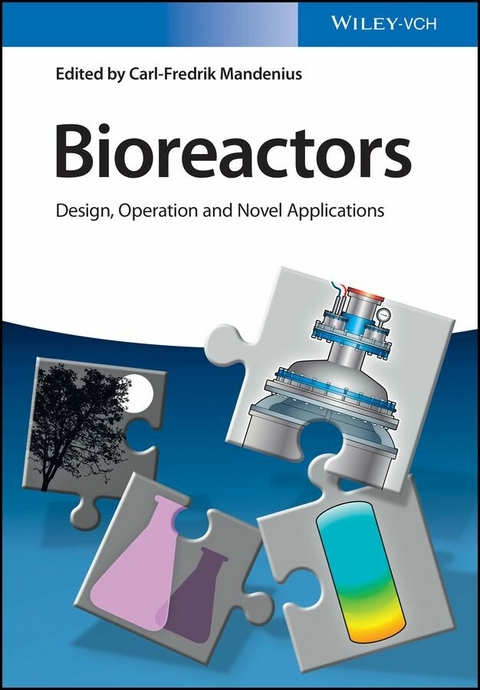
Combining theory and practice, the authors explain such leading-edge technologies as single-use bioreactors, bioreactor simulators, and soft sensor monitoring, and discuss novel applications, such as stem cell production, process development, and multi-product reactors, using case studies from academia as well as from industry. A final section addresses the latest trends, including culture media design and systems biotechnology, which are expected to have an increasing impact on bioreactor design.
With its focus on cutting-edge technologies and discussions of future developments, this handbook will remain an invaluable reference for many years to come.
Carl-Fredrik Mandenius is professor of Engineering Biology at Linkoping University (Sweden) since 1999 and head of the Division of Biotechnology. He holds a master and PhD degree in Engineering from Lund University. His main research interests are bioprocess engineering, biosensor technology and biotechnology design.
Carl-Fredrik Mandenius is professor of Engineering Biology at Linköping University (Sweden) since 1999 and head of the Division of Biotechnology. He holds a master and PhD degree in Engineering from Lund University. His main research interests are bioprocess engineering, biosensor technology and biotechnology design.
New bioreactor design challenges: An Overview
Bioreactors for expansion of induced pluripotent stem cells and their differentiation to cardiac cells
Scale up of stem cell manufacture for cell therapy needs
Culturing entrapped hESC in continuous stirred reactors
Artificial liver bioreactor design
Design of microbioreactor system for process development, Multivariate modeling for bioreactor monitoring and control
Rational integration of bioreactors with primary recovery
Virtual operator training simulators for bioreactors
Soft sensor monitoring and control of bioreactors
Coping with physiological stress in recombinant protein production by bioreactor design
The design bottlenecks with single use bioreactors
The Bioreactor-on a-Chip
Multibioreactors and Design-of-Experiments
Culture media design
Systems biotechnology
Chapter 1
Challenges for Bioreactor Design and Operation
Carl-Fredrik Mandenius
1.1 Introduction
As per definition, the bioreactor is the designed space where biological reactions take place. Hence, the bioreactor is essentially an engineering achievement and its design a challenge for bioengineers.
The bioreactor should create a biosphere that as profoundly and adequately as possible provides the ideal environment for the biological reaction.
The path for reaching, attaining, and maintaining this is the main task for bioreactor engineers to find. That task decomposes into several endeavors necessary to accomplish. One is to design the physical entity of the bioreactor itself – by that, ensuring favorable physical conditions for transport of gases and liquids and solids over time. Another is to ensure that the physical entity of the bioreactor is favorably adapted to the biological system that performs the bioreactions. Yet another is to ensure that the dynamic biophysical and biochemical events taking place are operable in an industrial environment.
In some of these design perspectives, bioreactor design is addressed at a process development stage where the performance of operations is independent of scale or biological system inside the bioreactor. Others address specific biological systems and the particular requirements of these. Others take the viewpoint at the holistic level: how to integrate the bioreactor and its design into an entire bioprocess with the constraints that this creates. Others concern provision of methodologies for observing the bioreactor at R&D as well as at operation stages in order to monitor and control and to optimize its performance from a variety of needs and purposes. Others provide better methods for supporting plant engineers and technicians to manage to operate the bioreactor processes under unpredictable industrial conditions where unexpected events, faults, and mishaps must be interpreted in short time and acted upon.
Importantly, all these aspects on design and operation may, and even must, be amalgamated into coherent design methodologies that are conceivable and practically achievable. It is the ambition of this book to provide a collection of design options where engineering principles and design tools are presented that facilitate to develop and apply good solutions to emerging needs in bioreactor design.
1.2 Biotechnology Milestones with Implications on Bioreactor Design
The bioreactor is a historical apparatus known since ancient times. Old antique cultures were able to solve bioengineering design challenges for practical purposes such as wine and beer making from mere experience and observations. This paved the way for the evolvement of biotechnological processes, primarily for preparation and production of food products [1].
The notion that microscopic life is a huge industrial resource came gradually to man and with some resistance from the established scientific society itself. An array of fundamental scientific steps paved the way for the unfolding of industrial biotechnology. Growing understanding of the mechanisms of diseases and its interplay with cell biology supported the development.
In the early nineteenth century, scientists such as Lorenz Oken (1779–1851), Theodor Schwann (1810–1882), and others did stepwise begin to fathom the fundamental principles of the cell's behavior in the body and in culture [2]. Louis Pasteur (1822–1895) took these observations and conclusions further into a coherent description of the fermentation mechanisms [3]. Later, researchers such as Emile Roux (1853–1933) and Robert Koch (1843–1910) realized the implications to bacteriology and for spread of diseases. These consorted ascents in cell biology and medicine did synergistically create the necessary background for the exploitation of the industrial potential of cells. By that, also important prerequisites for a furthering of bioreactor design were set.
The microbiology research brought better insights into the up-till-then-hidden processes of the cell and, hence, to the development of bioengineering and to the widespread industrial biotechnology applications during the twentieth century. It is in this framework of bioindustrial activity and progress the bioreactors and their design have been shaped. Still, it is noteworthy that 100 years ago an industrial bioreactor facility did not look too different from today's industrial sites (Figure 1.1).
Figure 1.1 (a) An old fermentation plant from the late nineteenth century. (b) A modern fermentation plant one century later. The gap in time between the plants reveals that some of the design features have undergone changes, while others are unchanged: the bioreactors are cylindrical vessels, the containment of the broth and concern about contamination were in former days less, piping are essential, many vessels are using the available plant space, and few plant operators are close to the process.
In the early twentieth century, large-scale fermentation processes were set up with impact onto the war-time industry of that period. Glycerol production for use in the manufacture of explosives, using yeast for conversion from glucose, was established. Another contemporary example is the large-scale production of butanol and acetone by butyric acid bacteria, as developed by Chaim Weizmann, used first for explosives and then for rubber manufacture in the emerging car industry [4]. However, these bioprocesses were soon abandoned for petroleum-based products that had better process economy.
The story of the development of antibiotics is an impressive example of how microbiology and industrial biotechnology evolved over an extended period of time by consorted actions between academic research and industrial product development. The original discovery in 1929 by Alexander Fleming of the antibiotic effect of a Penicillium culture was in a series of steps for amplifying the yield and activity of cultures transferred into large-scale production [5]. And other renowned scientists such as Howard Florey, Ernest Chain, Norman Heatley, Marvin Johnson, and others in close collaboration with pharmaceutical companies managed to identify, stabilize, exploit, select strains, exploit genetics, mutational methods and, finally, establish large-scale bioproduction in bioreactors for meeting global medical needs for curing infections [6]. The latter did indeed challenge the engineering skills in understanding optimization in the design and operation of the bioreactor. It also gave ample examples of how knowledge and skills from one group of products could be transferred into others and, by that, pave way for other antibiotics such as cephalosporins, streptomycins, and aminoglycosides.
These endeavors and experiences contributed substantially to facilitate forthcoming bioprocess development of biotherapeutics. Undoubtedly, the concept of process intensification was driving the development although the term was not yet coined. The same was true for the transfer of the concept of continuous strain improvement of microbial strains and cell lines.
In parallel with the progress of developing antibiotics, other microbial primary and secondary products were realized. These included amino acids (e.g., glutamate and lysine) and organic acids (e.g., vitamins) used as food ingredients and commodity chemicals and reached considerable production volumes. Microbial polymers such as xanthan and polyhydroxyalkanoates are other examples of bioprocess unfolding during the mid-1950s [7].
Protein manufacture, especially industrial enzymes, became comparatively soon a part of the industrial biotechnology with large-scale production sites at a few specialized companies (e.g., Novo, Genencor, Tanabe). At these up-scaled processes, very important findings and experiences were reached concerning bioreactor design and operation. Although not yet exploiting gene transfer between species for these proteins, significant technology development for later use was accomplished [1].
Subsequently, the emerging industrial use of animal cells came about. Culturing at large scale, at lower cell densities than fungi and yeasts, and with much lower product titers posed a next challenge to bioreactor engineering [8].
With the ascents of Köhler and Milstein (1975) in expressing monoclonal antibodies in hybridoma cell culture and the ensuing setup of cell culture reactor systems for production, a new epoch came across which has impacted industrial biotechnology and bioengineering tremendously. It initiated a art of cultivation technology where conditions and procedures for the operation of a cell culture showed a number of constraints necessary to surpassed in order to make processing industrially feasible [10].
However, it was the genetic engineering and recombinant DNA technology that created a revolution in the field of industrial biotechnology with macromolecular products from cells, first in bacteria and yeast and subsequently in animal and human cells [11]. Industry was proactive and efficient in transforming science into business activity. In California, Cetus and Genentech were established in the early 1970s. In the years thereafter, Biogen, Amgen, Chiron, and Genzyme followed, all with successful biotherapeutic products in their pipelines – insulin, erythropoietin, interferons, growth hormones, blood coagulation factors, interleukins, and others reached the therapeutic market with relatively short development times, in spite of regulatory requirements and the multitude of novel production conditions...
| Erscheint lt. Verlag | 16.2.2016 |
|---|---|
| Sprache | englisch |
| Themenwelt | Naturwissenschaften ► Chemie |
| Technik | |
| Schlagworte | Artificial • biochemical engineering • Biochemische Verfahrenstechnik • Biopharmaceuticals & Pharmaceutical Biotechnology • Biopharmazeutika u. Pharmazeutische Biotechnologie • Bioreaktor • Biotechnologie • Biotechnologie i. d. Biowissenschaften • Biotechnologie i. d. Chemie • Biotechnology • Biowissenschaften • Cell • CFD • chemical engineering • Chemie • Chemische Verfahrenstechnik • Chemistry • Computational • continuous • Control • Culture • culturing • Design • Development • DOE • downstream • Dynamics • experiments • Fluid • Life Sciences • Liver • <p>bioreactor • media • Medicinal • micro • Modelling • Monitoring • Operation • Optimization • Process • Protein • Recombinant • Scalable • scale • screening</p> • Sensor • stem • therapy • up |
| ISBN-10 | 3-527-68338-0 / 3527683380 |
| ISBN-13 | 978-3-527-68338-3 / 9783527683383 |
| Informationen gemäß Produktsicherheitsverordnung (GPSR) | |
| Haben Sie eine Frage zum Produkt? |
 EPUB (Adobe DRM)
Kopierschutz: Adobe-DRM
Adobe-DRM ist ein Kopierschutz, der das eBook vor Mißbrauch schützen soll. Dabei wird das eBook bereits beim Download auf Ihre persönliche Adobe-ID autorisiert. Lesen können Sie das eBook dann nur auf den Geräten, welche ebenfalls auf Ihre Adobe-ID registriert sind.
Details zum Adobe-DRM
Dateiformat: EPUB (Electronic Publication)
EPUB ist ein offener Standard für eBooks und eignet sich besonders zur Darstellung von Belletristik und Sachbüchern. Der Fließtext wird dynamisch an die Display- und Schriftgröße angepasst. Auch für mobile Lesegeräte ist EPUB daher gut geeignet.
Systemvoraussetzungen:
PC/Mac: Mit einem PC oder Mac können Sie dieses eBook lesen. Sie benötigen eine
eReader: Dieses eBook kann mit (fast) allen eBook-Readern gelesen werden. Mit dem amazon-Kindle ist es aber nicht kompatibel.
Smartphone/Tablet: Egal ob Apple oder Android, dieses eBook können Sie lesen. Sie benötigen eine
Geräteliste und zusätzliche Hinweise
Buying eBooks from abroad
For tax law reasons we can sell eBooks just within Germany and Switzerland. Regrettably we cannot fulfill eBook-orders from other countries.
aus dem Bereich