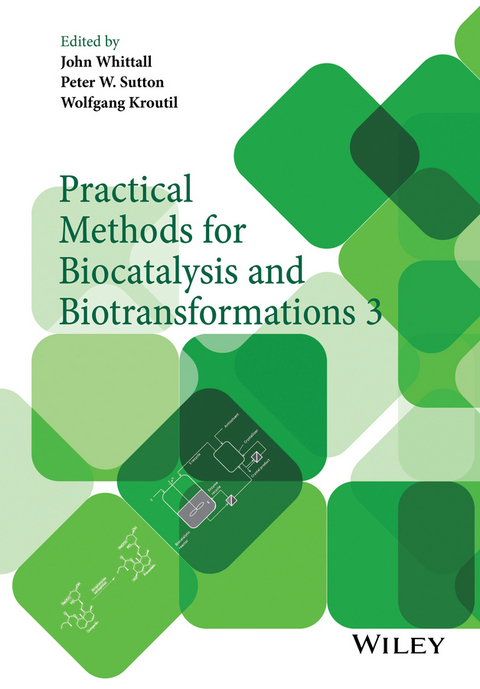
Practical Methods for Biocatalysis and Biotransformations 3 (eBook)
John Wiley & Sons (Verlag)
978-1-118-69629-3 (ISBN)
Biocatalysts are increasingly used by chemists engaged in fine chemical synthesis within both industry and academia. Today, there exists a huge choice of high-tech enzymes and whole cell biocatalysts, which add enormously to the repertoire of synthetic possibilities.
Practical Methods for Biocatalysis and Biotransformations 3 will be a companion book to Practical Methods for Biocatalysis and Biotransformations (2009) and Practical Methods for Biocatalysis and Biotransformations 2 (2012). Following the successful format of the two volumes, it will be a 'how-to' guide focusing on commercially available enzymes and strains of microorganisms that are readily obtained from culture collections. The source of starting materials and reagents, hints, tips and safety advice (where appropriate) will be given to ensure, as far as possible, that the procedures are reproducible. Comparisons to alternative methodology will be given and relevant references to the primary literature will be cited.
Contents include:
- Biotransformation Process Technology
- Industrial Biooxidation
- Hydrolase catalysed hydrolysis/synthesis
- Reduction
- Oxidation
- Halogenation
- Transferase catalysed glycosylation, methylation, etc
- C-C bond formation
- Tandem Biocatalytic Reactions
Practical Methods for Biocatalysis and Biotransformations, Volume 3 is an essential collection of validated biocatalytic methods which will find a place on the bookshelves of synthetic organic chemists, pharmaceutical chemists, and process R&D chemists in industry and academia.
Biocatalysts are increasingly used by chemists engaged in fine chemical synthesis within both industry and academia. Today, there exists a huge choice of high-tech enzymes and whole cell biocatalysts, which add enormously to the repertoire of synthetic possibilities. Practical Methods for Biocatalysis and Biotransformations 3 will be a companion book to Practical Methods for Biocatalysis and Biotransformations (2009) and Practical Methods for Biocatalysis and Biotransformations 2 (2012). Following the successful format of the two volumes, it will be a how-to guide focusing on commercially available enzymes and strains of microorganisms that are readily obtained from culture collections. The source of starting materials and reagents, hints, tips and safety advice (where appropriate) will be given to ensure, as far as possible, that the procedures are reproducible. Comparisons to alternative methodology will be given and relevant references to the primary literature will be cited. Contents include: Biotransformation Process Technology Industrial Biooxidation Hydrolase catalysed hydrolysis/synthesis Reduction Oxidation Halogenation Transferase catalysed glycosylation, methylation, etc C-C bond formation Tandem Biocatalytic Reactions Practical Methods for Biocatalysis and Biotransformations, Volume 3 is an essential collection of validated biocatalytic methods which will find a place on the bookshelves of synthetic organic chemists, pharmaceutical chemists, and process R&D chemists in industry and academia.
Dr John Whittall, Centre of Excellence for Biocatalysis, Biotransformations and Biocatalytic Manufacture (CoEBio3), Manchester Interdisciplinary Biocentre, University of Manchester, UK. Dr Peter W Sutton, Senior Scientist, GlaxoSmithKline Research and Development Limited, UK. Dr Wolfgang Kroutil, Department of Chemistry, Organic and Bioorganic Chemistry, University of Graz, Austria.
List of Contributors
Syed T. Ahmed School of Chemistry, Manchester Institute of Biotechnology, The University of Manchester, UK
Ian Archer Ingenza Ltd, Roslin BioCentre, UK
Frances H. Arnold Division of Chemistry and Chemical Engineering, California Institute of Technology, USA
Robert Ashe AM Technology, UK
Lara Babich Van't Hoff Institute for Molecular Sciences, University of Amsterdam, The Netherlands
Jan-E. Bäckvall Department of Organic Chemistry, Arrhenius Laboratory, Stockholm University, Sweden
Maria Bawn Prozomix Limited, UK
Beatrice Bechi School of Chemistry, Manchester Institute of Biotechnology, The University of Manchester, UK
Gary Black Northumbria University, Department of Applied Science, UK
Fabrizio Bonina Institute of Pharmaceutical Sciences, Albert Ludwigs University of Freiburg, Germany
Uwe T. Bornscheuer Institute of Biochemistry, Department of Biotechnology and Enzyme Catalysis, University of Greifswald, Germany
Elisabetta Brenna Department of Chemistry, Material and Chemical Engineering “G. Natta,” Polytechnic University of Milan, Italy
Aleksandra Bury Van't Hoff Institute for Molecular Sciences, University of Amsterdam, The Netherlands
Andrada But Biobased Commodity Chemistry, Wageningen University, The Netherlands
Simon Charnock Prozomix Limited, UK
Bi-Shuang Chen Department of Biotechnology, Delft University of Technology, The Netherlands
Yong-Jun Chen Department of Chemical and Biological Engineering, Zhejiang University, China
Pere Clapés Biotransformation and Bioactive Molecules Group, Institute of Advanced Chemistry of Catalonia (IQAC-CSIC), Spain
Thomas Classen Institute of Bioorganic Chemistry, Heinrich Heine University Düsseldorf, Germany
Marine Debacker Clermont University, Blaise Pascal University, ICCF, Clermont-Ferrand, France; CNRS, UMR 6296, France
Tom Desmet Centre for Industrial Biotechnology and Biocatalysis, Faculty of Bioscience Engineering, Ghent University, Belgium
Karel De Winter Centre for Industrial Biotechnology and Biocatalysis, Faculty of Bioscience Engineering, Ghent University, Belgium
Griet Dewitte Centre for Industrial Biotechnology and Biocatalysis, Faculty of Bioscience Engineering, Ghent University, Belgium
Alba Díaz-Rodríguez Department of Organic and Inorganic Chemistry, Asturias Institute of Biotechnology, University of Oviedo, Spain
Carola Dresen Institute of Pharmaceutical Sciences, Albert Ludwigs University of Freiburg, Germany
Richard Duncan Prozomix Limited, UK
Marc Dürrenberger Department of Inorganic Chemistry, University of Basel, Switzerland
Tadashi Ema Division of Chemistry and Biotechnology, Graduate School of Natural Science and Technology, Okayama University, Japan
Ulrike Engel Institute of Process Engineering in Life Sciences, Section II: Technical Biology, Karlsruhe Institute of Technology, Germany
Roman S. Esipov Shemyakin and Ovchinnikov Institute of Bioorganic Chemistry, Russian Academy of Sciences, Russia
Kurt Faber Department of Chemistry, Organic and Bioorganic Chemistry, University of Graz, Austria
Christopher C. Farwell Division of Chemistry and Chemical Engineering, California Institute of Technology, USA
James Finnigan Prozomix Limited, UK
Christine Fuchs Department of Chemistry, Organic and Bioorganic Chemistry, University of Graz, Austria
Michael Fuchs Department of Chemistry, Organic and Bioorganic Chemistry, University of Graz, Austria
Anna Fryszkowska Merck Research Laboratories, USA
Eduardo García-Junceda Department of Bioorganic Chemistry, Institute of General Organic Chemistry, Spain
Gilda Gasparini AM Technology, UK
Francesco G. Gatti Department of Chemistry, Material and Chemical Engineering “G. Natta,” Polytechnic University of Milan, Italy
Edzard M. Geertsema Department of Pharmaceutical Biology, Groningen Research Institute of Pharmacy, University of Groningen, The Netherlands
Laura Getrey DECHEMA Research Institute, Germany
Diego Ghislieri School of Chemistry, Manchester Institute of Biotechnology, The University of Manchester, UK
Silvia M. Glueck Austrian Centre of Industrial Biotechnology, Department of Chemistry, Organic and Bioorganic Chemistry, University of Graz, Austria
Michael Golden AstraZeneca, Chemical Development, UK
Animesh Goswami Chemical Development, Bristol-Myers Squibb, USA
Vicente Gotor Department of Organic and Inorganic Chemistry, Asturias Institute of Biotechnology, University of Oviedo, Spain
Vicente Gotor-Fernández Department of Organic and Inorganic Chemistry, Asturias Institute of Biotechnology, University of Oviedo, Spain
Johannes Gross Austrian Centre of Industrial Biotechnology, Department of Chemistry, Organic and Bioorganic Chemistry, University of Graz, Austria
Christine Guérard-Hélaine Clermont University, Blaise Pascal University, ICCF, Clermont-Ferrand, France; CNRS, UMR 6296, France
Zhiwei Guo Chemical Development, Bristol-Myers Squibb, USA
Karl P. J. Gustafson Department of Organic Chemistry, Arrhenius Laboratory, Stockholm University, Sweden
Helen C. Hailes Department of Chemistry, Christopher Ingold Laboratories, University College London, UK
Ulf Hanefeld Department of Biotechnology, Delft University of Technology, The Netherlands
Steven P. Hanlon F. Hoffmann-La Roche Ltd., Switzerland
Aloysius F. Hartog Van't Hoff Institute for Molecular Sciences, University of Amsterdam, The Netherlands
Bernhard Hauer Institute of Technical Biochemistry, University of Stuttgart, Germany
Rachel S. Heath School of Chemistry, Manchester Institute of Biotechnology, The University of Manchester, UK
Virgil Hélaine Clermont University, Blaise Pascal University, ICCF, Clermont-Ferrand, France; CNRS, UMR 6296, France
Susanne Herter Institute of Biochemistry, Department of Biotechnology and Enzyme Catalysis, University of Greifswald, Germany
Matthew R. Hickey Chemical Development, Bristol-Myers Squibb, USA
Michael Hofer Fraunhofer Institute for Interfacial Engineering and Biotechnology, Institute branch Straubing, BioCat – Bio-, Chemo- and Electrocatalysis, Germany
Frank Hollmann Department of Biotechnology, Delft University of Technology, The Netherlands
Dirk Holtmann DECHEMA Research Institute, Germany
Karen Holt-Tiffin Dr Reddy's Laboratories Ltd, Chirotech Technology Centre, UK
Roger M. Howard Pfizer Ltd, Chemical Research & Development, UK
Gjalt Huisman Codexis Inc, USA
Shahed Hussain School of Chemistry, Manchester Institute of Biotechnology, The University of Manchester, UK
Syed Masood Husain Institute of Pharmaceutical Sciences, Albert-Ludwigs-Universität Freiburg, Germany
Todd K. Hyster Department of Inorganic Chemistry, University of Basel, Switzerland; Department of Chemistry, Colorado State University, USA
Ed Jones C-Tech Innovation Ltd, UK
Predrag Jovanovic Department of Organic Chemistry, Faculty of Pharmacy, University of Belgrade, Serbia
Shusuke Kamata Division of Chemistry and Biotechnology, Graduate School of Natural Science and Technology, Okayama University, Japan
Elena Kasparyan Institute of Pharmaceutical Sciences, Albert Ludwigs University of Freiburg, Germany
Hans Kierkels DSM Innovative Synthesis BV, The Netherlands
Matthias Kittelmann NovartisPharma AG, Switzerland
Livia Knörr Department of Inorganic Chemistry, University of Basel, Switzerland
Valentin Köhler Department of Inorganic Chemistry, University of Basel, Switzerland
Pieter de Koning Dr Reddy's Laboratories Ltd, Chirotech Technology Centre, UK
Robert Kourist Junior Research Group for Microbial Biotechnology, Ruhr-University Bochum, Germany
Thomas Krieg DECHEMA Research Institute, Germany
Wolfgang Kroutil Department of Chemistry, Organic and Bioorganic Chemistry, University of Graz, Austria
Jim Lalonde Codexis Inc, USA
Eleanor D. Lamming Department of Chemistry, Christopher Ingold Laboratories, University College London, UK
Alexander Lang General Biochemistry, Dresden University of Technology, Germany
Iván Lavandera Department of Organic and Inorganic Chemistry, Asturias Institute of Biotechnology, University of Oviedo, Spain
Friedemann Leipold School of Chemistry, Manchester Institute of Biotechnology, The University of Manchester, UK
Marielle Lemaire Clermont University, Blaise Pascal University, ICCF, Clermont-Ferrand, France; CNRS, UMR 6296, France
Jerôme Le Nôtre Biobased Commodity Chemistry, Wageningen University, The Netherlands
Shu-Ming Li Institute of Pharmaceutical Biology and Biotechnology, Philipp University of Marburg, Germany
Zhi Li Department of...
| Erscheint lt. Verlag | 16.2.2016 |
|---|---|
| Sprache | englisch |
| Themenwelt | Naturwissenschaften ► Biologie ► Biochemie |
| Naturwissenschaften ► Chemie | |
| Technik ► Maschinenbau | |
| Technik ► Umwelttechnik / Biotechnologie | |
| Schlagworte | Biocatalysis • Biocatalysts • Biochemie • Biochemie u. Chemische Biologie • Biochemistry (Chemical Biology) • Biokatalyse • Biotransformation Process Technology • C-C Bond Formation • Chemical Synthesis • Chemie • Chemistry • Chemists • halogenation • high-tech enzymes • Hydrolase catalysed hydrolysis • hydrolase catalysed synthesis • Industrial Biooxidation • Methods - Synthesis & Techniques • methylation • microorganisms • Organische Chemie • Organische Chemie / Methoden, Synthesen, Verfahren • Oxidation • pharmaceutical chemists • Pharmaceutical science • reduction • Synthetic Organic Chemistry • Tandem Biocatalytic Reactions • Transferase catalysed glycosylation • Whole cell biocatalysts |
| ISBN-10 | 1-118-69629-8 / 1118696298 |
| ISBN-13 | 978-1-118-69629-3 / 9781118696293 |
| Informationen gemäß Produktsicherheitsverordnung (GPSR) | |
| Haben Sie eine Frage zum Produkt? |
 EPUB (Adobe DRM)
Kopierschutz: Adobe-DRM
Adobe-DRM ist ein Kopierschutz, der das eBook vor Mißbrauch schützen soll. Dabei wird das eBook bereits beim Download auf Ihre persönliche Adobe-ID autorisiert. Lesen können Sie das eBook dann nur auf den Geräten, welche ebenfalls auf Ihre Adobe-ID registriert sind.
Details zum Adobe-DRM
Dateiformat: EPUB (Electronic Publication)
EPUB ist ein offener Standard für eBooks und eignet sich besonders zur Darstellung von Belletristik und Sachbüchern. Der Fließtext wird dynamisch an die Display- und Schriftgröße angepasst. Auch für mobile Lesegeräte ist EPUB daher gut geeignet.
Systemvoraussetzungen:
PC/Mac: Mit einem PC oder Mac können Sie dieses eBook lesen. Sie benötigen eine
eReader: Dieses eBook kann mit (fast) allen eBook-Readern gelesen werden. Mit dem amazon-Kindle ist es aber nicht kompatibel.
Smartphone/Tablet: Egal ob Apple oder Android, dieses eBook können Sie lesen. Sie benötigen eine
Geräteliste und zusätzliche Hinweise
Buying eBooks from abroad
For tax law reasons we can sell eBooks just within Germany and Switzerland. Regrettably we cannot fulfill eBook-orders from other countries.
aus dem Bereich