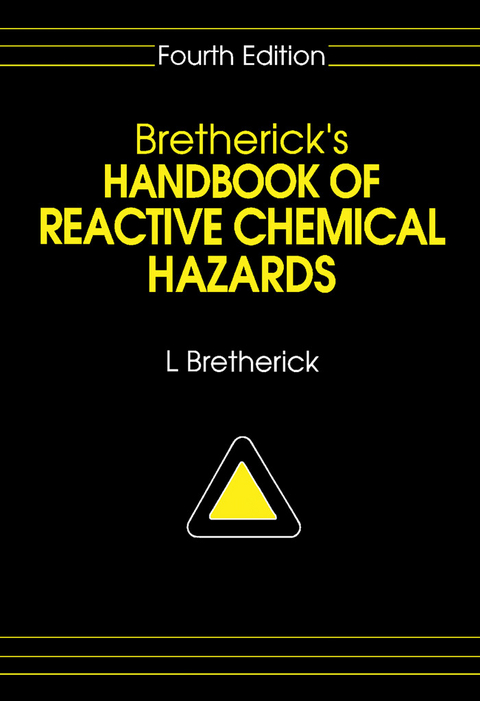
Bretherick's Handbook of Reactive Chemical Hazards (eBook)
2054 Seiten
Elsevier Science (Verlag)
978-1-4831-6250-8 (ISBN)
Bretherick's Handbook of Reactive Chemical Hazards, Fourth Edition, has been prepared and revised to give access to a wide and up-to-date selection of documented information to research students, practicing chemists, safety officers, and others concerned with the safe handling and use of reactive chemicals. This will allow ready assessment of the likely potential for reaction hazards which may be associated with an existing or proposed chemical compound or reaction system. A secondary, longer-term purpose is to present the information in a way which will, as far as possible, bring out the causes of, and interrelationships between, apparently disconnected facts and incidents. This handbook includes all information which had become available to the author by April 1989 on the reactivity hazards of individual elements or compounds, either alone or in combination. It begins with an introductory chapter that provides an overview of the complex subject of reactive chemical hazards, drawing attention to the underlying principles and to some practical aspects of minimizing such hazards. This is followed by two sections: Section 1 provides detailed information on the hazardous properties of individual chemicals, either alone or in combination with other compounds; the entries in Section 2 are of two distinct types. The first type of entry gives general information on the hazardous behavior of some recognizably discrete classes or groups of the 4,600 or so individual compounds for which details are given in Section 1. The second type of entry concerns reactive hazard topics, techniques, or incidents which have a common theme or pattern of behavior involving compounds of several different groups, so that no common structural feature exists for the compounds involved.
| Erscheint lt. Verlag | 27.10.2016 |
|---|---|
| Sprache | englisch |
| Themenwelt | Naturwissenschaften ► Chemie ► Technische Chemie |
| Technik ► Umwelttechnik / Biotechnologie | |
| ISBN-10 | 1-4831-6250-8 / 1483162508 |
| ISBN-13 | 978-1-4831-6250-8 / 9781483162508 |
| Informationen gemäß Produktsicherheitsverordnung (GPSR) | |
| Haben Sie eine Frage zum Produkt? |
 PDF (Adobe DRM)
Kopierschutz: Adobe-DRM
Adobe-DRM ist ein Kopierschutz, der das eBook vor Mißbrauch schützen soll. Dabei wird das eBook bereits beim Download auf Ihre persönliche Adobe-ID autorisiert. Lesen können Sie das eBook dann nur auf den Geräten, welche ebenfalls auf Ihre Adobe-ID registriert sind.
Details zum Adobe-DRM
Dateiformat: PDF (Portable Document Format)
Mit einem festen Seitenlayout eignet sich die PDF besonders für Fachbücher mit Spalten, Tabellen und Abbildungen. Eine PDF kann auf fast allen Geräten angezeigt werden, ist aber für kleine Displays (Smartphone, eReader) nur eingeschränkt geeignet.
Systemvoraussetzungen:
PC/Mac: Mit einem PC oder Mac können Sie dieses eBook lesen. Sie benötigen eine
eReader: Dieses eBook kann mit (fast) allen eBook-Readern gelesen werden. Mit dem amazon-Kindle ist es aber nicht kompatibel.
Smartphone/Tablet: Egal ob Apple oder Android, dieses eBook können Sie lesen. Sie benötigen eine
Geräteliste und zusätzliche Hinweise
Buying eBooks from abroad
For tax law reasons we can sell eBooks just within Germany and Switzerland. Regrettably we cannot fulfill eBook-orders from other countries.
aus dem Bereich