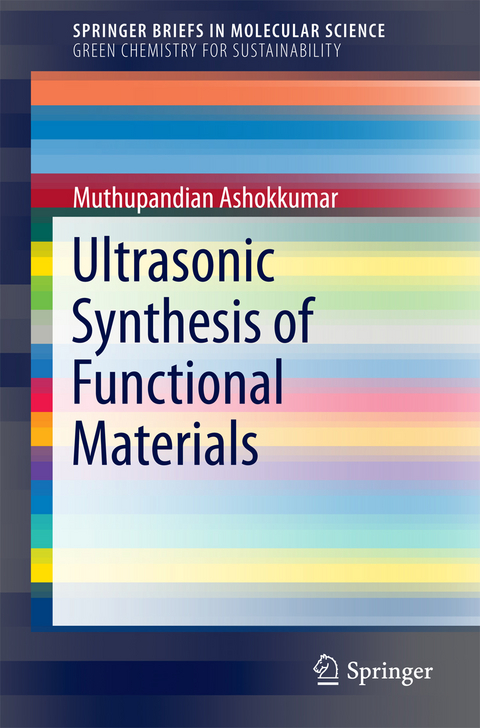
Ultrasonic Synthesis of Functional Materials (eBook)
IX, 42 Seiten
Springer International Publishing (Verlag)
978-3-319-28974-8 (ISBN)
This book begins by giving a summary of sonochemistry and explains how a chemical reaction can be induced by the interaction of sound waves and gas bubbles in liquids. The work outlines how primary and secondary radicals combined with the physical effects generated during acoustic cavitation are active in the ultrasonic synthesis of a variety of functional materials. The brief covers hot topics that include ultrasonic synthesis of various functional materials covering the following broad areas: acoustic cavitation and sonochemistry, synthesis of functional polymers and their applications, synthesis of functional inorganic materials and their applications, improving functionality of food/dairy systems, synthesis of functional biomaterials and their applications, synthesis of graphene based catalytic materials. Theory is kept to a minimum. The book is aimed at individuals at universities and will also interest those in industry. It is suitable for all levels.
Prof Muthupandian Ashokkumar obtained his Bachelor of Science (1982) and Master (1984) degrees from Madurai- Kamaraj University. In 1989 he obtained his PhD from University of Madras, India.
Ashokkumar is a Professor in the School of Chemistry, The University of Melbourne. Within the school, he is the Group Leader of the Sonochemistry Research Group.
The group has been exploring various industrial applications of ultrasound. In collaboration with Food Science Australia, they have also been investigating the use of ultrasound in food processing applications. The sonochemistry research group has also been exploring the use of ultrasound for synthesising targeted drug delivery agents. In addition, they use ultrasound to generate efficient catalytic materials for wastewater treatment using alternative energy resources such as solar energy.
Ashokkumar has received a number of awards including Grimwade Prize in Industrial Chemistry.
Ashokkumar is also a member of the University of Melbourne Energy Institute (MEI) Built Environment research group.
Prof Muthupandian Ashokkumar obtained his Bachelor of Science (1982) and Master (1984) degrees from Madurai- Kamaraj University. In 1989 he obtained his PhD from University of Madras, India. Ashokkumar is a Professor in the School of Chemistry, The University of Melbourne. Within the school, he is the Group Leader of the Sonochemistry Research Group. The group has been exploring various industrial applications of ultrasound. In collaboration with Food Science Australia, they have also been investigating the use of ultrasound in food processing applications. The sonochemistry research group has also been exploring the use of ultrasound for synthesising targeted drug delivery agents. In addition, they use ultrasound to generate efficient catalytic materials for wastewater treatment using alternative energy resources such as solar energy. Ashokkumar has received a number of awards including Grimwade Prize in Industrial Chemistry. Ashokkumar is also a member of the University of Melbourne Energy Institute (MEI) Built Environment research group.
Preface 6
Acknowledgments 7
Contents 8
1 Introduction 9
Abstract 9
1.1 Sound 10
1.2 Acoustic Cavitation 11
1.3 Physical and Chemical E?ects of Acoustic Cavitation 14
References 19
2 Ultrasonic Synthesis of Functional Materials 24
Abstract 24
2.1 Functional Inorganic Nanoparticles 24
2.2 Functional Organic Nanoparticles 32
2.3 Functional Microspheres 35
2.4 Functional Foods 40
References 43
3 Advantages, Disadvantages and Challenges of Ultrasonic Technology 48
Abstract 48
| Erscheint lt. Verlag | 11.1.2016 |
|---|---|
| Reihe/Serie | SpringerBriefs in Green Chemistry for Sustainability |
| SpringerBriefs in Green Chemistry for Sustainability | |
| SpringerBriefs in Molecular Science | SpringerBriefs in Molecular Science |
| Zusatzinfo | IX, 42 p. 21 illus. |
| Verlagsort | Cham |
| Sprache | englisch |
| Themenwelt | Naturwissenschaften ► Chemie |
| Technik ► Maschinenbau | |
| Wirtschaft | |
| Schlagworte | Biomaterials Ultrasound Techniques • Catalytic Materials Sonochemistry Applications • Graphene Based Materials Sonochemistry • Green Chemistry Sonochemistry • Green Synthesis • Non-hazardous Acoustic Radiation • Sonochemistry and Synthesis Chemistry • Ultrasonic Techniques Functionality of Foods • Ultrasound Techniques Synthesis Materials |
| ISBN-10 | 3-319-28974-8 / 3319289748 |
| ISBN-13 | 978-3-319-28974-8 / 9783319289748 |
| Informationen gemäß Produktsicherheitsverordnung (GPSR) | |
| Haben Sie eine Frage zum Produkt? |
 PDF (Wasserzeichen)
DRM: Digitales Wasserzeichen
Dieses eBook enthält ein digitales Wasserzeichen und ist damit für Sie personalisiert. Bei einer missbräuchlichen Weitergabe des eBooks an Dritte ist eine Rückverfolgung an die Quelle möglich.
Dateiformat: PDF (Portable Document Format)
Mit einem festen Seitenlayout eignet sich die PDF besonders für Fachbücher mit Spalten, Tabellen und Abbildungen. Eine PDF kann auf fast allen Geräten angezeigt werden, ist aber für kleine Displays (Smartphone, eReader) nur eingeschränkt geeignet.
Systemvoraussetzungen:
PC/Mac: Mit einem PC oder Mac können Sie dieses eBook lesen. Sie benötigen dafür einen PDF-Viewer - z.B. den Adobe Reader oder Adobe Digital Editions.
eReader: Dieses eBook kann mit (fast) allen eBook-Readern gelesen werden. Mit dem amazon-Kindle ist es aber nicht kompatibel.
Smartphone/Tablet: Egal ob Apple oder Android, dieses eBook können Sie lesen. Sie benötigen dafür einen PDF-Viewer - z.B. die kostenlose Adobe Digital Editions-App.
Buying eBooks from abroad
For tax law reasons we can sell eBooks just within Germany and Switzerland. Regrettably we cannot fulfill eBook-orders from other countries.
aus dem Bereich