


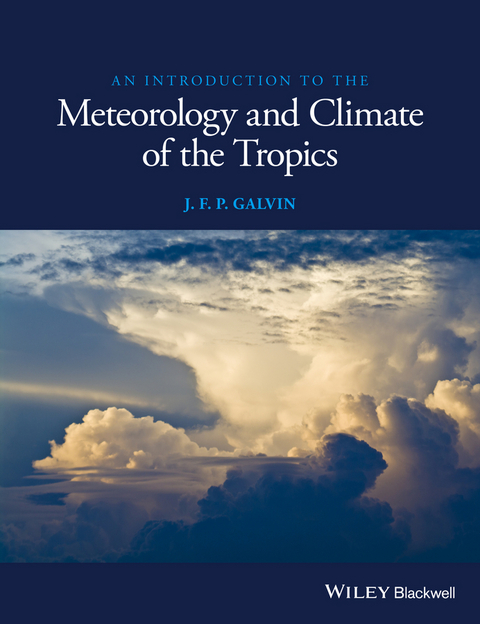
An Introduction to the Meteorology and Climate of the Tropics (eBook)
John Wiley & Sons (Verlag)
978-1-119-08623-9 (ISBN)
Jim Galvin has had a long interest in tropical meteorology. He is a Senior Operational Meteorologist in the Met Office World Area Forecast Centre in Exeter, UK and also produces the Shipping Forecast. In 2014, he became Editor of the RMetS journal Weather. He enjoys photography and singing in a choir.
What do we mean by the tropics? The weather and the climates it produces across the tropical zone are significantly different from those experienced by the people living in higher latitudes, so forecasters across Europe and much of North America are unfamiliar with its effects. In this book, Jim Galvin demystifies the topic in this zone that is increasingly of interest to those studying weather and climate. This book was written for weather forecasters, meteorology, environmental science and geography students as an introductory guide. It builds on the experience of the author, his professional experience in the World Area Forecast Centre at the Met Office, Exeter, using studies into the weather and climate seen within the tropical air mass conducted over many years. Its unique approach presents a practical approach to tropical weather studies, drawing on both academic and practical knowledge, covering air mass dynamics, seasonal changes, moist and dry weather, climate variability and human health in chapters and appendices that build up the overall picture, summarising our current state of knowledge. As an overview, it covers the broad range of effects connected with climate and weather in a straightforward way and is clearly illustrated throughout.
Jim Galvin has had a long interest in tropical meteorology. He is a Senior Operational Meteorologist in the Met Office World Area Forecast Centre in Exeter, UK and also produces the Shipping Forecast. In 2014, he became Editor of the RMetS journal Weather. He enjoys photography and singing in a choir.
1
Setting the Scene
1.1 Introduction
Much of what we know about the weather has been focused on mid-latitude weather systems, first because most early researchers came from rapidly developing western Europe and eastern North America, and second because of the risks and consequences of weather systems prevalent in these zones. However, although there are simple non-scientific descriptions of weather events from the tropics and tropical climates going back hundreds or thousands of years, it is only since the late 1960s that much scientific research has been carried out within the tropical zone, although observational networks were established in many populous areas as early as the 19th century. What we know of the weather (and, to some extent, the climate) of the tropics remains limited and has typically focused on severe weather events, such as tropical revolving storms (Emanuel 2005) or data from a limited range of observing stations. This is partly because upper-air networks, in particular, are thinly spread with weather balloons launched rarely more than once per day. Of necessity, desert regions have few observing stations. Weather observations are often the first ‘casualties’ of economic hardship (see Appendix 1).
However, many factors of the day-to-day weather are important in the tropics, not least for aviation and public safety. It is also important for holiday-makers to know what to expect. In recent years, tropical resorts have become readily available and popular for their warmth and sunshine, but travellers often know comparatively little about seasonal weather variation or the effects of exposure to sunshine in the tropics.
For instance, the primary purposes of forecasting for aircraft operations in the tropics are safety and the maximization of efficiency for the benefit of passengers and aircraft operators. The most accurate and appropriate forecasts will achieve this goal using a mixture of numerical weather prediction products, observed data and good forecasting knowledge. It is the effects of the weather, in other words its outcomes, which must be considered.
In order to maintain observational networks and co-ordinate the exchange of atmospheric and hydrological data and numerical forecasts, the World Meteorological Organization (WMO) – an agency of the United Nations (UN) – has established various programmes, not least the World Weather Watch (WMO 2013). This agency has more members worldwide than any other UN agency, emphasizing the importance of meteorology and hydrology. The research carried out as part of the World Climate Research Programme since the early 1970s is very important in allowing us to understand many of the processes and associated weather of the tropical zone (Gates & Newson 2006). Knowledge continues to grow through more recent research programmes, such as Tropical Ocean Global Atmosphere (TOGA), which investigates the important links between the tropical ocean and the global atmosphere (Fleming 1986). It is clear that the tropics have an important effect on weather systems throughout the globe, providing much of their energy.
1.2 What do we mean by ‘the tropics’?
In order to examine tropical weather and climate we need to define what we mean by ‘the tropics’. Although most of us have some concept involving warmth, the definition is not straightforward and it is possible even for meteorologists and climatologists to have different views of what constitutes the tropical zone.
The most commonly used definition of the tropics is the zone within which the sun is directly overhead at some time during the year: the zone between the Tropics of Cancer and Capricorn (23.45°N and 23.45°S, respectively). However, a weather-related definition, rather than the elevation of the sun at midday, is probably more useful to the weather forecaster.
1.2.1 Climatological methods
The range of temperature is often large over land in the tropics. This is because the high sun brings high daytime temperatures, but the loss of temperature by long-wave radiation overnight is also large, the rate of loss of radiation increasing exponentially with absolute temperature (Stefan’s law). Because condensation and a high water-vapour content reduce the loss of temperature, its range is also governed by humidity, so the mean daily temperature range is greatest across the deserts (15°C) and lower in the humid zone, in particular close to the oceans. However, even in humid coastal areas and on mountains the range is rarely less than 5°C. Temperature varies little over the ocean surface, where most solar radiation is absorbed rather than re-radiated, although daily variation is larger in many (but not all) parts of the tropics than it is at higher latitudes.
We could define our ‘tropical’ zone as, say, the region within which the mean temperature is above some nominal value, say, 20°C, throughout the year. However, this has the disadvantage of excluding even relatively modest high ground and, for part of the year, continental areas that are relatively close to the equator. Whilst this failing could be corrected by adjusting the nominal value to a specific level,1 this is not the most satisfactory method as it can include high mountain areas well north and south of zones normally considered as tropical.
Figure 1.1 demonstrates the difficulties of using mean temperature as the main method of definition of climatic zones. It is readily apparent that some of what most meteorologists or climatologists would call the tropics – albeit along the poleward extremes – is classified by Köppen as ‘temperate’ (zone C), largely due to altitude or the presence of cool air over the coasts of cool oceans. His scheme defines the tropics in two zones: A, wet climates and B, dry climates. However, this results in a narrowing of the tropical zone to within 25° of the equator in places and an expansion as far poleward as 50° (in the dry zone) elsewhere. One result of this classification scheme is to place northern parts of the monsoon zones in the temperate zone and the dry (often cold) deserts of central Asia in the tropics.
Figure 1.1 Climatic zones of the tropics: Af/Am, humid tropical; Aw, savanna; BS/BSh/BShw, tropical steppe; BWh, tropical and sub-tropical desert; Cf, warm temperate with no dry season; Cs, warm temperate with dry summer; Cw, warm temperate with dry winter; Cb, temperate climate with cool summer months; H, highlands; stippled, modification due to altitude (using the system devised by Wladimir Köppen (McKnight & Hess 2000)). The effect of high ground has a profound influence on climate in the tropics, particularly above about 2 km. The black lines indicate latitudes 30°N and 30°S.
A geographical method could be to use the limits to growth of a particular characteristic crop: bananas or fruiting pine trees might be considered ideal crops in this respect. This approach is useful in many ways, especially if adjustment is made for areas that are too dry to grow the crop, such as deserts. However, some parts of these dry lands are susceptible to frost (which would kill sensitive plants, such as banana bushes) and the cold of high mountains would also exclude their growth (rather than latitude constraints). However, both crops are grown in many sunny frost-free parts of the extra tropics, such as south-western coastal Cyprus, so perhaps an agricultural indicator has too many limitations?
A simple method is to divide the globe into fixed tropical and extra-tropical zones. This method is often employed for the verification of numerical forecasts (WMO 1982; Fuller 2004). One such form divides the globe into two equal-sized halves with somewhat arbitrary dividing lines at 30°N and 30°S (marked on Fig. 1.1). Conveniently, this latitude range includes the area within which near-surface winds are predominantly easterly and all of the climatic zones that can be regarded as tropical: humid, savanna, semi-desert and tropical desert. However, part of some of these climate zones, notably the tropical desert and semi-desert, frequently lies north or south of 30°, in the margin of the extra-tropical zone and some zones that do not have tropical characteristics extend equatorward of 30°N and 30°S. In addition, as we will see in Chapter 2, the area between these latitudes on average receives a surplus of incoming solar radiation (insolation) over that lost by long-wave radiation. This surplus is carried poleward into a more readily defined extra-tropical zone (Fig. 2.5).
The zones of predominantly westerly winds make incursions equatorward of these lines of latitude, particularly in winter. In order to keep within a zone of predominantly easterly winds at most levels, a narrower north–south zone must be used.
We might also define the tropical zone as the area within which there is more solar energy (short-wave radiation) received at the surface than that emitted from it (long-wave radiation). The energy balance is discussed in Chapter 2 and is an important aspect of our definition of the tropical zone. However, even this has its problems: whilst there is an excess of...
| Erscheint lt. Verlag | 22.1.2016 |
|---|---|
| Sprache | englisch |
| Themenwelt | Naturwissenschaften ► Geowissenschaften ► Meteorologie / Klimatologie |
| Technik | |
| Schlagworte | across • America • atmospheric sciences • Book • Climate • climates • Different • earth sciences • Effects • experienced • forecasters • galvin • Geographie • Geography • Geowissenschaften • Guide • Increasingly • Interest • Klimatologie • Klimatologie u. Meteorologie • Meteorologie • meteorology • North • People • physical geography • Physiogeographie • significantly • topic • Tropen • Tropical • tropics • unfamiliar • Weather • Zone |
| ISBN-10 | 1-119-08623-X / 111908623X |
| ISBN-13 | 978-1-119-08623-9 / 9781119086239 |
| Informationen gemäß Produktsicherheitsverordnung (GPSR) | |
| Haben Sie eine Frage zum Produkt? |
 EPUB (Adobe DRM)
Kopierschutz: Adobe-DRM
Adobe-DRM ist ein Kopierschutz, der das eBook vor Mißbrauch schützen soll. Dabei wird das eBook bereits beim Download auf Ihre persönliche Adobe-ID autorisiert. Lesen können Sie das eBook dann nur auf den Geräten, welche ebenfalls auf Ihre Adobe-ID registriert sind.
Details zum Adobe-DRM
Dateiformat: EPUB (Electronic Publication)
EPUB ist ein offener Standard für eBooks und eignet sich besonders zur Darstellung von Belletristik und Sachbüchern. Der Fließtext wird dynamisch an die Display- und Schriftgröße angepasst. Auch für mobile Lesegeräte ist EPUB daher gut geeignet.
Systemvoraussetzungen:
PC/Mac: Mit einem PC oder Mac können Sie dieses eBook lesen. Sie benötigen eine
eReader: Dieses eBook kann mit (fast) allen eBook-Readern gelesen werden. Mit dem amazon-Kindle ist es aber nicht kompatibel.
Smartphone/Tablet: Egal ob Apple oder Android, dieses eBook können Sie lesen. Sie benötigen eine
Geräteliste und zusätzliche Hinweise
Buying eBooks from abroad
For tax law reasons we can sell eBooks just within Germany and Switzerland. Regrettably we cannot fulfill eBook-orders from other countries.
aus dem Bereich


