Soil Water Measurement (eBook)
John Wiley & Sons (Verlag)
978-1-119-10602-9 (ISBN)
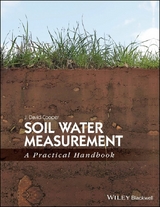
The theory and practice of the workings of the main instruments and methods available is described, along with practical tips on surmounting some of the main difficulties and explanations of many commonly encountered jargon words.
David Cooper graduated in Physics from Imperial College, London. He spent 23 years as a soil physicist with the UK Institute of Hydrology, later the Centre for Ecology & Hydrology (CEH), followed by 12 years as Head of the Hydrological Instruments Group at CEH. His work has focussed mainly on field measurement of soil water and solute fluxes and of soil hydraulic properties in a wide variety of lithologies and areas of the world, including at several sites in southern England, northern France, Kenya, Niger, Mauritius, India and China. He has contributed to advances in measurement of soil water content by neutron, capacitance and time domain reflectometry techniques, hydraulic properties measurement methods in situ in the field and soil water potential measurement using mercury manometer and pressure transducer tensiometers over extended periods at both shallow and deep depths, down to at least 60 metres. He has six children and, at the time of writing, nine grandchildren.
This book is written for all those involved in measurement of soil water phenomena, whether they be environmental scientists, field technicians, agronomists, meteorologists, hydrogeologists, foresters, physical geographers, civil or water engineers or students in these subjects. It contains a comprehensive description of all the major methods used for measurement of soil water content and potential, solute concentration, transport and balance of water and solutes, including recharge to groundwater aquifers. The emphasis is firmly on techniques which can be applied in the field or on samples obtained from the field. The theory and practice of the workings of the main instruments and methods available is described, along with practical tips on surmounting some of the main difficulties and explanations of many commonly encountered jargon words.
Author affiliation: DAVID COOPER graduated in Physics from Imperial College, London. He spent 23 years as a soil physicist with the UK Institute of Hydrology, later the Centre for Ecology & Hydrology (CEH), followed by 12 years as Head of the Hydrological Instruments Group at CEH. His work has focussed mainly on field measurement of soil water and solute fluxes and of soil hydraulic properties in a wide variety of lithologies and areas of the world, including at several sites in southern England, northern France, Kenya, Niger, Mauritius, India and China. He has contributed to advances in measurement of soil water content by neutron, capacitance and time domain reflectometry techniques, hydraulic properties measurement methods in situ in the field and soil water potential measurement using mercury manometer and pressure transducer tensiometers over extended periods at both shallow and deep depths, down to at least 60 m. He has six children and, at the time of writing, nine grandchildren.
Preface vi
Part I: Introduction 1
1 Soil Water in Context 3
2 How Does Water in Soil Interact with the Soil Matrix, Air, Roots, Gravity and Other Substances Present? 6
3 What Do We Need to Measure? 14
4 Spatial Variability 16
Part II: Water Content 21
5 Definitions 23
6 Gravimetric Method 26
7 Neutron Scattering 43
8 Dielectric METHODS 101
9 Dual-Probe Heat-Pulse Sensors 150
10 Electrical Resistivity Imaging 152
Part III: Water Potential 159
11 Water Potential Measurement 161
12 Tensiometers 164
13 Indirect Methods of Water Potential Measurement 203
14 Beyond .10 Metres Water Head 214
Part IV: Water Content - Potential Relations 223
15 Soil Water Characteristic Measurement 225
Part V: Hydraulic Conductivity 237
16 Hydraulic Conductivity Measurement and Prediction 239
17 Hydraulic Conductivity Measurement of Confined Soil Samples 241
18 Unconfined Measurements in the Field 257
Part VI: Solute Measurement 277
19 Principles and Pitfalls 279
20 Solution Sampling 283
21 Solute Concentra tion Estimation by Electrical Conductivity 292
Part VII: Water and Solute Movement 301
22 Water and Solute Transport Applications 303
23 Water and Solute Flux Measurement 306
24 Soil Water and Solute Balance Measurement and Estimation 312
Part VIII: Conclusion 333
25 Concluding Remarks 335
References 336
Index 353
1
Soil Water in Context
The interactions between water and soil are, arguably, the most fundamental relationships in the terrestrial environment. They control, in combination with other agents, such as the weather and plants, the fate of water after it falls as rain. This, in turn, determines aquifer recharge, river flow, water availability to crops and pasture for animals and the transport of nutrients and pollutants. These are critical in determining water resources, flooding, food production, the potability of water, ecology and public health. In view of these important roles, there has been and continues to be a great deal of scientific effort expended in understanding soil–water relationships. Nevertheless, many soil water specialists feel that the value of this work is not fully recognised and is underfunded by comparison with many other environmental topics. The reasons for this may include the fact that several aspects of the subject run counter to most people’s intuition, that work in the field is physically hard and frequently messy, that little spectacular equipment or results are involved and that the subject rarely offers good photo opportunities.
The applications of soil physics are principally in the fields of agriculture, environmental protection and water resources. Some of the more common uses are:
- Measuring or estimating the soil bearing capacity to support agricultural operations
- Characterising the soil water status at various stages of crop growth
- Estimating irrigation requirements
- Optimising the quantity and timing of fertiliser or pesticide applications
- Estimating the water consumption of crops and other land covers
- Estimating the recharge of water to aquifers
- Estimating the rate at which pollutants travel through the unsaturated zone to groundwater bodies or watercourses
- Forecasting and mitigating the hazards of floods
Serious study of the physics involved in the relations between water and soil started in the early 20th century in the United States, driven by the need to increase food production for a rapidly expanding population. Later, important centres of research developed in the Netherlands, Australia, Israel and the United Kingdom. The motivation was usually to increase agricultural yields, focussed either on irrigation in arid areas or land drainage in humid and low-lying ones. From the 1970s, environmental concerns have accounted for an increasing proportion of the research effort, focussing on flood generation, pollution of rivers and aquifers from both natural and artificial sources, water resources assessment and effects on biodiversity. This has taken the subject into the area between what would normally be regarded as ‘soil’ and the zone of saturated rock, which is the province of hydrogeologists. This is often referred to as the vadose zone, particularly in America, although many hydrologists prefer to define the unsaturated zone as a composite of the soil and vadose zone. In this book, the term unsaturated zone will be used, recognising that there is, in reality, no neat subdivision between the soil, the underlying porous material of weathered or unweathered rock and, indeed, the saturated zone.
The amount of work on soil physics has produced a steady stream of books on the subject (e.g. Marshall et al., 1996; Warrick, 2002, 2003; Hillel, 2004; Jury & Horton, 2004; Lal & Shukla, 2004; Rose, 2004). Some of these are highly mathematical and theoretical, while others attempt to explain the principles in relatively simple language. Few of them contain much detail explaining how it is actually done. There are also several books dealing with measurement methods and principles. Pride of place should probably go to the encyclopaedic work of Dane and Topp (2002), one of a series of books on all aspects of soil measurement. Over some 300 pages, it explains the principles behind most methods of soil water measurement, as well as having sections on all manner of other physical measurements in the soil. In similar mode is Mullins and Smith’s (2001) book, focussed more specifically on soil water. While giving comprehensive coverage of the principles of measurement, both books tend to lack information on the practicalities of making measurements in frequently imperfect conditions. The book closest in spirit to the present one is that of Dirksen (1999). This book is intended to update and extend the contents of Dirksen (1999); to explain without descent into hand-waving argument, but using no more mathematics than necessary, the principles of operation of the most common instruments and methods of water measurement in the unsaturated zone and to give as much practical guidance as possible on using the methods in real-life situations. The emphasis is firmly on techniques for use in the field. Much useful research has been conducted on real and artificial soils in the laboratory, and the discovery of some principles of soil water behaviour would not have been possible without laboratory measurements. The author is not, for instance, aware of any convincing demonstration of the applicability of Darcy’s law to unsaturated field soils. However, in almost all cases, laboratory measurements are intended to mimic field conditions and be applicable to that situation. It is the contention of this book that, for all the difficulties caused by distance, the weather, mud, stones, communications, power supply, spatial variability, animals and vandalism, field measurements are the final arbiter of research and monitoring work on soil–water interactions.
The limitations imposed by the nature of soil and the difficulties just mentioned mean that the accuracy achievable in any measurement is usually at best modest and in some cases extremely poor by most standards. It may come as a shock to some that, when we can measure the distance to the moon to a few cm and the value of some fundamental constants to 1 part in 1012, we often do well to achieve a measurement accuracy of soil water content better than 5% by volume. It is, however, also true that astrophysicists are often happy to get within a few orders of magnitude of the ‘true’ figure, so soil physicists are, at least, somewhere in between. The modest level of accuracy achievable usually makes it unnecessary to take into account quantities like the variation of density of water with temperature and small variations of the acceleration due to gravity from one place to another. These will be assumed equal to 1000 kg m−3 and 9.8 m s−2, respectively, throughout this text. The reader should, however, be aware that there are circumstances when such imprecision is not warranted, although such instances in soil physics are extremely rare.
With large increases in computer power and its availability over the last few decades, numerical modelling of ever more complex environmental systems has achieved great prominence. Additionally, many of the methods described in the later chapters of this book would not be practical without the availability of cheap computer power, whether for measurement of soil hydraulic properties by inverse methods, for statistical evaluation of data collected, for controlling the recording and storage of field data automatically or for incorporation into instruments to perform the calculations which turn an electrical signal into a meaningful quantity. The Internet is making large databases of soil properties and much other environmental information available to researchers and decision makers worldwide. So whether derived from the modeller’s own or their colleagues’ observations, or from elsewhere, a wealth of data is easily available, although its quality may be difficult to assess.
This book is not, however, about modelling, except in so far as it can be used to help interpret experiments, but the use of soil water measurements as input to a variety of models in environmental science, management of water resources, agriculture and ecology cannot be ignored. Measurements are important for modelling of environmental systems in several ways:
- To provide a description of the properties of the various components of the system, such as soil water characteristics and hydraulic conductivity of the soil.
- To supply data to drive the model, for instance, rainfall and other meteorological information.
- To validate the model and evaluate how well it reproduces the observed behaviour of the system. The more aspects of the system that are successfully reproduced by a model, the more confidence can be placed in its ability to predict events, either in the future or at locations where monitoring is absent.
A prominent omission from the methods described later is that of remote sensing. I felt that not only am I not sufficiently qualified to deal with the subject adequately but also that the topic would need too much space in the present volume. There are, in any case, several good books on this rapidly developing subject that repetition here would be superfluous.
All fields of human endeavour tend to develop a language to refer to peculiar aspects of the field. This is often perceived (and sometimes intended) to exclude those outside the field from entering it. I have tried to avoid the use of this jargon, but where it would not be practical to do so, I have put the first use of such a term in italics and defined its meaning. In other cases, I have provided a definition of common jargon words in the hope that readers will be able to understand the works of others more easily.
1.1 What Is Soil...
| Erscheint lt. Verlag | 19.1.2016 |
|---|---|
| Sprache | englisch |
| Themenwelt | Naturwissenschaften ► Geowissenschaften ► Geologie |
| Naturwissenschaften ► Geowissenschaften ► Hydrologie / Ozeanografie | |
| Technik | |
| Schlagworte | Bodenkunde • Bodenkunde, Geoarchäologie • Bodenkunde, Geoarchäologie • David Cooper • dielectrics • earth sciences • field soils • Geowissenschaften • Gravimetric Method • Heat dissipation • hydraulic conductivity • Hydrological Sciences • Hydrologie • in situ measurements • Neutron Probe • Soil Science & Geoarchaeology • Soil Water Measurement • solute content • unsaturated rocks • water potential • Zero Flux Plane Method |
| ISBN-10 | 1-119-10602-8 / 1119106028 |
| ISBN-13 | 978-1-119-10602-9 / 9781119106029 |
| Informationen gemäß Produktsicherheitsverordnung (GPSR) | |
| Haben Sie eine Frage zum Produkt? |
 EPUB (Adobe DRM)
Kopierschutz: Adobe-DRM
Adobe-DRM ist ein Kopierschutz, der das eBook vor Mißbrauch schützen soll. Dabei wird das eBook bereits beim Download auf Ihre persönliche Adobe-ID autorisiert. Lesen können Sie das eBook dann nur auf den Geräten, welche ebenfalls auf Ihre Adobe-ID registriert sind.
Details zum Adobe-DRM
Dateiformat: EPUB (Electronic Publication)
EPUB ist ein offener Standard für eBooks und eignet sich besonders zur Darstellung von Belletristik und Sachbüchern. Der Fließtext wird dynamisch an die Display- und Schriftgröße angepasst. Auch für mobile Lesegeräte ist EPUB daher gut geeignet.
Systemvoraussetzungen:
PC/Mac: Mit einem PC oder Mac können Sie dieses eBook lesen. Sie benötigen eine
eReader: Dieses eBook kann mit (fast) allen eBook-Readern gelesen werden. Mit dem amazon-Kindle ist es aber nicht kompatibel.
Smartphone/Tablet: Egal ob Apple oder Android, dieses eBook können Sie lesen. Sie benötigen eine
Geräteliste und zusätzliche Hinweise
Buying eBooks from abroad
For tax law reasons we can sell eBooks just within Germany and Switzerland. Regrettably we cannot fulfill eBook-orders from other countries.
aus dem Bereich