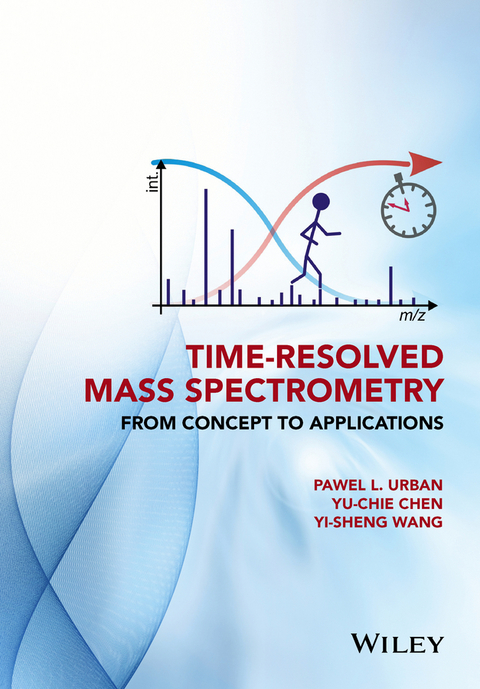
Time is an important factor in physical and natural sciences. It characterizes the progress of chemical and biochemical processes. Mass spectrometry provides the means to study molecular structures by detecting gas-phase ions with the unique mass-to-charge ratios. Time-resolved mass spectrometry (TRMS) allows one to differentiate between chemical states that can be observed sequentially at different time points. Real-time mass spectrometric monitoring enables recording data continuously with a specified temporal resolution. The TRMS approaches - introduced during the past few decades - have shown temporal resolutions ranging from hours down to microseconds and beyond.
This text covers the key aspects of TRMS. It introduces ion sources, mass analyzers, and interfaces utilized in time-resolved measurements; discusses the influence of data acquisition and treatment; finally, it reviews most prominent applications of TRMS - in the studies of reaction kinetics and mechanism, physicochemical phenomena, protein structure dynamics, biocatalysis, and metabolic profiling.
It will assist science and engineering students to gain a basic understanding of the TRMS concept, and to recognize its usefulness. In addition, it may benefit scientists who conduct molecular studies in the areas of chemistry, physics and biology.
Time is an important factor in physical and natural sciences. It characterizes the progress of chemical and biochemical processes. Mass spectrometry provides the means to study molecular structures by detecting gas-phase ions with the unique mass-to-charge ratios. Time-resolved mass spectrometry (TRMS) allows one to differentiate between chemical states that can be observed sequentially at different time points. Real-time mass spectrometric monitoring enables recording data continuously with a specified temporal resolution. The TRMS approaches introduced during the past few decades have shown temporal resolutions ranging from hours down to microseconds and beyond.This text covers the key aspects of TRMS. It introduces ion sources, mass analyzers, and interfaces utilized in time-resolved measurements; discusses the influence of data acquisition and treatment; finally, it reviews most prominent applications of TRMS in the studies of reaction kinetics and mechanism, physicochemical phenomena, protein structure dynamics, biocatalysis, and metabolic profiling.It will assist science and engineering students to gain a basic understanding of the TRMS concept, and to recognize its usefulness. In addition, it may benefit scientists who conduct molecular studies in the areas of chemistry, physics and biology.
Pawel Urban is an Assistant Professor in the Department of Applied Chemistry at National Chiao Tung University, Taiwan. He studied his MISMaP MSc, in biology at the University of Warsaw, Poland between 1999 & 2002. He then studied at the University of York UK, between 2004 & 2007 where he gained his PhD, in Chemistry. He began working as a postdoctoral Assistant in the Faculty of Biology, University of Warsaw, before moving to Swiss Federal Institute of Technology (ETH), Zurich and 2 years later to National Chiao Tung University, where in both institutes he?worked as a PDRA, before beginning his current role of Assistant Professor.
Yu-Chie Chen is a Professor of Chemistry in the Department of Applied Chemistry, National Chiao Tung University, Taiwan. She obtained her Bachelor degree at Kung University, Taiwan, her Masters at Sun Yat-sen, Taiwan and her P.h.D at Montana State University, USA. Before working at National Chiao Tung University, she held positions at Swiss Federal Institute of Technology Zurich, Tzu Chi Medical and Tzu Chi University.
Yi-Sheng Wang is an Associate Research Fellow at the Genomics Research Center, Academia Sinica, Taiwan. He acheived his Chemistry Ph.D. at the National Taiwan University, in 2001. Between 2001 & 2005, he began working as a?Postdoctoral Fellow, at the Institute of Atomic and Molecular Sciences (IAMS), Academia Sinica, (including a Postdoctoral Fellow at?National High Magnetic Field Laboratory (NHMFL), Florida State University, U.S.A. between 2002-2003). In 2005, he moved to the Genomics Research Center, Academia Sinica, Taiwan, as a Assistant Research?Fellow, until 2011, when he was promoted to?his current position of Associate Research Fellow.
List of Acronyms
| ABS | acrylonitrile butadiene styrene |
| ADP | adenosine diphosphate |
| AMS | aerosol mass spectrometry |
| APCI | atmospheric pressure chemical ionization |
| API | atmospheric pressure ionization |
| APPI | atmospheric pressure photoionization |
| ASAP | atmospheric solids analysis probe |
| ATP | adenosine triphosphate |
| BIRD | blackbody infrared radiative dissociation |
| CAD | computer-aided design |
| C-API | contactless atmospheric pressure ionization |
| CCS | collision cross-section |
| CE | capillary electrophoresis |
| CEC | capillary electrochromatography |
| CFA | continuous flow analysis |
| CGE | capillary gel electrophoresis |
| CID | collision-induced dissociation |
| cITP | capillary isotachophoresis |
| CSI | cold spray ionization |
| CTI | charge-transfer ionization |
| CZE | capillary zone electrophoresis |
| DAPCI | desorption atmospheric pressure chemical ionization |
| DART | direct analysis in real time |
| DBDI | dielectric barrier discharge ionization |
| DESI | desorption electrospray ionization |
| DHB | 2,5-dihydroxybenzoic acid |
| DIOS | desorption/ionization on silicon |
| DMF | digital microfluidics |
| EASI | easy ambient sonic-spray ionization |
| ECD | electron capture dissociation |
| EESI | extractive electrospray ionization |
| EIC | extracted-ion current |
| EKC | electrokinetic chromatography |
| ELDI | electrospray-assisted laser desorption/ionization |
| ELISA | electrostatic ion storage ring, Aarhus |
| ESI | electrospray ionization |
| ESSI | electrosonic spray ionization |
| ETD | electron transfer dissociation |
| EWOD | electrowetting-on-dielectric |
| FAB | fast atom bombardment |
| FAPA | flowing atmospheric-pressure afterglow |
| FIA | flow-injection analysis |
| FID | flame ionization detection |
| FPOP | fast photochemical oxidation of proteins |
| FWHM | full width at half maximum |
| HDX | hydrogen/deuterium exchange |
| HETP | height equivalent to a theoretical plate |
| HILIC | hydrophilic interaction chromatography |
| HPLC | high-performance liquid chromatography |
| ICAT | isotope-coded affinity tag |
| ICP | inductively coupled plasma |
| ICR | ion cyclotron resonance |
| IMAC | immobilized metal ion affinity chromatography |
| IMS | ion-mobility spectrometry |
| IRMPD | infrared multiphoton dissociation |
| LAESI | laser ablation electrospray ionization |
| LDI | laser desorption/ionization |
| LTP | low-temperature plasma |
| MALDI | matrix-assisted laser desorption/ionization |
| MAMS | micro-arrays for mass spectrometry |
| MEKC | micellar electrokinetic chromatography |
| MIMS | membrane inlet mass spectrometry |
| MPI | multiphoton ionization |
| MRM | multiple reaction monitoring |
| MudPIT | multidimensional protein identification technology |
| nanoDESI | nanospray desorption electrospray ionization |
| nanoESI | nanospray electrospray ionization |
| NBDPZ | 4-nitro-7-piperazino-2,1,3-benzoxadiazole |
| NIMS | nanostructure-initiator mass spectrometry |
| NMR | nuclear magnetic resonance |
| NP-LC | normal-phase liquid chromatography |
| PAT | process analytical technology |
| PDMS | polydimethylsiloxane |
| PESI | probe electrospray ionization |
| PET | polyethylene terephthalate |
| PFTBA | perfluorotri-n-butylamine |
| PICT | photoionization charge transfer |
| PI-ESI | polarization induced electrospray ionization |
| PMMA | poly(methyl methacrylate) |
| PTR | proton-transfer reaction |
| QMF | quadrupole mass filter |
| RP-LC | reversed-phase liquid chromatography |
| SALDI | surface-assisted laser desorption/ionization |
| SAT | spectrum acquisition time |
| SDS | sodium dodecyl sulfate |
| SEC | size-exclusion chromatography |
| SID | surface-induced dissociation |
| SIFT | selected ion flow tube |
| SILAC | stable isotope labeling by amino acids in cell culture |
| SIM | selected ion monitoring |
| SIMS | secondary ion mass spectrometry |
| SPE | solid-phase extraction |
| SPME | solid-phase microextraction |
| SPI | single photon ionization |
| SRM | selected reaction monitoring |
| Erscheint lt. Verlag |
19.1.2016
|
| Sprache |
englisch |
| Themenwelt
|
Naturwissenschaften ► Biologie ► Biochemie |
| Naturwissenschaften ► Chemie ► Analytische Chemie |
| Technik |
| Schlagworte |
Analytical Chemistry • Biochemie • biochemistry • Biomolecules (DNA, RNA, Peptides, etc.) • Biomolekül • Biomoleküle (DNA, RNA, Peptide) • Biomolekül • Biomoleküle (DNA, RNA, Peptide) • Biowissenschaften • Chemical Analysis • Chemie • Chemistry • Instrumentation • Life Sciences • Massenspektrometrie • Mass Spectrometry • molecular dynamics • Reaction kinetics • Real-time Monitoring • Temporal Resolution • Time-resolved measurements |
| ISBN-10 |
1-118-88735-2 / 1118887352 |
| ISBN-13 |
978-1-118-88735-6 / 9781118887356 |
 EPUB (Adobe DRM)
Kopierschutz: Adobe-DRM
Adobe-DRM ist ein Kopierschutz, der das eBook vor Mißbrauch schützen soll. Dabei wird das eBook bereits beim Download auf Ihre persönliche Adobe-ID autorisiert. Lesen können Sie das eBook dann nur auf den Geräten, welche ebenfalls auf Ihre Adobe-ID registriert sind.
Details zum Adobe-DRM
Dateiformat: EPUB (Electronic Publication)
EPUB ist ein offener Standard für eBooks und eignet sich besonders zur Darstellung von Belletristik und Sachbüchern. Der Fließtext wird dynamisch an die Display- und Schriftgröße angepasst. Auch für mobile Lesegeräte ist EPUB daher gut geeignet.
Systemvoraussetzungen:
PC/Mac: Mit einem PC oder Mac können Sie dieses eBook lesen. Sie benötigen eine Adobe-ID und die Software Adobe Digital Editions (kostenlos). Von der Benutzung der OverDrive Media Console raten wir Ihnen ab. Erfahrungsgemäß treten hier gehäuft Probleme mit dem Adobe DRM auf.
eReader: Dieses eBook kann mit (fast) allen eBook-Readern gelesen werden. Mit dem amazon-Kindle ist es aber nicht kompatibel.
Smartphone/Tablet: Egal ob Apple oder Android, dieses eBook können Sie lesen. Sie benötigen eine Adobe-ID sowie eine kostenlose App.
Geräteliste und zusätzliche Hinweise
Buying eBooks from abroad
For tax law reasons we can sell eBooks just within Germany and Switzerland. Regrettably we cannot fulfill eBook-orders from other countries.