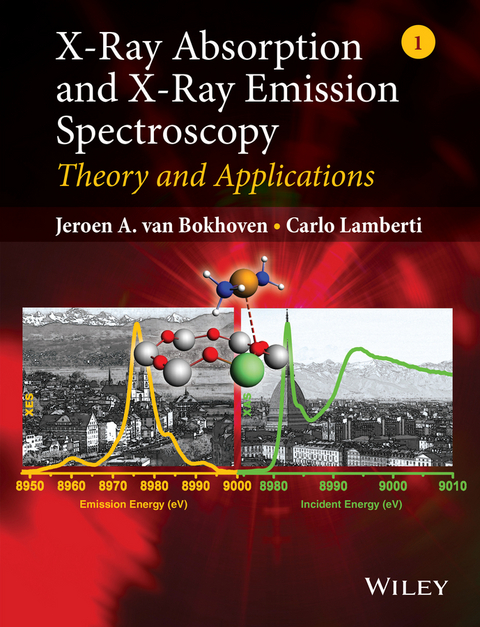
X-Ray Absorption and X-Ray Emission Spectroscopy (eBook)
896 Seiten
Wiley (Verlag)
978-1-118-84428-1 (ISBN)
During the last two decades, remarkable and often spectacular progress has been made in the methodological and instrumental aspects of x-ray absorption and emission spectroscopy. This progress includes considerable technological improvements in the design and production of detectors especially with the development and expansion of large-scale synchrotron reactors All this has resulted in improved analytical performance and new applications, as well as in the perspective of a dramatic enhancement in the potential of x-ray based analysis techniques for the near future. This comprehensive two-volume treatise features articles that explain the phenomena and describe examples of X-ray absorption and emission applications in several fields, including chemistry, biochemistry, catalysis, amorphous and liquid systems, synchrotron radiation, and surface phenomena. Contributors explain the underlying theory, how to set up X-ray absorption experiments, and how to analyze the details of the resulting spectra.
X-Ray Absorption and X-ray Emission Spectroscopy: Theory and Applications:
- Combines the theory, instrumentation and applications of x-ray absorption and emission spectroscopies which offer unique diagnostics to study almost any object in the Universe.
- Is the go-to reference book in the subject for all researchers across multi-disciplines since intense beams from modern sources have revolutionized x-ray science in recent years
- Is relevant to students, postdocurates and researchers working on x-rays and related synchrotron sources and applications in materials, physics, medicine, environment/geology, and biomedical materials
Jeroen van Bokhoven has been an Associate Professor of Heterogeneous Catalysis in the Department of Chemistry and Applied Biology at ETH since 2010. He completed a degree in chemistry at Utrecht University in 1995 and went on to obtain a PhD in inorganic chemistry and catalysis in 2000. From 1999 until 2002 he was head of the XAS (X-ray absorption spectroscopy) users - support group at Utrecht University. In 2006 he obtained an SNF assistant professorship in the Department of Chemistry and Applied Biology. He was the 2008 recipient of the Swiss Chemical Society Werner Prize. Van Bokhoven works in the field of heterogeneous catalysis and (X-ray) spectroscopy. His main interests are heterogeneous catalysts and developing advanced tools in X-ray spectroscopy to study the catalyst structure under catalytic relevant conditions. Carlo Lamberti achieved his degree in Physics in 1988 with a thesis in the field of many body Physics. From 1988 to 1993 he worked in the CSELT laboratories Torino, on the characterization of the interfaces of semiconductor heterostructures with high resolution XRD and X-ray absorption spectroscopies. He presented his PhD defense in solid state physics on this topic in Rome in 1993. He was appointed to the position of researcher in October 1998 at the Department of Inorganic, Physical and Materials Chemistry of the Torino University, and as Associate Professor in December 2006. In recent years he has become an expert in the techniques based on Synchrotron Radiation and Neutrons beams in the characterization of materials, performing more than 90 experiments approved by international committees on the following large scale facilities. He has authored and co-authored more than 200 research articles and five book chapters and two books. He is member of the PhD School in Material Science of the Torino University, and is the Italian coordinator of the MaMaSELF European Master in Materials Science.
CHAPTER 1
Introduction: Historical Perspective on XAS
Carlo Lamberti1,2 and Jeroen A. van Bokhoven3,4
1Department of Chemistry, University of Turin, Italy
2Southern Federal University, Rostov-on-Don, Russia
3Swiss Light Source, Paul Scherrer Institute, Switzerland
4Institute for Chemical and Bioengineering, ETH Zurich, Switzerland
1.1 Historical Overview of 100 Years of X-Ray Absorption: A Focus on the Pioneering 1913−1971 Period
The x-ray absorption spectroscopy (XAS) adventure started about one hundred years ago and has come a long way since. The technique remained a curiosity for much of this time, representing a minor branch of science, developed by only a few highly motivated and enthusiastic scientists. without any apparent possibility of practical application and without a solid and comprehensive theory able to describe and predict the experimental observations done, on gases, liquids and solid (crystalline and amorphous) systems. In 1971, Sayers, Stern and Lytle made ground-breaking progress when they applied Fourier analysis to the point-scattering theory of x-ray absorption fine structure, so as to formally invert the experimental data (primarily collected in the photoelectron wave-vector space) into a radial distribution function. For the first time, they were able to quantitatively determine structural parameters, such as the bond distance, coordination number, as well as the thermal and disorder parameters [1]. In the 44 years following that key publication, the field developed exponentially. Nowadays it is impossible to imagine frontier research in materials science, solid state physics and chemistry, catalysis, chemistry, biology, medicine, earth science, environmental science, cultural heritage, nanoscience, etc. without the contribution of XAS and related techniques. In this introductory chapter we provide a brief sketch of the main events that have established XAS and related techniques as leading scientific characterization tools.
After the discovery of x-rays in 1895 by Röntgen [2, 3], it took a while before the first x-ray absorption spectrum was observed by de Broglie in 1913 [4]. De Broglie mounted a single crystal on the cylinder of a recording barometer, using a clockwork mechanism to rotate the crystal around its vertical axis at a constant angular speed. As the crystal rotated, the x-rays scattered at all angles between the incident beam and the diffraction planes hence, according to the Bragg law (2dhkl sin θ = λ = hc/E, with c being the speed of light, c = 2.9979 10+8 m/s, and h being the Planck constant, h = 6.626 × 10⁻³⁴ J s [5], so that hc = 12.3984 Å keV) [6–8], changing the x-ray energy E. X-rays of varying intensities were recorded on a photographic plate. Two distinct discontinuities were observed on the film, which were found to be independent of the setting of the x-ray tube. These proved to be the K-edge absorption spectra of silver and bromine atoms contained in the photographic emulsion. As the spectrographic dispersion was poor at these short wavelengths, the spectra were of low energy resolution and the fine structure was not resolved. Successive work by de Broglie in this field proved remarkable [9, 10]. A posteriori, it is curious to note that de Broglie's famous intuition concerning the association of a wavelength (λ) to any massive particle with momentum (p): λ = h/p [11], is actually the key to understanding the phenomenon related to the fine structure of the x-ray absorption spectra.
In 1913, Moseley published his empirical law describing the frequencies (energies, E = hν) of certain characteristic x-rays emitted from pure elements, named Kα and Lα lines according to the successive Siegbahn notation. Emission energies were found to be approximately proportional to the square of the element atomic number Z [12]. This finding supported Bohr's model of the atom [13–15] in which the atomic number corresponds to the positive charge of the nucleus of the atom measured in |e| units: |e| =1.602 10−19 C. Almost 50 years after Mendeleev's milestone work, Moseley's findings suggested that the atomic weight A was not a deciding player in the periodicity of physical and chemical properties of the elements within the periodic table. In contrast, the properties of the elements varied periodically with the atomic number Z. This x-ray emission study is historically important because it quantitatively justifies the nuclear model of the atom, where the atom's positive charge is located in the nucleus and associated on an integer basis with the atomic number. Until Moseley's work, the term “atomic number” was merely a label to identify the place of each element in the periodic table, and it was not known to be associated with any measurable physical quantity.
In 1916, in Lund in Sweden, Siegbahn and Stenström [16–18] developed the first vacuum x-ray spectrometer [19, 20] (Figure 1.1(a)), thereby taking a fundamental technological step in the progress of x-ray spectroscopy. With this kind of innovative technology, the fine structure beyond the absorption edges of selected atoms was – for the first time – experimentally observed by Fricke in 1920 [21] and by Hertz in 1921 [22]. Fricke detected the K-edges for the elements from magnesium (Z = 12, E0 = 1.3 keV) up to chromium (Z = 24, E0 = 6.0 keV) [21], whereas Hertz canvassed the L-edges of cesium (Z = 55, E0 = 5.0 keV) up to neodymium (Z = 60, E0 = 6.2 keV) [22]. In the period before World War II, other authors reported analogous behavior on several different absorption edges [20, 23–37].
Figure 1.1 (a) Scheme of the vapor cell and x-ray spectrometer used by Hanawalt [20] to measure the fine structures in K-edge x-ray absorption spectra of molecules in the vapor phase. The cell was composed of: two furnaces (B and A), the former to host the solid phase and control the vapor pressure via the temperature, the latter to prevent re-condensation of the evaporated phase; a long quartz tube hosting the vapor phase (V) equipped at the end with two concave windows (W) as thin as 3 μm so as to maintain a vacuum and remain sufficiently transparent to x-rays. The spectrometer consists of: an x-ray tube of the Siegbahn type (X); slits used to collimate the incoming x-rays (S); a calcite (CaCO3) crystal used as a monochromator (C); a quartz tube fluxed with H2 (H) and equipped with biological x-ray transparent membranes (G) acting as windows; and a photographic plate used as a detector (P). This spectrometer was able to cover the 4.9−12.4 keV spectral region, corresponding to 2.5 Å > λ > 1.0 Å and represents the historical prototype of a dispersive spectrometer (see [38], Chapter 8 in this volume). Depending on the absorbing gas, the length of time ranging from 4 to 30 h is needed to impress the photographic plate as shown in (b), where the energy increases from top to bottom. The absorption edge and the successive modulations are clearly visible in (b). The photographic images were then converted into absorption-energy plots such as those reported in (c) and (d) for AsCl3 (as K-edge at 11.8 keV) and Zn (K-edge at 9.6 keV), respectively. Because only I1 is measured in the set-up, the spectra appear inverted. The first resonance after the edge, representing a maximum in the absorption, was called the white line while the successive minimum in the absorption spectrum was called the black line. The former term is retained in the current terminology, whereas the latter has been lost. Adapted from Hanawalt, 1931, [20], with permission American Physical Society.
Hanawalt made remarkable observations in 1931 [20], observing that the chemical and physical state of the sample affects the fine structure of the corresponding XAS spectra. Using the experimental set-up reported in Figure 1.1(a), consisting of a quartz cell allowing the XAFS spectra of different molecules sublimated in the vapor phase to be acquired, and collecting XAFS spectra on a photographic plate (Figure 1.1(b)), he was able to make two empirical observations of fundamental importance. First, he proved that substances sublimating in the molecular form, such as arsenic (4Assolid → (As4)gas) and AsCl3 (Figure 1.1(c)), are characterized by XAFS spectra exhibiting different fine structures above the edge when measured in the solid or in the vapor phase. Second, he observed that the monatomic vapors of zinc (Figure 1.1(d)), mercury, xenon and krypton elements exhibit no secondary structure. These incredibly advanced experiments already at this stage captured the main messages of EXAFS spectroscopy, but it took several years for the correct interpretation and decades before quantitative data could be extracted and the full potential of EXAFS exploited [1].
The first theoretical attempt to explain the fine structure in the XAS spectra was proposed in 1931 and 1932 by Kronig [39, 40], who developed a model based on the presence of long-range order in the probed system. The Kronig long-range order theory can be summarized in the following equation:
where Wn are the energy positions corresponding to the...
| Erscheint lt. Verlag | 14.1.2016 |
|---|---|
| Sprache | englisch |
| Themenwelt | Naturwissenschaften ► Chemie ► Analytische Chemie |
| Naturwissenschaften ► Physik / Astronomie ► Atom- / Kern- / Molekularphysik | |
| Naturwissenschaften ► Physik / Astronomie ► Hochenergiephysik / Teilchenphysik | |
| Technik | |
| Schlagworte | Analytical Chemistry • Analytische Chemie • Biowissenschaften • Chemie • Chemistry • Life Sciences • materials characterization • Materials Science • Materialwissenschaften • Röntgenabsorptionsspektroskopie • Röntgenemissionsspektroskopie • Röntgenabsorptionsspektroskopie • Röntgenemissionsspektroskopie • Spektroskopie • structural biology • Strukturbiologie • Werkstoffprüfung • Werkstoffprüfung • XAS • X-ray absorption spectroscopy XES • X-ray emission spectroscopy Time resolved experiments Space resolved experiments Structure determination Synchrotron radiation and free electron laser Electronic structure Solid state physics Coordination chemistry and catalysis Environmental science XAS • X-ray emission spectroscopy Time resolved experiments Space resolved experiments Structure determination Synchrotron radiation Free electron lasers Electronic structure Solid state physics Coordination chemistry Catalysis Environmental science Pump and Probe experiments Semiconductors Nanomaterials Electrochemistry Nuclear Materials Coordination Chemistry Amorphous materials Structure of Liquids Surface Phenomena |
| ISBN-10 | 1-118-84428-9 / 1118844289 |
| ISBN-13 | 978-1-118-84428-1 / 9781118844281 |
| Informationen gemäß Produktsicherheitsverordnung (GPSR) | |
| Haben Sie eine Frage zum Produkt? |
 EPUB (Adobe DRM)
Kopierschutz: Adobe-DRM
Adobe-DRM ist ein Kopierschutz, der das eBook vor Mißbrauch schützen soll. Dabei wird das eBook bereits beim Download auf Ihre persönliche Adobe-ID autorisiert. Lesen können Sie das eBook dann nur auf den Geräten, welche ebenfalls auf Ihre Adobe-ID registriert sind.
Details zum Adobe-DRM
Dateiformat: EPUB (Electronic Publication)
EPUB ist ein offener Standard für eBooks und eignet sich besonders zur Darstellung von Belletristik und Sachbüchern. Der Fließtext wird dynamisch an die Display- und Schriftgröße angepasst. Auch für mobile Lesegeräte ist EPUB daher gut geeignet.
Systemvoraussetzungen:
PC/Mac: Mit einem PC oder Mac können Sie dieses eBook lesen. Sie benötigen eine
eReader: Dieses eBook kann mit (fast) allen eBook-Readern gelesen werden. Mit dem amazon-Kindle ist es aber nicht kompatibel.
Smartphone/Tablet: Egal ob Apple oder Android, dieses eBook können Sie lesen. Sie benötigen eine
Geräteliste und zusätzliche Hinweise
Buying eBooks from abroad
For tax law reasons we can sell eBooks just within Germany and Switzerland. Regrettably we cannot fulfill eBook-orders from other countries.
aus dem Bereich