


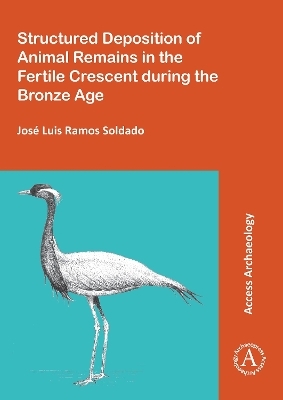
Structured Deposition of Animal Remains in the Fertile Crescent during the Bronze Age
Seiten
2016
Archaeopress Access Archaeology (Verlag)
978-1-78491-272-7 (ISBN)
Archaeopress Access Archaeology (Verlag)
978-1-78491-272-7 (ISBN)
The aim of this research is to draw up a literature review of the structured deposits of animal remains during the third and second millennia BC in the Ancient Near East for its subsequent classification and detailed interpretation.
Although most of the animal remains recorded throughout the archaeological excavations consist usually of large assemblages of discarded and fragmented bones, it is possible to yield articulated animal skeletons in some cases. Most of them have been usually picked up from sacred and/or funerary contexts, but not all of them might fit necessarily in ritual and symbolic interpretations, and not all of the structured deposit of animal remains may be explained due to anthropic factors. In addition, zooarchaeology has traditionally focused on animal domestication, husbandry and economy, and species identification above all, shutting out further discussion about these type of findings. Moreover, the limited condition of the data is also another issue to bear in mind. Thus, the aim of this study has been to draw up a literature review of the structured deposits of animal remains during the third and second millennia BC in the Ancient Near East for its subsequent classification and detailed interpretation. In this survey it has been attested that not only most of the articulated animal remains have been found in ritual and/or funerary contexts but also that all species recorded- but some exceptions-are domestic. Hence there is a broad religious attitude towards the main domesticated animals of human economy in the Ancient Near East, based on the closeness of these animals to the human sphere. Therefore, it seems that domesticated animals were powerful constituents in the cultural landscape of these regions, never simply resources.
Although most of the animal remains recorded throughout the archaeological excavations consist usually of large assemblages of discarded and fragmented bones, it is possible to yield articulated animal skeletons in some cases. Most of them have been usually picked up from sacred and/or funerary contexts, but not all of them might fit necessarily in ritual and symbolic interpretations, and not all of the structured deposit of animal remains may be explained due to anthropic factors. In addition, zooarchaeology has traditionally focused on animal domestication, husbandry and economy, and species identification above all, shutting out further discussion about these type of findings. Moreover, the limited condition of the data is also another issue to bear in mind. Thus, the aim of this study has been to draw up a literature review of the structured deposits of animal remains during the third and second millennia BC in the Ancient Near East for its subsequent classification and detailed interpretation. In this survey it has been attested that not only most of the articulated animal remains have been found in ritual and/or funerary contexts but also that all species recorded- but some exceptions-are domestic. Hence there is a broad religious attitude towards the main domesticated animals of human economy in the Ancient Near East, based on the closeness of these animals to the human sphere. Therefore, it seems that domesticated animals were powerful constituents in the cultural landscape of these regions, never simply resources.
1. Introduction; 2. Historical and archaeological context; 3. Structured deposition of animal remains in the Fertile Crescent during the III Millennium BC; 4. Structured deposition of animal remains in the Fertile Crescent during the II Millennium BC; 5. Discussion; 6. Conclusions; Bibliography; Appendix A. Number of articulated animal individuals recorded at each site classified by species, region and period; Appendix B. Identification of equid species classified by site and period
| Erscheinungsdatum | 28.09.2017 |
|---|---|
| Zusatzinfo | Illustrated throughout in colour and black & white |
| Sprache | englisch |
| Maße | 210 x 297 mm |
| Gewicht | 740 g |
| Themenwelt | Geisteswissenschaften ► Archäologie |
| Geschichte ► Allgemeine Geschichte ► Vor- und Frühgeschichte | |
| Naturwissenschaften ► Biologie ► Zoologie | |
| ISBN-10 | 1-78491-272-7 / 1784912727 |
| ISBN-13 | 978-1-78491-272-7 / 9781784912727 |
| Zustand | Neuware |
| Informationen gemäß Produktsicherheitsverordnung (GPSR) | |
| Haben Sie eine Frage zum Produkt? |
Mehr entdecken
aus dem Bereich


aus dem Bereich
auf den Spuren der frühen Zivilisationen
Buch | Hardcover (2023)
C.H.Beck (Verlag)
CHF 27,95
Erkennen. Bestimmen. Beschreiben
Buch | Softcover (2022)
Deutscher Kunstverlag
CHF 27,85


