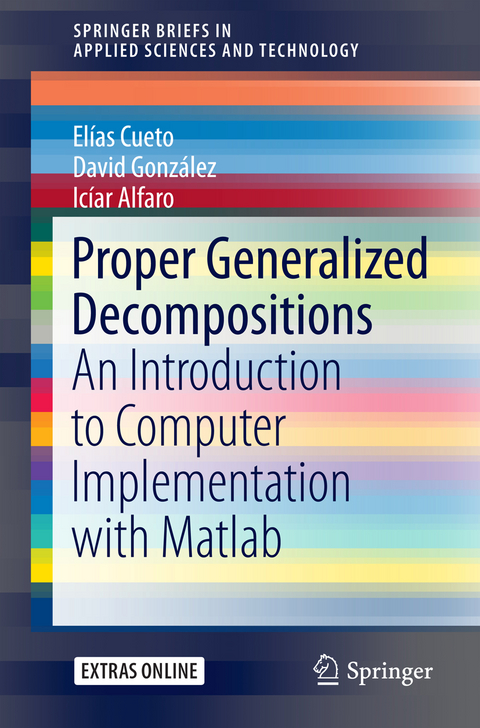
Proper Generalized Decompositions
Springer International Publishing (Verlag)
978-3-319-29993-8 (ISBN)
Proper Generalized Decomposition (PGD) is a method for numerical simulation in many fields of applied science and engineering. As a generalization of Proper Orthogonal Decomposition or Principal Component Analysis to an arbitrary number of dimensions, PGD is able to provide the analyst with very accurate solutions for problems defined in high dimensional spaces, parametric problems and even real-time simulation.
Introduction.- 2 To begin with: PGD for Poisson problems.- 2.1 Introduction.- 2.2 The Poisson problem.- 2.3 Matrix structure of the problem.- 2.4 Matlab code for the Poisson problem.- 3 Parametric problems.- 3.1 A particularly challenging problem: a moving load as a parameter.- 3.2 The problem under the PGD formalism.- 3.2.1 Computation of S(s) assuming R(x) is known.- 3.2.2 Computation of R(x) assuming S(s) is known.- 3.3 Matrix structure of the problem.- 3.4 Matlab code for the influence line problem.- 4 PGD for non-linear problems.- 4.1 Hyperelasticity.- 4.2 Matrix structure of the problem.- 4.2.1 Matrix form of the term T2.- 4.2.2 Matrix form of the term T4.- 4.2.3 Matrix form of the term T6.- 4.2.4 Matrix form for the term T8.- 4.2.5 Matrix form of the term T9.- 4.2.6 Matrix form of the term T10.- 4.2.7 Final comments.- 4.3 Matlab code.- 5 PGD for dynamical problems.- 5.1 Taking initial conditions as parameters.- 5.2 Developing the weak form of the problem.- 5.3 Matrix form of the problem.- 5.3.1 Time integration of the equations of motion.- 5.3.2 Computing a reduced-order basis for the field of initial conditions.- 5.3.3 Projection of the equations onto a reduced, parametric basis.- 5.4 Matlab code.- References.- Index.
"This book provides a brief introduction to Proper Generalized Decompositions (PGD), with strong emphasis on computational aspects. The book discusses the implementation of PGD for the Poisson problem, parameter-dependent problems, linear-elasticity, and dynamical problems. For every problem, matrix assembly is developed and Matlab routines are presented." (Dante Kalise, Mathematical Reviews, July, 2017)
“This book provides a brief introduction to Proper Generalized Decompositions (PGD), with strong emphasis on computational aspects. The book discusses the implementation of PGD for the Poisson problem, parameter-dependent problems, linear-elasticity, and dynamical problems. For every problem, matrix assembly is developed and Matlab routines are presented.” (Dante Kalise, Mathematical Reviews, July, 2017)
| Erscheinungsdatum | 08.10.2016 |
|---|---|
| Reihe/Serie | SpringerBriefs in Applied Sciences and Technology |
| Zusatzinfo | XII, 96 p. 20 illus., 1 illus. in color. |
| Verlagsort | Cham |
| Sprache | englisch |
| Maße | 155 x 235 mm |
| Themenwelt | Mathematik / Informatik ► Mathematik ► Analysis |
| Mathematik / Informatik ► Mathematik ► Angewandte Mathematik | |
| Mathematik / Informatik ► Mathematik ► Wahrscheinlichkeit / Kombinatorik | |
| Naturwissenschaften ► Physik / Astronomie | |
| Technik ► Maschinenbau | |
| Schlagworte | computational science and engineering • Continuum Mechanics and Mechanics of Materials • Engineering • MATLAB • Model order reduction • Numerical and Computational Physics • Proper Generalized Decomposition • Proper Orthogonal Decomposition • real-time simulation |
| ISBN-10 | 3-319-29993-X / 331929993X |
| ISBN-13 | 978-3-319-29993-8 / 9783319299938 |
| Zustand | Neuware |
| Informationen gemäß Produktsicherheitsverordnung (GPSR) | |
| Haben Sie eine Frage zum Produkt? |
aus dem Bereich