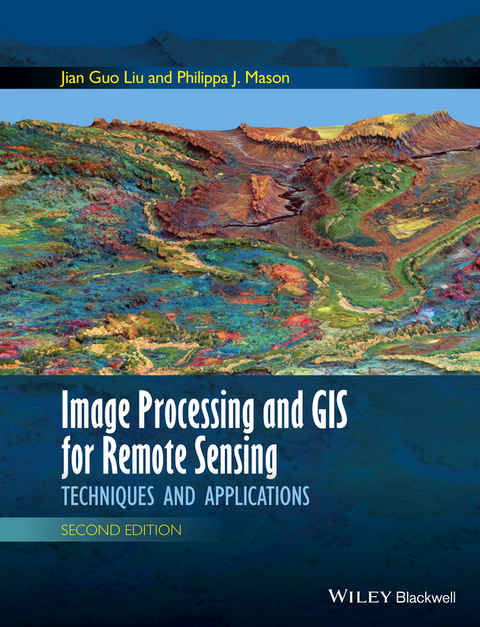
Image Processing and GIS for Remote Sensing (eBook)
John Wiley & Sons (Verlag)
978-1-118-72417-0 (ISBN)
Following the successful publication of the 1st edition in 2009, the 2nd edition maintains its aim to provide an application-driven package of essential techniques in image processing and GIS, together with case studies for demonstration and guidance in remote sensing applications. The book therefore has a '3 in 1' structure which pinpoints the intersection between these three individual disciplines and successfully draws them together in a balanced and comprehensive manner.
The book conveys in-depth knowledge of image processing and GIS techniques in an accessible and comprehensive manner, with clear explanations and conceptual illustrations used throughout to enhance student learning. The understanding of key concepts is always emphasised with minimal assumption of prior mathematical experience.
The book is heavily based on the authors' own research. Many of the author-designed image processing techniques are popular around the world. For instance, the SFIM technique has long been adopted by ASTRIUM for mass-production of their standard 'Pan-sharpen' imagery data. The new edition also includes a completely new chapter on subpixel technology and new case studies, based on their recent research.
Jian Guo Liu received a Ph.D. in 1991 in remote sensing and image processing from Imperial College London, UK and an M.Sc. in 1982 in remote sensing and geology from China University of Geosciences, Beijing, China. He is a Reader in remote sensing in the Department of Earth Science and Engineering, Imperial College London. His current research activities include: sub-pixel technology for image registration, DEM generation and change detection; image processing techniques for data fusion, filtering and InSAR; and GIS multi-data modelling for geohazard studies.
Philippa J Mason completed a BSc in Geology at Southampton University in 1987, an MSc in Remote Sensing at University College London in 1993 and a PhD in 1998 at Imperial College London. She is a lecturer in remote sensing & GIS at Imperial College London and a consultant in geological remote sensing and image interpretation. Her research interests include the application of geospatial sciences to geohazards, tectonic geomorphology, spectral geology and mineral exploration.
Following the successful publication of the 1st edition in 2009, the 2nd edition maintains its aim to provide an application-driven package of essential techniques in image processing and GIS, together with case studies for demonstration and guidance in remote sensing applications. The book therefore has a 3 in 1 structure which pinpoints the intersection between these three individual disciplines and successfully draws them together in a balanced and comprehensive manner. The book conveys in-depth knowledge of image processing and GIS techniques in an accessible and comprehensive manner, with clear explanations and conceptual illustrations used throughout to enhance student learning. The understanding of key concepts is always emphasised with minimal assumption of prior mathematical experience. The book is heavily based on the authors own research. Many of the author-designed image processing techniques are popular around the world. For instance, the SFIM technique has long been adopted by ASTRIUM for mass-production of their standard Pan-sharpen imagery data. The new edition also includes a completely new chapter on subpixel technology and new case studies, based on their recent research.
Jian Guo Liu received a Ph.D. in 1991 in remote sensing and image processing from Imperial College London, UK and an M.Sc. in 1982 in remote sensing and geology from China University of Geosciences, Beijing, China. He is a Reader in remote sensing in the Department of Earth Science and Engineering, Imperial College London. His current research activities include: sub-pixel technology for image registration, DEM generation and change detection; image processing techniques for data fusion, filtering and InSAR; and GIS multi-data modelling for geohazard studies. Philippa J Mason completed a BSc in Geology at Southampton University in 1987, an MSc in Remote Sensing at University College London in 1993 and a PhD in 1998 at Imperial College London. She is a lecturer in remote sensing & GIS at Imperial College London and a consultant in geological remote sensing and image interpretation. Her research interests include the application of geospatial sciences to geohazards, tectonic geomorphology, spectral geology and mineral exploration.
CHAPTER 1
Digital image and display
1.1 What is a digital image?
An image is a picture, photograph or any form of a two-dimensional (2D) representation of objects or a scene. The information in an image is presented in tones or colours. A digital image is a two-dimensional array of numbers. Each cell of a digital image is called a pixel, and the number representing the brightness of the pixel is called a digital number (DN) (Fig. 1.1). As a 2D array, a digital image is composed of data in lines and columns. The position of a pixel is allocated with the line and column of its DN. Such regularly arranged data, without x and y coordinates, are usually called raster data. As digital images are nothing more than data arrays, mathematical operations can be readily performed on the digital numbers of images. Mathematical operations on digital images are called digital image processing.
Digital image data can also have a third dimension: layers (Fig. 1.1). Layers are the images of the same scene but containing different information. In multi-spectral images, layers are the images of different spectral ranges called bands or channels. For instance, a colour picture taken by a digital camera is composed of three bands containing red, green and blue spectral information individually. The term band is more often used than layer to refer to multi-spectral images. Generally speaking, geometrically registered multi-dimensional data sets of the same scene can be considered as layers of an image. For example, we can digitise a geological map and then co-register the digital map with a Landsat TM image. Then the digital map becomes an extra layer of the scene beside the seven TM spectral bands. Similarly, if we have a dataset of digital elevation model (DEM) to which a SPOT image is rectified, then the DEM can be considered as a layer of the SPOT image beside its four spectral bands. In this sense, we can consider a set of co-registered digital images as a three-dimensional (3D) dataset and with the ‘third’ dimension providing the link between image processing and GIS.
Fig. 1.1 A digital image and its elements.
A digital image can be stored as a file in a computer data store on a variety of media, such as a hard disk, memory stick, CD, etc. It can be displayed in black and white or in colour on a computer monitor as well as in hard copy output such as film or print. It may also be output as a simple array of numbers for numerical analysis. As a digital image, its advantages include:
- The images do not change with environmental factors as hard copy pictures and photographs do;
- the images can be identically duplicated without any change or loss of information;
- the images can be mathematically processed to generate new images without altering the original images;
- the images can be electronically transmitted from or to remote locations without loss of information.
Remotely sensed images are acquired by sensor systems onboard aircraft or spacecraft, such as earth observation satellites. The sensor systems can be categorised into two major branches: passive sensors and active sensors. Multi-spectral optical imaging systems are passive sensors that use solar radiation as the principal source of illumination for imaging. Typical examples include across-track and push-broom multi-spectral scanners, and digital cameras. An active sensor system provides its own means of illumination for imaging, such as synthetic aperture radar (SAR). Details of major remote sensing satellites and their sensor systems are beyond the scope of this book, but we provide a summary in Appendix A for your reference.
1.2 Digital image display
We live in a world of colour. The colours of objects are the result of selective absorption and reflection of electromagnetic radiation from illumination sources. Perception by the human eye is limited to the spectral range of 0.38–0.75 μm, that is, a very small part of the solar spectral range. The world is actually far more colourful than we can see. Remote sensing technology can record over a much wider spectral range than human visual ability, and the resultant digital images can be displayed as either black and white or colour images using an electronic device such as a computer monitor. In digital image display, the tones or colours are visual representations of the image information recorded as digital image DNs, but they do not necessarily convey the physical meanings of these DNs. We will explain this further in our discussion on false colour composites later.
The wavelengths of major spectral regions used for remote sensing are listed below:
| Visible light (VIS): | 0.4–0.7 μm |
| Blue (B) | 0.4–0.5 μm |
| Green (G) | 0.5–0.6 μm |
| Red (R) | 0.6–0.7 μm |
| Visible-photographic infrared: | 0.5–0.9 μm |
| Reflective infrared (IR): | 0.7–3.0 μm |
| Nearer infrared (NIR) | 0.7–1.3 μm |
| Short-wave infrared (SWIR) | 1.3–3.0 μm |
| Thermal infrared (TIR): | 3–5 μm, 8–14 μm |
| Microwave: | 0.1–100 cm |
Commonly used abbreviations of the spectral ranges are denoted by the letters in the brackets in the list above. The spectral range covering visible light and nearer infrared is the most popular for broadband multi-spectral sensor systems and it is usually denoted as VNIR.
1.2.1 Monochromatic display
Any image, either a panchromatic image or a spectral band of a multi-spectral image, can be displayed as a black and white (B/W) image by a monochromatic display. The display is implemented by converting DNs to electronic signals in a series of energy levels that generate different grey tones (brightness) from black to white, and thus to formulate a B/W image display. Most image processing systems support an 8 bits graphical display, which corresponds to 256 grey levels and displays DNs from 0 (black) to 255 (white). This display range is wide enough for human visual capability. It is also sufficient for some of the more commonly used remotely sensed images, such as Landsat TM/ETM+, SPOT HRV and Terra-1 ASTER VIR-SWIR (see Appendix A); the DN ranges of these images are not wider than 0–255. On the other hand, many remotely sensed images have much wider DN ranges than 8 bits, such as Ikonos and QuickBird, whose images have an 11 bits DN range (0–2047), and Landsat 8 Operational Land Imager (OLI), of 12 bits. In this case, the images can still be visualised in an 8-bit display device in various ways, such as by compressing the DN range into 8 bits or displaying the image in scenes of several 8-bit intervals of the whole DN range. Many sensor systems offer wide dynamic ranges to ensure that the sensors can record across all levels of radiation energy without localised sensor adjustment. Since the received solar radiation does not normally vary significantly within an image scene of limited size, the actual DN range of the scene is usually much narrower than the full dynamic range of the sensor and thus can be well adapted into an 8-bit DN range for display.
In a monochromatic display of a spectral band image, the brightness (grey level) of a pixel is proportional to the reflected energy in this band from the corresponding ground area. For instance, in a B/W display of a red band image, light red appears brighter than dark red. This is also true for invisible bands (e.g. infrared bands), though the ‘colours’ cannot be seen. After all, any digital image is composed of DNs; the physical meaning of DNs depends on the source of the image. A monochromatic display visualises DNs in grey tones from black to white, while ignoring the physical relevance.
1.2.2 Tristimulus colour theory and RGB (red, green, blue) colour display
If you understand the structure and principle of a colour TV tube, you must know that the tube is composed of three colour guns of red, green and blue. These three colours are known as primary colours. The mixture of the lights of these three primary colours can produce any colour on a TV. This property of the human perception of colour can be explained by the tristimulus colour theory. The human retina has three types of cones and the response by each type of cone is a function of the wavelength of the incident light; they peak at 440 nm (blue), 545 nm (green) and 680 nm (red). In other words, each type of cone is primarily sensitive to one of the primary colours: blue, green or red. A colour perceived by a person depends on the proportion of each of these three types of cones being stimulated and thus can be expressed as a triplet of numbers (r, g, b) even though visible light is electromagnetic radiation in a continuous spectrum of 380–750 nm. A light of non-primary colour C will stimulate different portions of each cone type to...
| Erscheint lt. Verlag | 4.1.2016 |
|---|---|
| Sprache | englisch |
| Themenwelt | Naturwissenschaften ► Geowissenschaften ► Geografie / Kartografie |
| Naturwissenschaften ► Geowissenschaften ► Geologie | |
| Technik | |
| Schlagworte | AIM • applicationdriven • Applications • Book • CASE • Demonstration • earth sciences • Edition • Essential • Fernerkundung • Geographie • Geography • Geoinformationssystem • Geologie u. Geophysik • Geology & Geophysics • Geowissenschaften • GIS • GIS & Remote Sensing • GIS, Fernerkundung u. Kartographie • GIS, Remote Sensing & Cartography • GIS u. Fernerkundung • Image • Individual • Intersection • maintains • Nd • package • pinpoints • Publication • remote • sensing • ST • Structure • Studies • Successful • techniques • Three |
| ISBN-10 | 1-118-72417-8 / 1118724178 |
| ISBN-13 | 978-1-118-72417-0 / 9781118724170 |
| Informationen gemäß Produktsicherheitsverordnung (GPSR) | |
| Haben Sie eine Frage zum Produkt? |
 EPUB (Adobe DRM)
Kopierschutz: Adobe-DRM
Adobe-DRM ist ein Kopierschutz, der das eBook vor Mißbrauch schützen soll. Dabei wird das eBook bereits beim Download auf Ihre persönliche Adobe-ID autorisiert. Lesen können Sie das eBook dann nur auf den Geräten, welche ebenfalls auf Ihre Adobe-ID registriert sind.
Details zum Adobe-DRM
Dateiformat: EPUB (Electronic Publication)
EPUB ist ein offener Standard für eBooks und eignet sich besonders zur Darstellung von Belletristik und Sachbüchern. Der Fließtext wird dynamisch an die Display- und Schriftgröße angepasst. Auch für mobile Lesegeräte ist EPUB daher gut geeignet.
Systemvoraussetzungen:
PC/Mac: Mit einem PC oder Mac können Sie dieses eBook lesen. Sie benötigen eine
eReader: Dieses eBook kann mit (fast) allen eBook-Readern gelesen werden. Mit dem amazon-Kindle ist es aber nicht kompatibel.
Smartphone/Tablet: Egal ob Apple oder Android, dieses eBook können Sie lesen. Sie benötigen eine
Geräteliste und zusätzliche Hinweise
Buying eBooks from abroad
For tax law reasons we can sell eBooks just within Germany and Switzerland. Regrettably we cannot fulfill eBook-orders from other countries.
aus dem Bereich