


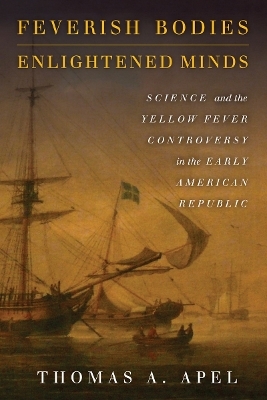
Feverish Bodies, Enlightened Minds
Science and the Yellow Fever Controversy in the Early American Republic
Seiten
2016
|
New edition
Stanford University Press (Verlag)
978-0-8047-9740-5 (ISBN)
Stanford University Press (Verlag)
978-0-8047-9740-5 (ISBN)
Feverish Bodies, Enlightened Minds considers the scientific controversy about the cause of yellow fever to examine and conduct of scientific practice in the early United States.
From 1793 to 1805, yellow fever devastated U.S. port cities in a series of terrifying epidemics. The search for the cause and prevention of the disease involved many prominent American intellectuals, including Noah Webster and Benjamin Rush. This investigation produced one of the most substantial and innovative outpourings of scientific thought in early American history. But it also led to a heated and divisive debate—both political and theological—around the place of science in American society.
Feverish Bodies, Enlightened Minds opens an important window onto the conduct of scientific inquiry in the early American republic. The debate between "contagionists," who thought the disease was imported, and "localists," who thought it came from domestic sources, reflected contemporary beliefs about God and creation, the capacities of the human mind, and even the appropriate direction of the new nation. Through this thoughtful investigation of the yellow fever epidemic and engaging examination of natural science in early America, Thomas Apel demonstrates that the scientific imaginations of early republicans were far broader than historians have realized: in order to understand their science, we must understand their ideas about God.
From 1793 to 1805, yellow fever devastated U.S. port cities in a series of terrifying epidemics. The search for the cause and prevention of the disease involved many prominent American intellectuals, including Noah Webster and Benjamin Rush. This investigation produced one of the most substantial and innovative outpourings of scientific thought in early American history. But it also led to a heated and divisive debate—both political and theological—around the place of science in American society.
Feverish Bodies, Enlightened Minds opens an important window onto the conduct of scientific inquiry in the early American republic. The debate between "contagionists," who thought the disease was imported, and "localists," who thought it came from domestic sources, reflected contemporary beliefs about God and creation, the capacities of the human mind, and even the appropriate direction of the new nation. Through this thoughtful investigation of the yellow fever epidemic and engaging examination of natural science in early America, Thomas Apel demonstrates that the scientific imaginations of early republicans were far broader than historians have realized: in order to understand their science, we must understand their ideas about God.
Thomas A. Apel teaches history at Menlo College.
Introduction
1. Contexts and Causes
2. "Declare the Past"
3. "Nature is the Great Experimenter"
4. "Let Not God Intervene"
5. "In Politics as well as Medicine"; Or, The Arrogance of the Enlightened
Conclusion: Conclusion
| Erscheinungsdatum | 09.04.2016 |
|---|---|
| Zusatzinfo | 3 halftones |
| Verlagsort | Palo Alto |
| Sprache | englisch |
| Maße | 152 x 229 mm |
| Themenwelt | Sachbuch/Ratgeber ► Geschichte / Politik ► Allgemeines / Lexika |
| Geschichte ► Allgemeine Geschichte ► Neuzeit (bis 1918) | |
| Geisteswissenschaften ► Geschichte ► Regional- / Ländergeschichte | |
| Medizin / Pharmazie ► Allgemeines / Lexika | |
| Studium ► 2. Studienabschnitt (Klinik) ► Rechtsmedizin | |
| Naturwissenschaften | |
| ISBN-10 | 0-8047-9740-4 / 0804797404 |
| ISBN-13 | 978-0-8047-9740-5 / 9780804797405 |
| Zustand | Neuware |
| Informationen gemäß Produktsicherheitsverordnung (GPSR) | |
| Haben Sie eine Frage zum Produkt? |
Mehr entdecken
aus dem Bereich



aus dem Bereich
Geschichte einer wilden Handlung
Buch | Hardcover (2024)
C.H.Beck (Verlag)
CHF 47,60


