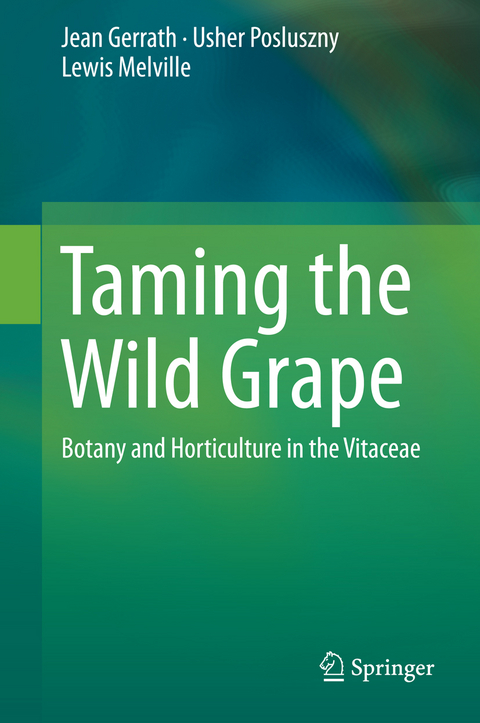
Taming the Wild Grape (eBook)
XII, 194 Seiten
Springer-Verlag
978-3-319-24352-8 (ISBN)
Dr. Jean M. Gerrath Professor EmeritusUniversity of Northern IowaDepartment of Biology70 Dumbarton St.Guelph, ON N1E 3T6Dr. Usher PoslusznyUniversity of GuelphMolecular and cellular Biology50 Stone Road EastGuelph, ON N1G 2W1
Foreword Acknowledgements Table of Contents Section I. The Grape Family (Vitaceae) Chapter 1. Vitaceae Systematics (Origin, Characteristics, Relationships) Introduction Non-Winemaking Uses of Vitaceae Morphological Characteristics of the Vitaceae Relationships within the Vitaceae – Systematics and Phylogeny Order Vitales: Leeaceae (Leea) Vitaceae: Clade I (Ampelopsis, Rhoicissus, Clematicissus, Nekemias) Clade II (Parthenocissus, Yua) Clade III (Ampelocissus, Vitis, Nothocissus, Pterisanthes) Clade IV (Cissus) Clade V (Causonis, Cayratia, Cyphostemma, Tetrastigma) Chapter 2. Vegetative Features of the Vitaceae Shoot Patterns and their Initiation Leaves—Types, Initiation and Development Lateral Buds: Pattern and Position Tendrils and Inflorescences Trichomes (Hairs) Plant-Animal Interactions--Pearl Bodies and Domatia Chapter 3. Reproductive Features of the Vitaceae Inflorescences—Initiation, Development and Mature Patterns Flowers –Mature Features, Development, Dioecy, Pollination and Fertilization Fruits and Seeds—Seed Development, Internal and External Features Chapter 4. Identification of Vitaceae in North America ; Genera (Ampelopsis, Causonis, Cissus, Nekemias, Parthenocissus, Vitis) Keys, descriptions, and illustrations of species (Ampelopsis aconitifolia, A. glandulosa (brevipedunculata); Causonis japonica; Cissus trifoliata; Nekemias arborea; Parthenocissus quinquefolia, P. tricuspidata, P. vitacea; Vitis acerifolia, V. aestivalis, V. arizonica, V. cinerea, V. labrusca, V. palmata, V. riparia, V. rotundifolia, V. rupestris, V. vulpina. Section II. Grapes (Vitis) Chapter 5. Humans and Grapes Human cultivation of grapes—beginnings Cultural importance and history of grapes and wine in Europe Grapevine cultivation in North America Chapter 6. Identification of Cold Climate Grape Cultivars in North America Introduction History of Grapevine Identification Identification of Some Important Cultivars in North America Baco Noir, Catawba, Cayuga White, Chambourcin, Chancellor, Chardonnay, Concord, Cynthiana/Norton, De Chaunac, Frontenac/Frontenac Gris/Frontenac Blanc, L’Acadie, La Crescent, La Crosse, Léon Millot, Maréchal Foch, Marquette, Riesling, Seyval Blanc, St. Croix/Sabrevois, St. Pepin, Swenson Red, Traminette, Veeblanc, Ventura, Vidal Blanc, Vignoles) Appendix I. Using Ampelographic Characters to Identify Grapes Choosing Characters—the OIV Descriptor Priority List Leaves, Flowers and Inflorescences, Fruits and Seeds Using a Dichotomous Identification Key Appendix II. The Growth Cycle (Phenology) of the “Typical” Grapevine Appendix III. Glossary
| Erscheint lt. Verlag | 27.11.2015 |
|---|---|
| Zusatzinfo | XII, 194 p. 80 illus., 73 illus. in color. |
| Verlagsort | Cham |
| Sprache | englisch |
| Themenwelt | Naturwissenschaften ► Biologie ► Botanik |
| Technik | |
| Schlagworte | grape breeding • GRAPES • Identification • Morphology • systematic botany • Vitis |
| ISBN-10 | 3-319-24352-7 / 3319243527 |
| ISBN-13 | 978-3-319-24352-8 / 9783319243528 |
| Informationen gemäß Produktsicherheitsverordnung (GPSR) | |
| Haben Sie eine Frage zum Produkt? |
 PDF (Wasserzeichen)
DRM: Digitales Wasserzeichen
Dieses eBook enthält ein digitales Wasserzeichen und ist damit für Sie personalisiert. Bei einer missbräuchlichen Weitergabe des eBooks an Dritte ist eine Rückverfolgung an die Quelle möglich.
Dateiformat: PDF (Portable Document Format)
Mit einem festen Seitenlayout eignet sich die PDF besonders für Fachbücher mit Spalten, Tabellen und Abbildungen. Eine PDF kann auf fast allen Geräten angezeigt werden, ist aber für kleine Displays (Smartphone, eReader) nur eingeschränkt geeignet.
Systemvoraussetzungen:
PC/Mac: Mit einem PC oder Mac können Sie dieses eBook lesen. Sie benötigen dafür einen PDF-Viewer - z.B. den Adobe Reader oder Adobe Digital Editions.
eReader: Dieses eBook kann mit (fast) allen eBook-Readern gelesen werden. Mit dem amazon-Kindle ist es aber nicht kompatibel.
Smartphone/Tablet: Egal ob Apple oder Android, dieses eBook können Sie lesen. Sie benötigen dafür einen PDF-Viewer - z.B. die kostenlose Adobe Digital Editions-App.
Buying eBooks from abroad
For tax law reasons we can sell eBooks just within Germany and Switzerland. Regrettably we cannot fulfill eBook-orders from other countries.
aus dem Bereich