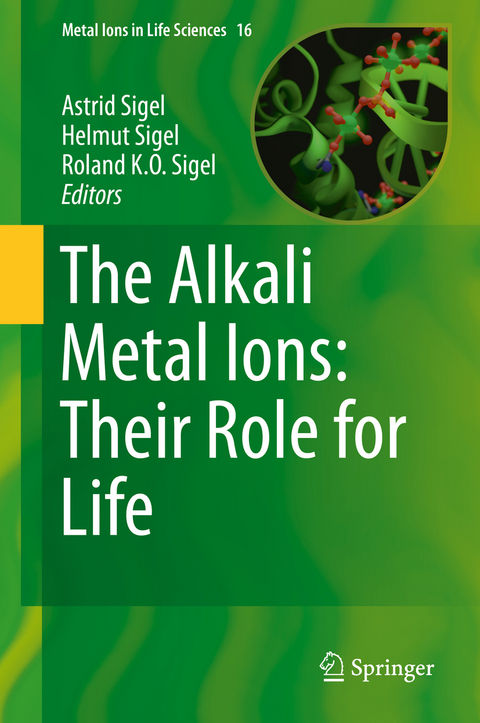
The Alkali Metal Ions: Their Role for Life (eBook)
XLI, 628 Seiten
Springer International Publishing (Verlag)
978-3-319-21756-7 (ISBN)
MILS-16 provides an up-to-date review of the impact of alkali metal ions on life. Their bioinorganic chemistry and analytical determination, the solid state structures of bio-ligand complexes and the properties of alkali metal ions in solution in the context of all kinds of biologically relevant ligands are covered, this includes proteins (enzymes) and nucleic acids (G-quadruplexes). Minerals containing sodium (Na+) and potassium (K+) are abundant in the Earth's crust, making Na+ and K+ easily available. In contrast, the alkali elements lithium (Li+), rubidium, and cesium are rare and the radioactive francium occurs only in traces. Since the intra- and extracellular, as well as the compartmental concentrations of Na+ and K+ differ significantly, homeostasis and active transport of these ions are important; this involves transporters/carriers and pore-forming ion channel proteins. Systems like Na+/K+-ATPases, H+/K+-ATPases or Na+/H+ antiporters are thoroughly discussed. The role of K+ in photosynthesis and the role of Na+ in charging the 'battery of life' are pointed out. Also, the relationships between alkali metal ions and diseases (e.g., Parkinson or traumatic brain injury) are covered and the relevance of Li+ salts in medicine (pharmacology and mechanism) is reviewed. This and more is treated in an authoritative and timely manner in the 16 stimulating chapters of Volume 16, The Alkali Metal Ions: Their Role for Life, which are written by 44 internationally recognized experts from 12 nations. The impact of this vibrant research area is manifested in nearly 3000 references, over 30 tables and more than 150 illustrations (two thirds in color). MILS-16 also provides excellent information for teaching.
Astrid Sigel, Helmut Sigel, and Roland K. O. Sigel have long-standing interests in Biological Inorganic Chemistry. Their research focuses on metal ion interactions with nucleotides and nucleic acids and on related topics. They edited previously 44 volumes in the series Metal Ions in Biological Systems.
1. Bioinorganic Chemistry of the Alkali Metal Ions; Youngsam Kim, Thuy Tien Nguyen, and David G. Churchill2. Determination of Alkali Ions in Biological and Environmental Samples; Peter C. Hauser3. Solid State Structures of Alkali Metal Ion Complexes Formed by Low-Molecular-Weight Ligands of Biological Relevance; Katsuyuki Aoki, Kazutaka Murayama, and Ning-Hai Hu4. Discriminating Properties of Alkali Metal Ions towards the Constituents of Proteins and Nucleic Acids. Conclusions from Gas-Phase and Theoretical Studies; Mary T. Rodgers and Peter B. Armentrout 5. Alkali Metal Ion Complexes with Phosphates, Nucleotides, Amino Acids, and Related Ligands of Biological Relevance. Their Properties in Solution; Francesco Crea, Concetta De Stefano, Claudia Foti, Gabriele Lando, Demetrio Milea, and Silvio Sammartano6. Sodium and Potassium Interactions with Nucleic Acids; Pascal Auffinger, Luigi D'Ascenzo, and Eric Ennifar7. Role of Alkali Metal Ions in G-Quadruplex Nucleic Acid Structure and Stability; Eric Largy, Jean-Louis Mergny and Valérie Gabelica8. Sodium and Potassium Ions in Proteins and Enzyme Catalysis; Milan Vašák and Joachim Schnabl9. Roles and Transport of Sodium and Potassium in Plants; Manuel Nieves-Cordones, Fouad Razzaq Al Shiblawi, and Hervé Sentenac10. Potassium versus Sodium Selectivity in Monovalent Ion Channel Selectivity Filters; Carmay Lim and Todor Dudev 11. Sodium as Coupling Cation in Respiratory Energy Conversion; Günter Fritz and Julia Steuber 12. Sodium-Proton (Na+/H+) Antiporters: Properties and Roles in Health and Disease; Etana Padan and Meytal Landau13. Proton-Potassium (H+/K+) ATPases: Properties and Roles in Health and Diseases; Hideki Sakai, Takuto Fujii, and Noriaki Takeguchi 14. Bioinspired Artificial Sodium and Potassium Ion Channels; Nuria Rodríguez-Vázquez, Alberto Fuertes, Manuel Amorín, and Juan R. Granja15. Lithium in Medicine: Mechanisms of Action; Duarte Mota de Freitas, Brian D. Leverson, and Jesse L. Goossens16. Sodium and Potassium Relating to Parkinson's Disease and Traumatic Brain Injury; Yonghwang Ha, Jeong A. Jeong, Youngsam Kim, and David G. Churchill
| Erscheint lt. Verlag | 9.2.2016 |
|---|---|
| Reihe/Serie | Metal Ions in Life Sciences | Metal Ions in Life Sciences |
| Zusatzinfo | XLI, 628 p. 194 illus., 114 illus. in color. |
| Verlagsort | Cham |
| Sprache | englisch |
| Themenwelt | Naturwissenschaften ► Biologie |
| Technik | |
| Schlagworte | Ligands • Li+ salts • Nucleic acids • Potassium • sodium |
| ISBN-10 | 3-319-21756-9 / 3319217569 |
| ISBN-13 | 978-3-319-21756-7 / 9783319217567 |
| Informationen gemäß Produktsicherheitsverordnung (GPSR) | |
| Haben Sie eine Frage zum Produkt? |
 PDF (Wasserzeichen)
DRM: Digitales Wasserzeichen
Dieses eBook enthält ein digitales Wasserzeichen und ist damit für Sie personalisiert. Bei einer missbräuchlichen Weitergabe des eBooks an Dritte ist eine Rückverfolgung an die Quelle möglich.
Dateiformat: PDF (Portable Document Format)
Mit einem festen Seitenlayout eignet sich die PDF besonders für Fachbücher mit Spalten, Tabellen und Abbildungen. Eine PDF kann auf fast allen Geräten angezeigt werden, ist aber für kleine Displays (Smartphone, eReader) nur eingeschränkt geeignet.
Systemvoraussetzungen:
PC/Mac: Mit einem PC oder Mac können Sie dieses eBook lesen. Sie benötigen dafür einen PDF-Viewer - z.B. den Adobe Reader oder Adobe Digital Editions.
eReader: Dieses eBook kann mit (fast) allen eBook-Readern gelesen werden. Mit dem amazon-Kindle ist es aber nicht kompatibel.
Smartphone/Tablet: Egal ob Apple oder Android, dieses eBook können Sie lesen. Sie benötigen dafür einen PDF-Viewer - z.B. die kostenlose Adobe Digital Editions-App.
Buying eBooks from abroad
For tax law reasons we can sell eBooks just within Germany and Switzerland. Regrettably we cannot fulfill eBook-orders from other countries.
aus dem Bereich