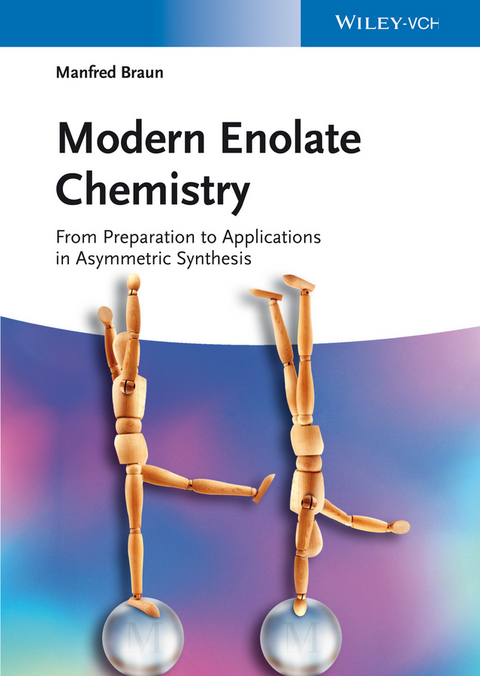
Modern Enolate Chemistry (eBook)
350 Seiten
Wiley-VCH (Verlag)
9783527671083 (ISBN)
While great care is taken to cover novel, successful concepts, such classical methods as the famous Evans enolates are equally highlighted. Throughout the book representative reaction procedures are presented, thus helping readers to find the best solution for their own synthetic problem.
Of high interest to synthetic chemists in academia, as well as the pharmaceuticals, agrochemicals and fine chemicals industries.
Manfred Braun was born in Schwalbach near Saarlouis in 1948. From 1966 until 1971 he studied chemistry at the university (TH) of Karlsruhe, and in 1975 he completed his doctorate under D. Seebach at the Justus-Liebig university of Giessen. After his postdoctoral studies with G. Büchi at the Massachusetts Institute of Technology in 1975 and 1976 he joined H. Musso's research group at the university of Karlsruhe and completed the habilitation there in 1981. Since 1985 he has been a professor of organic chemistry at the Heinrich-Heine university in Düsseldorf. He received the Heisenberg scholarship from the Deutsche Forschungsgemeinschaft and the Karl Winnacker scholarship. Guest professorships led him to the Universite de Rennes, France and the University of Wisconsin in Madison, USA. His current research interests include the development of new synthetic methods, especially for asymmetric synthesis, organometallic chemistry, and syntheses of natural products, and biologically active compounds.
Manfred Braun was born in Schwalbach near Saarlouis in 1948. From 1966 until 1971 he studied chemistry at the university (TH) of Karlsruhe, and in 1975 he completed his doctorate under D. Seebach at the Justus-Liebig university of Giessen. After his postdoctoral studies with G. Büchi at the Massachusetts Institute of Technology in 1975 and 1976 he joined H. Musso's research group at the university of Karlsruhe and completed the habilitation there in 1981. Since 1985 he has been a professor of organic chemistry at the Heinrich-Heine university in Düsseldorf. He received the Heisenberg scholarship from the Deutsche Forschungsgemeinschaft and the Karl Winnacker scholarship. Guest professorships led him to the Universite de Rennes, France and the University of Wisconsin in Madison, USA. His current research interests include the development of new synthetic methods, especially for asymmetric synthesis, organometallic chemistry, and syntheses of natural products, and biologically active compounds.
Introductory Remarks
General Methods for the Preparation of Enolates
Structures of Enolates
Enolates with Chiral Auxiliaries in Asymmetric Syntheses
Enolates in Asymmetric Catalysis
Chapter 1
Introductory Remarks
The “central role in synthetic organic chemistry played by the carbonyl group” [1] is well recognized, and enolate chemistry is definitely a major part of carbonyl chemistry; the number of conversions involving enolates became legion. In textbooks of organic chemistry dating back to the 1950s or earlier, the question of the structure of enolates–the reactive species in widely applied carbon–carbon bond forming reactions like the aldol addition, the Claisen condensation, and the Mannich and Michael reactions–was simply answered by the concept of the enolate anion, described as a resonance hybrid of the carbanionic and the oxyanionic resonance formulas. The metal cation was usually ignored completely or little attention was paid to it. The mechanism given in the 1965 edition of Roberts and Caserio for the aldol addition (Figure 1.1) may serve for a representation of the enolate concept in teaching.
Figure 1.1 Formation of the enolate anion by removal of an α-hydrogen by base is the first step in the aldol addition [2].
This point of view was acceptable as long the corresponding reactions were run in highly polar protic, frequently aqueous solvents that allowed for a at least partial dissociation into an enolate anion and a metal cation. At the times however when, initiated by Wittig's seminal contributions, the concept of the “directed aldol reaction” [3] came up, the protic milieu had to be given up, and the generation and conversion of preformed enolate were moved into moderately polar solvents like cyclic and acyclic ethers, chlorinated hydrocarbons, or even alkanes and arenes, frequently with tertiary amines as cosolvents, the idea of charge separation or even dissociation into a “free” enolate anion and a metal cation became doubtful. As a consequence, the question arose whether the metal is linked to the carbonyl oxygen (O-bound enolates 1) or to the α-carbon atom (C-bound enolates 2). Is it the oxygen or the carbon atom that balances on the ball? In addition, a third structure is possible, wherein the metal forms an η3 bond to the enolate (oxallyl enolate 3) (Scheme 1.1).
Scheme 1.1 General enolate structures.
After almost half century of intensive, fundamental, and fruitful investigations of enolate structures, there is now clear evidence indicating that enolates of groups 1, 2, and 13 metals–lithium and boron being the most relevant ones–exist as the O-bound tautomers 1; the same holds in general for silicon, tin, titanium, and zirconium enolates [4]. Numerous crystal structure analyses and spectroscopic data confirmed type metalla tautomer 1 to be the rule for enolates of the alkali metals, magnesium, boron, and silicon [5].
The metal–oxygen interaction may be considered a highly polar covalent bond or a tight ion pair in the case of alkali and earth alkali metals. The O–metal bond and the resulting carbon–carbon double-bond character were early recognized in enolate chemistry by means of NMR spectroscopy that revealed a rotation barrier of at least 27 kcal mol−1 for the enolate 4, as determined in triglyme [6]. Not only the methyl groups in 4 are nonequivalent but also the α-protons (3.14 and 3.44 ppm in benzene) in “Rathke's enolate” 5 derived from t-butyl acetate [7]–to give just two illustrative examples of lithium enolates. The double-bond character holds of course also all O-bound enolates, including those of transition metals – rhodium enolate 6 [8] and palladium enolate 7 [9] may serve as illustrative examples: in their 1H NMR spectra, the nonisochronous olefinic protons displaying two singlets at 4.40 ppm/4.62 ppm and 4.90 ppm/4.99 ppm, respectively (Scheme 1.2).
Scheme 1.2 Examples of nonequivalency of α-substituents in lithium enolates 4 and 5, rhodium enolate 6, and palladium enolate 7.
The structural feature of the O–metal bond has a substantial consequence that holds for carbonyl compounds with nonidentical substituents in the α-position: the configurational isomerism with respect to the carbon–carbon double bond giving rise to cis- or trans-enolates 8 (Scheme 1.3). This diastereomerism was recognized in the early stage of enolate research by NMR spectroscopy [10, 11] and later impressively confirmed by crystal structure analyses [12]. Chemists learned to generate cis- or trans-enolates selectively and to handle them under conditions that prohibited them from cis–trans isomerization. In an early, fundamental work in enolate chemistry, House and Trost disclosed that cis- and trans-8 (X = Me, M = Li, R = nBu) do not interconvert even at elevated temperature [13]. Seminal contributions in the groups of Dubois and Fellmann [14] and Ireland et al. [15] revealed the distinct influence of enolate configurations to the stereochemical outcome of the aldol reaction and the Claisen–Ireland rearrangement, so that, in turn, these reactions served as a probe for deducing the configuration of enolates.
Scheme 1.3 General structures of diastereomeric cis- and trans-O-bound enolates.
At a glance, the descriptors Z and E might seem to be appropriate for O–metal-bound enolates like 6. Indeed, E/Z nomenclature causes no problems when the configuration of preformed enolates derived from aldehydes, ketones, and amides has to be assigned, because the O–metal residue at the enolate double bond has the higher priority. However, application of the E/Z descriptors to ester enolates leads to the dilemma that enolates with different metals but otherwise identical structures will be classified by opposite descriptors, as illustrated by lithium and magnesium enolates 9 and 10, respectively: the former would have to be termed Z, and the latter E (Scheme 1.4).
Scheme 1.4 Opposite assignment of configurations (Z and E) in an ester enolate depending on the O-bound metal.
In order to circumvent this complication, a pragmatic solution has been proposed by Evans: irrespective of the formal Cahn–Ingold–Prelog criteria, the oxygen atom bearing the metal (the OM residue) is given a higher priority, and the ipso-substituent X (in enolates 8) the lower one [4]b. Although this convention has been accepted by other authors, there are both practical and principal objectives against it. The following examples (Scheme 1.5) may illustrate the confusing situation that occurs: the identical diastereomer of enolate 11 has been termed E by Heathcock [4]d, and Z by Seebach [12]b, the latter using the correct Cahn–Ingold–Prelog assignment. Another nightmare in this respect is thioester enolates, as again opposite descriptors are spread out in the literature by using either Evans' convention [4]b, [16] or CIP-based nomenclature [17], as demonstrated by the related boron enolates 12 and 13.
Scheme 1.5 Examples of contradictory assignment of configurations in enolates.
Aside this confusion, there is a principal argument, not to use Evans' convention, because the hard descriptors E and Z must not be redefined. The soft descriptors cis and trans, however, can be used without violation of the strict definitions of the unequivocal E and Z. Therefore, in this book, the recommendation of Eliel et al. [18] is followed using the soft descriptors cis and trans, if a series or a class of enolates are addressed [19]. Thereby, “cis” means that the OM substituent is on the same side as the higher-priority group at the α-carbon atom, and “trans” means that the OM substituent is on the opposite side. Only in those cases, where an individual enolate is concerned, E/Z nomenclature is used according to its strict definition.
The C-bound metalla tautomers 2 are typical for the less electropositive metals [4]e. They have been postulated occasionally for zinc [20] and copper [21] but are a rule for mercury [10]a. Carbon-bound enolates of molybdenum, tungsten, manganese, rhenium, iron, rhodium, nickel, iridium, and palladium have been detected and characterized [22], but one has to be aware of the phenomenon that they exist in equilibrium with the O-bound metalla tautomers. The interconversion of the palladium enolates 14 and 15 (Scheme 1.6), whose activation barrier has been determined to amount to approximately 10 kcal mol−1, may serve as a typical example [8]. The dynamic of O- and C-bound tautomers 1 and 2 (Scheme 1.1) with transition metals is obviously a delicate balance depending on the individual enolate, the metal, and the ligands [9, 23].
Scheme 1.6 Rhodium and palladium enolates. Equilibrating O- and C-bound tautomers 14 and 15; rhodium complex 16, characterized by its crystal structure, as an example of an η3-oxallyl enolate; cationic palladium complex 17, proven as intermediate in Shibasaki's enantioselective aldol addition.
The third species in...
| Erscheint lt. Verlag | 24.11.2015 |
|---|---|
| Sprache | englisch |
| Themenwelt | Naturwissenschaften ► Chemie ► Organische Chemie |
| Technik | |
| Schlagworte | Chemie • Chemistry • chiral auxiliaries</p> • Enol • Industrial Chemistry • <p>catalysis • Methods - Synthesis & Techniques • Organische Chemie • Organische Chemie / Methoden, Synthesen, Verfahren • Organometallchemie • Organometallic Chemistry • Pharmaceutical & Medicinal Chemistry • Pharmazeutische u. Medizinische Chemie • Stereoselective Synthesis • Technische u. Industrielle Chemie |
| ISBN-13 | 9783527671083 / 9783527671083 |
| Informationen gemäß Produktsicherheitsverordnung (GPSR) | |
| Haben Sie eine Frage zum Produkt? |
 EPUB (Adobe DRM)
Kopierschutz: Adobe-DRM
Adobe-DRM ist ein Kopierschutz, der das eBook vor Mißbrauch schützen soll. Dabei wird das eBook bereits beim Download auf Ihre persönliche Adobe-ID autorisiert. Lesen können Sie das eBook dann nur auf den Geräten, welche ebenfalls auf Ihre Adobe-ID registriert sind.
Details zum Adobe-DRM
Dateiformat: EPUB (Electronic Publication)
EPUB ist ein offener Standard für eBooks und eignet sich besonders zur Darstellung von Belletristik und Sachbüchern. Der Fließtext wird dynamisch an die Display- und Schriftgröße angepasst. Auch für mobile Lesegeräte ist EPUB daher gut geeignet.
Systemvoraussetzungen:
PC/Mac: Mit einem PC oder Mac können Sie dieses eBook lesen. Sie benötigen eine
eReader: Dieses eBook kann mit (fast) allen eBook-Readern gelesen werden. Mit dem amazon-Kindle ist es aber nicht kompatibel.
Smartphone/Tablet: Egal ob Apple oder Android, dieses eBook können Sie lesen. Sie benötigen eine
Geräteliste und zusätzliche Hinweise
Buying eBooks from abroad
For tax law reasons we can sell eBooks just within Germany and Switzerland. Regrettably we cannot fulfill eBook-orders from other countries.
aus dem Bereich