Organic Redox Systems (eBook)
John Wiley & Sons (Verlag)
978-1-118-85872-1 (ISBN)
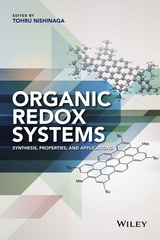
Providing a thorough overview of leading research from internationally-recognized contributing authors, this book describes methods for the preparation and application of redox systems for organic electronic materials like transistors, photovoltaics, and batteries.
• Covers bond formation and cleavage, supramolecular systems, molecular design, and synthesis and properties
• Addresses preparative methods, unique structural features, physical properties, and material applications of redox active p-conjugated systems
• Offers a useful guide for both academic and industrial chemists involved with organic electronic materials
• Focuses on the transition-metal-free redox systems composed of organic and organo main group compounds
Tohru Nishinaga, PhD, is an Associate Professor of Chemistry at Tokyo Metropolitan University. His current research interest is the design, synthesis and application of pi-electron systems with novel electronic properties. Dr. Nishinaga has published over 80 scientific papers and 10 book chapters.
Providing a thorough overview of leading research from internationally-recognized contributing authors, this book describes methods for the preparation and application of redox systems for organic electronic materials like transistors, photovoltaics, and batteries. Covers bond formation and cleavage, supramolecular systems, molecular design, and synthesis and properties Addresses preparative methods, unique structural features, physical properties, and material applications of redox active p-conjugated systems Offers a useful guide for both academic and industrial chemists involved with organic electronic materials Focuses on the transition-metal-free redox systems composed of organic and organo main group compounds
Tohru Nishinaga, PhD, is an Associate Professor of Chemistry at Tokyo Metropolitan University. His current research interest is the design, synthesis and application of pi-electron systems with novel electronic properties. Dr. Nishinaga has published over 80 scientific papers and 10 book chapters.
1
INTRODUCTION: BASIC CONCEPTS AND A BRIEF HISTORY OF ORGANIC REDOX SYSTEMS
Tohru Nishinaga
Department of Chemistry, Graduate School of Science and Engineering, Tokyo Metropolitan University, Hachioji, Tokyo, Japan
1.1 REDOX REACTION OF ORGANIC MOLECULES
Redox is a portmanteau word of “reduction” and “oxidation.” Originally, oxidation meant a chemical reaction in which oxygen combines with another substance, after Antoine Lavoisier, late in the eighteenth century, called a product of the reaction an oxide [1]. The term “reduction” had been used long before the introduction of the term “oxidation” in the smelting to produce iron from ore and coke [1]. In the contemporary definition recommended by IUPAC [2], oxidation is a reaction that satisfies criteria 1 “the complete, net removal of one or more electrons from a molecular entity” and 2 “an increase in the oxidation number of any atom within any substrate” and meets in many cases criterion 3 “gain of oxygen and/or loss of hydrogen of an organic substrate.” Conversely, reduction is the reverse process of oxidation.
For transition metals, a direct one-electron transfer related to the aforementioned criterion 1 is common due to their relatively lower ionization energy in comparison with main group elements [3] and low reactivity of the unpaired d-electrons. In contrast, the mechanisms of common organic redox reactions do not involve a direct one-electron transfer [4], and reactions based on the criterion 3 are typical. For example, oxidation of primary alcohol (RCH2OH) to aldehyde (RHC═O) with Cr(VI)O3 proceeds via chromic ester intermediate (RCH2O3Cr(VI)OH), and proton and HOCr(IV)O2− are eliminated from the intermediate [5] (Scheme 1.1a). In this reaction, the total number of electrons in the outer shell decreases from 14 at the C─O moiety to 12 at the C═O moiety, that is, two-electron oxidation, while the formal oxidation number of Cr changes from +6 to +4, that is, two-electron reduction. Similarly, reduction of carbonyl group to alcohol with NaBH4 in ethanol formally proceeds via nucleophilic attack of a pair of electrons in hydride to electron-deficient carbonyl carbon [5] (Scheme 1.1b). Thus, formally, a pair of two electrons moves together in typical organic redox reactions as known in other organic reactions such as substitutions.
SCHEME 1.1 (a) Oxidation of alcohol to aldehyde with Cr(VI) and (b) hydride reduction of aldehyde to alcohol.
On the other hand, one-electron oxidation or reduction of a neutral or ionic molecule (Scheme 1.2) gives generally highly reactive ion radicals or radicals, and follow-up reactions such as radical coupling and deprotonation are prone to take place [6]. Nevertheless, some organic molecules give persistent species after one-electron transfer at ambient temperature [7, 8]. Simple π-extension and substituents of resonance electron donating R2N─, RO─, RS─ or withdrawing N≡C─, C═O groups cause delocalization of spin and charge density, which reduces the reactivity of the reactive center. As the other thermodynamic stabilization, aromatization after electron transfer plays an important role for certain molecules. An appropriate steric protection is also an effective strategy for protecting a reactive radical center [9]. As a result of these effects, they can be reversibly regenerated by the reverse electron transfer. This book deals with organic π-electron systems and related organo main group compounds that show such reversible one-electron transfer.
SCHEME 1.2 One-electron oxidation and reduction of neutral and ionic molecules.
1.2 REDOX POTENTIAL IN NONAQUEOUS SOLVENTS
Redox potential is the important measure for redox systems, by which one can predict how easily one-electron oxidation or reduction takes place with other redox reagents. For the measurement of redox potential, cyclic voltammetry is usually the first choice, because not only the redox potential but also the stability of the species generated after electron transfer can be observed. Several types of reference electrodes are used to measure redox potentials. The standard hydrogen electrode (SHE) or normal hydrogen electrode (NHE), which is determined by redox potential of 2H+/H2 couple in an aqueous media, is defined as 0 V in standard electrode potential. However, since the setting of apparatus of SHE is complicated, other reference electrode such as saturated calomel electrode (SCE) and saturated Ag/AgCl or Ag/Ag+ electrode is commonly used for routine laboratory experiments. A saturated aqueous KCl solution is used for SCE and saturated Ag/AgCl electrodes, while polar solvent, for example, acetonitrile can be used for Ag/Ag+ electrode.
As for the absolute electrode potential, the value −4.44 ± 0.02 V vs NHE (25°C in H2O) is recommended by IUPAC [10]. The standard and absolute electrode potentials of NHE, SCE (=0.244 V vs NHE 25°C in H2O) [11], and saturated Ag/AgCl (=0.199 V vs NHE 25°C in H2O) [12] are shown in Figure 1.1. Since the potential of Ag/Ag+ electrode in a nonaqueous solvent varies with the conditions (solvent polarity, electrolyte, surface of Ag, etc.), the conversion of the Ag/Ag+ scale to SCE or Ag/AgCl scale is not straightforward.
FIGURE 1.1 Conversion of relative electrode potentials into electronic energies for aqueous systems. Note that this graph cannot be used to convert SCE or Ag/AgCl scale into Fc/Fc+ scale in the electrochemical measurements performed in nonaqueous media.
Most organic redox compounds do not dissolve in water, and hence their electrochemical measurements have to be taken in a nonaqueous solvent such as dichloromethane, DMF, and acetonitrile. In the case of the use of Ag/Ag+ reference electrode in a polar organic solvent, a careful preparation of the reference electrode is required for the reproducible measurements. If an SCE or saturated Ag/AgCl electrode is used as reference, liquid junction potential [13] generated between the aqueous media in reference electrode and the organic solvent used in the measurement cell cannot be negligible. Liquid junction potential causes a shift in the observed value from the inherent redox potential. The liquid junction potentials between saturated aqueous KCl solution and various aprotic polar organic solvents were shown to be 100–200 mV [14]. Occasionally, liquid junction potential exceeds 200 mV [13].
For this reason, IUPAC recommends the use of ferrocene/ferrocenium couple as internal reference for electrochemical measurements in a nonaqueous medium and also to report the potential in the scale against the redox potential of ferrocene (the abbreviation for the potential as V vs Fc/Fc+) [15]. The observed potential of Fc/Fc+ couple in various solvents and supporting electrolytes using an SCE reference electrode were reported [16]. The selected data are shown in Table 1.1. The observed values both in tetra-n-butylammonium hexafluorophosphate (TBAPF6) and perchlorate (TBAClO4) electrolytes tend to increase with decreasing solvent polarity. The liquid junction potential between aqueous media in the SCE reference electrode and the organic solvents is involved in the observed difference in the potentials for the Fc/Fc+ couple. Therefore, care must be taken when comparing the reported data in SCE or Ag/AgCl scale measured in different solvents. It is important to understand that such a comparison involves an unknown potential shift caused by liquid junction potential. Nevertheless, because of reproducibility of an SCE reference electrode even in nonaqueous media, the potentials in Table 1.1 can be used for the conversion from SCE scale to Fc/Fc+ scale, when the measurement conditions (solvent and supporting electrolyte) are identical [16].
TABLE 1.1 Formal Potentials (V) for the Ferrocene/Ferrocenium Couple vs SCE [16]
| Solvent | TBAPF6 | TBAClO4 |
| CH3CN | 0.40 | 0.38 |
| DMF | 0.45 | 0.47 |
| CH2Cl2 | 0.46 | 0.48 |
| THF | 0.56 | 0.53 |
| Other |
| H2O (0.1 M NaF) | 0.16 |
The HOMO and LUMO levels of organic redox compounds are often estimated from the oxidation (Eox V vs Fc/Fc+) or reduction (Ered V vs Fc/Fc+) potential obtained from electrochemical measurements and the energy level of Fc/Fc+ couple to vacuum (EFc/Fc+ V(abs)) by Equations (1.1) and (1.2) as follows:
For the EFc/Fc+ value, 4.8 eV is frequently used. The value was originally reported in 1995 [17] based on rather crude approximation that the absolute electrode potential for NHE was −4.6 V (the data from an older book) and that redox potential of Fc/Fc+ couple was 0.2 V vs NHE in acetonitrile (which is not consistent with the later value shown in Table 1.1). Then, the problems of the rough estimation were raised in 2011...
| Erscheint lt. Verlag | 25.11.2015 |
|---|---|
| Sprache | englisch |
| Themenwelt | Naturwissenschaften ► Chemie ► Organische Chemie |
| Technik ► Elektrotechnik / Energietechnik | |
| Schlagworte | Chemie • Chemistry • Electronic materials • Elektronische Materialien • Materials Science • Materialwissenschaften • Organic redox systems, organic electronic materials, redox reactions, pi-conjugated systems • Physical Chemistry • Physical Organic Chemistry • Physikalische Chemie • Physikalische Organische Chemie • Redoxsystem |
| ISBN-10 | 1-118-85872-7 / 1118858727 |
| ISBN-13 | 978-1-118-85872-1 / 9781118858721 |
| Informationen gemäß Produktsicherheitsverordnung (GPSR) | |
| Haben Sie eine Frage zum Produkt? |
 EPUB (Adobe DRM)
Kopierschutz: Adobe-DRM
Adobe-DRM ist ein Kopierschutz, der das eBook vor Mißbrauch schützen soll. Dabei wird das eBook bereits beim Download auf Ihre persönliche Adobe-ID autorisiert. Lesen können Sie das eBook dann nur auf den Geräten, welche ebenfalls auf Ihre Adobe-ID registriert sind.
Details zum Adobe-DRM
Dateiformat: EPUB (Electronic Publication)
EPUB ist ein offener Standard für eBooks und eignet sich besonders zur Darstellung von Belletristik und Sachbüchern. Der Fließtext wird dynamisch an die Display- und Schriftgröße angepasst. Auch für mobile Lesegeräte ist EPUB daher gut geeignet.
Systemvoraussetzungen:
PC/Mac: Mit einem PC oder Mac können Sie dieses eBook lesen. Sie benötigen eine
eReader: Dieses eBook kann mit (fast) allen eBook-Readern gelesen werden. Mit dem amazon-Kindle ist es aber nicht kompatibel.
Smartphone/Tablet: Egal ob Apple oder Android, dieses eBook können Sie lesen. Sie benötigen eine
Geräteliste und zusätzliche Hinweise
Buying eBooks from abroad
For tax law reasons we can sell eBooks just within Germany and Switzerland. Regrettably we cannot fulfill eBook-orders from other countries.
aus dem Bereich