Zum Hauptinhalt springen
Nicht aus der Schweiz? Besuchen Sie lehmanns.de
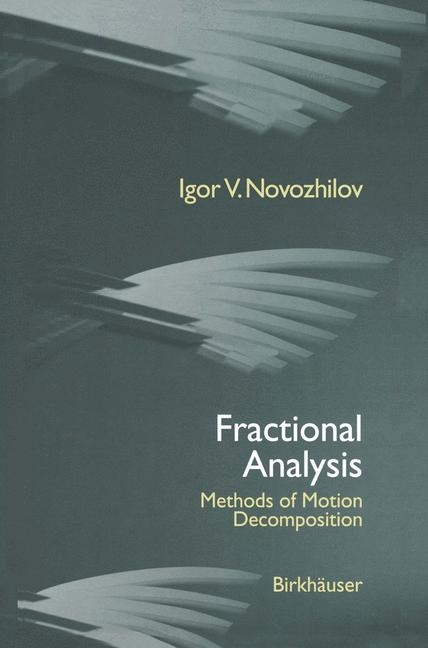
Fractional Analysis -  I.V. Novozhilov

Fractional Analysis (eBook)

Methods of Motion Decomposition
eBook Download: PDF
2012
Birkhauser Boston (Verlag)
978-1-4612-4130-0 (ISBN)
Systemvoraussetzungen
55,17 inkl. MwSt
(CHF 53,90)
Der eBook-Verkauf erfolgt durch die Lehmanns Media GmbH (Berlin) zum Preis in Euro inkl. MwSt.
  • Download sofort lieferbar
  • Zahlungsarten anzeigen
This book considers methods of approximate analysis of mechanical, elec- tromechanical, and other systems described by ordinary differential equa- tions. Modern mathematical modeling of sophisticated mechanical systems consists of several stages: first, construction of a mechanical model, and then writing appropriate equations and their analytical or numerical ex- amination. Usually, this procedure is repeated several times. Even if an initial model correctly reflects the main properties of a phenomenon, it de- scribes, as a rule, many unnecessary details that make equations of motion too complicated. As experience and experimental data are accumulated, the researcher considers simpler models and simplifies the equations. Thus some terms are discarded, the order of the equations is lowered, and so on. This process requires time, experimentation, and the researcher's intu- ition. A good example of such a semi-experimental way of simplifying is a gyroscopic precession equation. Formal mathematical proofs of its admis- sibility appeared some several decades after its successful introduction in engineering calculations. Applied mathematics now has at its disposal many methods of approxi- mate analysis of differential equations. Application of these methods could shorten and formalize the procedure of simplifying the equations and, thus, of constructing approximate motion models. Wide application of the methods into practice is hindered by the fol- lowing. 1. Descriptions of various approximate methods are scattered over the mathematical literature. The researcher, as a rule, does not know what method is most suitable for a specific case. 2.
Erscheint lt. Verlag 6.12.2012
Sprache englisch
Themenwelt Mathematik / Informatik Mathematik Analysis
Mathematik / Informatik Mathematik Angewandte Mathematik
Naturwissenschaften Physik / Astronomie
Technik Maschinenbau
ISBN-10 1-4612-4130-8 / 1461241308
ISBN-13 978-1-4612-4130-0 / 9781461241300
Informationen gemäß Produktsicherheitsverordnung (GPSR)
Haben Sie eine Frage zum Produkt?
PDFPDF (Adobe DRM)

Kopierschutz: Adobe-DRM
Adobe-DRM ist ein Kopierschutz, der das eBook vor Mißbrauch schützen soll. Dabei wird das eBook bereits beim Download auf Ihre persönliche Adobe-ID autorisiert. Lesen können Sie das eBook dann nur auf den Geräten, welche ebenfalls auf Ihre Adobe-ID registriert sind.
Details zum Adobe-DRM

Dateiformat: PDF (Portable Document Format)
Mit einem festen Seiten­layout eignet sich die PDF besonders für Fach­bücher mit Spalten, Tabellen und Abbild­ungen. Eine PDF kann auf fast allen Geräten ange­zeigt werden, ist aber für kleine Displays (Smart­phone, eReader) nur einge­schränkt geeignet.

Systemvoraussetzungen:
PC/Mac: Mit einem PC oder Mac können Sie dieses eBook lesen. Sie benötigen eine Adobe-ID und die Software Adobe Digital Editions (kostenlos). Von der Benutzung der OverDrive Media Console raten wir Ihnen ab. Erfahrungsgemäß treten hier gehäuft Probleme mit dem Adobe DRM auf.
eReader: Dieses eBook kann mit (fast) allen eBook-Readern gelesen werden. Mit dem amazon-Kindle ist es aber nicht kompatibel.
Smartphone/Tablet: Egal ob Apple oder Android, dieses eBook können Sie lesen. Sie benötigen eine Adobe-ID sowie eine kostenlose App.
Geräteliste und zusätzliche Hinweise

Buying eBooks from abroad
For tax law reasons we can sell eBooks just within Germany and Switzerland. Regrettably we cannot fulfill eBook-orders from other countries.

Mehr entdecken
aus dem Bereich