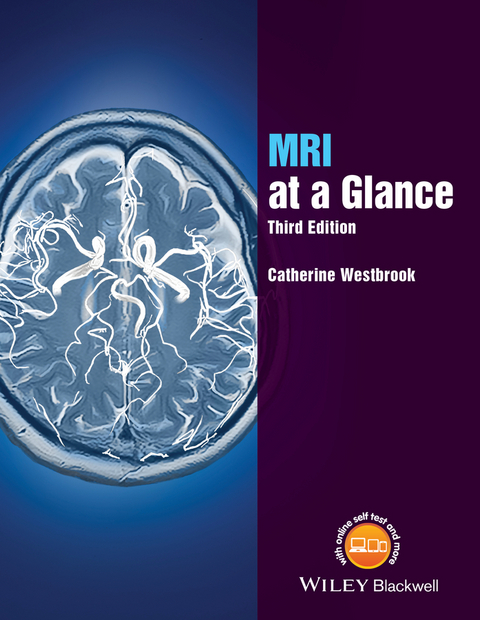
MRI at a Glance (eBook)
John Wiley & Sons (Verlag)
978-1-119-05354-5 (ISBN)
MRI at a Glance encapsulates essential MRI physics knowledge. Illustrated in full colour throughout, its concise text explains complex information, to provide the perfect revision aid. It includes topics ranging from magnetism to safety, K space to pulse sequences, and image contrast to artefacts.
This third edition has been fully updated, with revised diagrams and new pedagogy, including 55 key points, tables, scan tips, equations, and learning points. There is also an expanded glossary and new appendices on optimizing image quality, parameters and trade-offs.
A companion website is also available at www.ataglanceseries.com/mri featuring animations, interactive multiple choice questions, and scan tips to improve your own MRI technique.
MRI at a Glance is ideal for student radiographers and MRI technologists, especially those undertaking the American Registry of Radiation Technologist (ARRT) MRI examination, as well as other health professionals involved in MRI.
Catherine Westbrook, Senior Lecturer and Course Leader, Faculty of Medical Science, Anglia Ruskin University, UK.
Highly Commended at the British Medical Association Book Awards 2016MRI at a Glance encapsulates essential MRI physics knowledge. Illustrated in full colour throughout, its concise text explains complex information, to provide the perfect revision aid. It includes topics ranging from magnetism to safety, K space to pulse sequences, and image contrast to artefacts.This third edition has been fully updated, with revised diagrams and new pedagogy, including 55 key points, tables, scan tips, equations, and learning points. There is also an expanded glossary and new appendices on optimizing image quality, parameters and trade-offs.A companion website is also available at www.ataglanceseries.com/mri featuring animations, interactive multiple choice questions, and scan tips to improve your own MRI technique. MRI at a Glance is ideal for student radiographers and MRI technologists, especially those undertaking the American Registry of Radiation Technologist (ARRT) MRI examination, as well as other health professionals involved in MRI.
Catherine Westbrook, Senior Lecturer and Course Leader, Faculty of Medical Science, Anglia Ruskin University, UK.
MRI at a Glance 3
Contents 7
Preface 9
Acknowledgements 10
How to use your textbook 11
About the companion website 13
1 Magnetism and electromagnetism 16
Magnetic susceptibility 17
Paramagnetism 17
Super-paramagnetism 17
Diamagnetism 17
Ferromagnetism 17
Electromagnetism 17
2 Atomic structure 18
Introduction 19
Motion within the atom 19
MR active nuclei 19
3 Alignment 20
The classical theory 21
The quantum theory 21
What do the quantum and classical theories tell us? 21
4 Precession 22
Precessional (Larmor) frequency 23
Precessional phase 23
5 Resonance and signal generation 24
Energy absorption 25
Phase coherence 25
Did you know? 25
The MR signal 25
6 Contrast mechanisms 26
What is contrast? 27
Extrinsic contrast parameters 27
Intrinsic contrast mechanisms 27
The composition of fat and water 27
7 Relaxation mechanisms 28
Relaxation processes 29
Field inhomogeneities 29
8 T1 recovery 30
T1 recovery in fat 31
T1 recovery in water 31
Control of T1 recovery 31
9 T2 decay 32
T2 decay in fat 33
T2 decay in water 33
Control of T2 decay 33
Did you know? 33
10 T1 weighting 34
Typical values 35
11 T2 weighting 36
Typical values 37
12 PD weighting 38
Typical values 39
Other types of weighting 39
13 Conventional spin echo 40
Mechanisms of CSE 41
Contrast 41
Typical values 41
Uses 41
14 Fast or turbo spin echo – how it works 42
Mechanism 43
Contrast 43
15 Fast or turbo spin echo – how it is used 44
Typical values 45
Single echo T2 weighting 45
Single echo T1 weighting 45
Uses 45
16 Inversion recovery 46
Mechanism 47
Contrast 47
Typical values 47
Uses 47
17 Gradient echo – how it works 48
Mechanism 49
18 Gradient echo – how it is used 50
Typical values 51
Proton density weighting 51
Uses 51
19 The steady state 52
Echo generation in the steady state 53
20 Coherent gradient echo 54
Mechanism 55
Typical values 55
Uses 55
21 Incoherent gradient echo 56
Mechanism 57
Typical values 57
Uses 57
22 Steady-state free precession 58
Mechanism 59
Typical values 59
Uses 59
23 Balanced gradient echo 60
Mechanism 61
Typical values 61
Uses 61
24 Ultrafast sequences 62
Turbo gradient echo 63
Echo planar imaging 63
Typical values 63
Uses 63
25 Diffusion and perfusion imaging 64
Diffusion weighted imaging 65
Clinical applications 65
Perfusion imaging 65
Clinical applications 65
26 Functional imaging techniques 66
Functional MR imaging (fMRI) 67
BOLD imaging 67
Clinical applications 67
Spectroscopy 67
Clinical applications 67
27 Gradient functions 68
How gradients work 69
28 Slice selection 70
Mechanism 71
Slice thickness 71
29 Phase encoding 72
Mechanism 73
30 Frequency encoding 74
Mechanism 75
Did you know? 75
31 K space – what is it? 76
32 K space – how is it filled? 78
Did you know? 79
33 K space and image quality 80
K space – signal and contrast 81
Phase data 81
Frequency data 81
K space – spatial resolution 81
34 Data acquisition – frequency 82
Changing the receive bandwidth 83
Changing the frequency matrix 83
35 Data acquisition – phase 84
Did you know? 85
36 Data acquisition – scan time 86
TR 87
Phase matrix 87
Number of signal averages (NSA) 87
Types of acquisition 87
Reducing scan time 87
37 K space traversal and pulse sequences 88
K space traversal in gradient echo 89
K space traversal in spin echo 89
K space traversal in single shot 89
K space traversal in spiral imaging 89
38 Alternative K space filling techniques 90
Partial or fractional averaging 91
Rectangular FOV 91
Anti-aliasing/over-sampling 91
Centric imaging 91
Keyhole imaging 91
Parallel imaging 91
39 Signal to noise ratio 92
Proton density 93
Coil type and position 93
TR 93
TE 93
Flip angle 93
Number of signal averages (NSA) 93
Receive bandwidth 93
40 Contrast to noise ratio 94
Administration of contrast 95
Magnetization transfer contrast 95
Chemical suppression techniques 95
Flow techniques 95
T2 weighting 95
41 Spatial resolution 96
Voxel volume and SNR 97
Voxel volume and resolution 97
Changing the matrix and SNR 97
Changing the matrix and resolution 97
Changing the FOV and SNR 97
Changing the FOV and resolution 97
Changing slice thickness and SNR 97
Changing slice thickness and resolution 97
42 Chemical shift artefacts 98
Appearance 99
Remedy 99
Appearance 99
Remedy 99
43 Phase mismapping 100
Appearance 101
Remedy 101
Respiratory compensation 101
Cardiac and peripheral gating 101
Pre-saturation 101
Gradient moment nulling 101
Increasing NSA/NEX 101
Other remedies 101
44 Aliasing 102
Frequency aliasing 103
Phase aliasing 103
Appearance 103
Remedy 103
Did you know? 103
45 Other artefacts 104
Magnetic susceptibility 105
Appearance 105
Remedy 105
Cross-talk 105
Appearance 105
Remedy 105
Truncation artefact 105
Appearance 105
Remedy 105
Zipper artefact 105
Appearance 105
Remedy 105
46 Flow phenomena 106
Time-of-flight phenomenon 107
Entry slice phenomenon 107
Direction of flow 107
Intra-voxel dephasing 107
47 Time-of-flight MR angiography 108
Mechanism 109
2D vs 3D time-of-flight MRA 109
Clinical applications 109
Typical values 109
General advantages of TOF MRA 109
General disadvantages of TOF MRA 109
48 Phase contrast MR angiography 110
Mechanism 111
2D vs 3D phase contrast MRA 111
Clinical uses 111
Typical values 111
49 Contrast-enhanced MR angiography 112
Mechanism 113
Administration 113
Image timing 113
50 Contrast agents 114
Gadolinium 115
Chelation 115
Administration 115
Clinical applications 115
Iron oxide 115
Administration 115
Clinical applications 115
Other contrast agents 115
51 Magnets 116
Permanent magnets 117
Electromagnets 117
Resistive magnets 117
Superconducting electromagnets 117
Shim coils 117
52 Radiofrequency coils 118
Transmit coils 119
Receiver coils 119
RF coil types 119
Transmit/receive coils 119
Surface coils 119
Phased array coils (linear array) 119
Parallel imaging coils (volume array) 119
53 Gradients and other hardware 120
Gradients 121
The pulse control unit 121
The operator interface 121
Data storage 121
54 MR safety – bio-effects 122
Static magnetic field bio-effects 123
Time-varying field bio-effects 123
Site planning 123
55 MR safety – projectiles 124
Quenching 125
Metallic implants and prostheses 125
What is not safe to scan? 125
What is probably safe to scan? 125
Appendix 1(a): The results of optimizing image quality 126
Appendix 1(b): Parameters and their associated trade-offs 127
Appendix 2: Artefacts and their remedies 128
Appendix 3: Main manufacturers’ acronyms 129
Glossary 130
Index 135
EULA 138
| Erscheint lt. Verlag | 18.11.2015 |
|---|---|
| Reihe/Serie | At a Glance |
| At a Glance | At a Glance |
| Sprache | englisch |
| Themenwelt | Medizin / Pharmazie ► Allgemeines / Lexika |
| Medizin / Pharmazie ► Gesundheitsfachberufe | |
| Medizinische Fachgebiete ► Radiologie / Bildgebende Verfahren ► Kernspintomographie (MRT) | |
| Medizinische Fachgebiete ► Radiologie / Bildgebende Verfahren ► Nuklearmedizin | |
| Medizinische Fachgebiete ► Radiologie / Bildgebende Verfahren ► Radiologie | |
| Naturwissenschaften ► Chemie | |
| Technik | |
| Schlagworte | artefacts • Atomic • Chemie • Chemistry • Computertomographie (MRI) • electromagnetism • Gesundheits- u. Sozialwesen • Health & Social Care • Image • Instrumentation • K space • magnetism • Magnetresonanztomographie • Medical Science • Medizin • MRI • NMR Spectroscopy / MRI / Imaging • NMR-Spektroskopie / MRT / Bildgebende Verfahren • optimisation • Physics • Pulse • Radiographie • radiography • Radiologie u. Bildgebende Verfahren • Radiology & Imaging • Safety • sequences |
| ISBN-10 | 1-119-05354-4 / 1119053544 |
| ISBN-13 | 978-1-119-05354-5 / 9781119053545 |
| Informationen gemäß Produktsicherheitsverordnung (GPSR) | |
| Haben Sie eine Frage zum Produkt? |
 PDF (Adobe DRM)
Kopierschutz: Adobe-DRM
Adobe-DRM ist ein Kopierschutz, der das eBook vor Mißbrauch schützen soll. Dabei wird das eBook bereits beim Download auf Ihre persönliche Adobe-ID autorisiert. Lesen können Sie das eBook dann nur auf den Geräten, welche ebenfalls auf Ihre Adobe-ID registriert sind.
Details zum Adobe-DRM
Dateiformat: PDF (Portable Document Format)
Mit einem festen Seitenlayout eignet sich die PDF besonders für Fachbücher mit Spalten, Tabellen und Abbildungen. Eine PDF kann auf fast allen Geräten angezeigt werden, ist aber für kleine Displays (Smartphone, eReader) nur eingeschränkt geeignet.
Systemvoraussetzungen:
PC/Mac: Mit einem PC oder Mac können Sie dieses eBook lesen. Sie benötigen eine
eReader: Dieses eBook kann mit (fast) allen eBook-Readern gelesen werden. Mit dem amazon-Kindle ist es aber nicht kompatibel.
Smartphone/Tablet: Egal ob Apple oder Android, dieses eBook können Sie lesen. Sie benötigen eine
Geräteliste und zusätzliche Hinweise
Buying eBooks from abroad
For tax law reasons we can sell eBooks just within Germany and Switzerland. Regrettably we cannot fulfill eBook-orders from other countries.
aus dem Bereich