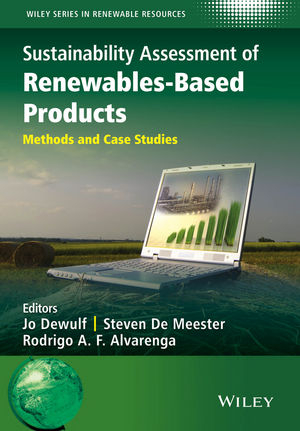
Sustainability Assessment of Renewables-Based Products (eBook)
Over the past decade, renewables-based technology and sustainability assessment methods have grown tremendously. Renewable energy and products have a significant role in the market today, and the same time sustainability assessment methods have advanced, with a growing standardization of environmental sustainability metrics and consideration of social issues as part of the assessment.
Sustainability Assessment of Renewables-Based Products: Methods and Case Studies is an extensive update and sequel to the 2006 title Renewables-Based Technology: Sustainability Assessment. It discusses the impressive evolution and role renewables have taken in our modern society, highlighting the importance of sustainability principles in the design phase of renewable-based technologies, and presenting a wide range of sustainability assessment methods suitable for renewables-based technologies, together with case studies to demonstrate their applications.
This book is a valuable resource for academics, businesses and policy makers who are active in contributing to more sustainable production and consumption.
For more information on the Wiley Series in Renewable Resources, visit www.wiley.com/go/rrs
Topics covered include:
• The growing role of renewables in our society
• Sustainability in the design phase of products and processes
• Principles of sustainability assessment
• Land use analysis
• Water use analysis
• Material and energy flow analysis
• Exergy and cumulative exergy analysis
• Carbon and environmental footprint methods
• Life Cycle Assessment (LCA), social Life Cycle Assessment and Life Cycle Costing (LCC)
• Case studies: renewable energy, bio-based chemicals and bio-based materials.
Over the past decade, renewables-based technology and sustainability assessment methods have grown tremendously. Renewable energy and products have a significant role in the market today, and the same time sustainability assessment methods have advanced, with a growing standardization of environmental sustainability metrics and consideration of social issues as part of the assessment. Sustainability Assessment of Renewables-Based Products: Methods and Case Studies is an extensive update and sequel to the 2006 title Renewables-Based Technology: Sustainability Assessment. It discusses the impressive evolution and role renewables have taken in our modern society, highlighting the importance of sustainability principles in the design phase of renewable-based technologies, and presenting a wide range of sustainability assessment methods suitable for renewables-based technologies, together with case studies to demonstrate their applications. This book is a valuable resource for academics, businesses and policy makers who are active in contributing to more sustainable production and consumption. For more information on the Wiley Series in Renewable Resources, visit www.wiley.com/go/rrs Topics covered include: The growing role of renewables in our society Sustainability in the design phase of products and processes Principles of sustainability assessment Land use analysis Water use analysis Material and energy flow analysis Exergy and cumulative exergy analysisCarbon and environmental footprint methods Life Cycle Assessment (LCA), social Life Cycle Assessment and Life Cycle Costing (LCC) Case studies: renewable energy, bio-based chemicals and bio-based materials.
Prof. Dr. Jo Dewulf, Institute for Environment and Sustainability, JRC, European Commision, Italy and Sustainable Organic Chemistry and Technology, Ghent University, Belgium Professor Dewulf performs research in the areas of environmental chemistry, environmental technology and clean technology at Ghent University. Since December 2013, he has been working as a senior researcher in the Institute for Environment and Sustainability at the Joint Research Institute of the European Commission. Key in his work is managing natural resources in a technically efficient way, performing thermodynamics based sustainability analysis at process, plant and cradle-to-gate level to support the development and assessment of new technologies. Supported by: Dr Steven De Meester, Sustainable Organic Chemistry and Technology, Ghent University, Belgium Dr De Meester works on the development of sustainability assessment methodologies for new technologies and applications of Life Cycle Assessment in industry. Dr Rodrigo Alvarenga, Universidade Federal de Santa Catarina, Brazil
List of Contributors
Rodrigo A.F. Alvarenga
Departamento de Engenharia Ambiental, Centro de Ciências Agroveterinárias (CAV), Universidade do Estado de Santa Catarina (UDESC); and EnCiclo Soluções Sustentáveis, Brazil
Fulvio Ardente
European Commission, Joint Research Centre, Institute for Environment and Sustainability, Italy
Gudni Axelsson
Environment and Natural Resources, School of Engineering and Natural Sciences and Institute of Sustainability Studies, University of Iceland; and Geothermal Training Department, Iceland GeoSurvey (ISOR), Iceland
Markus Berger
Chair of Sustainable Engineering, TU Berlin, Germany
Antonio Bonomi
Brazilian Center of Research in Energy and Materials (CNPEM), Brazilian Bioethanol Science and Technology Laboratory (CTBE), Brazil
Michael Borucke
Global Footprint Network, U.S.A.
Henk Bosch
DSM Corporate Operations & Responsible Care, The Netherlands
Miguel Brandão
International Energy Agency, IEA Bioenergy Task 38, Portugal
Patrizia Buttol
ENEA, LCA and Ecodesign Laboratory, Italy
Otavio Cavalett
Brazilian Center of Research in Energy and Materials (CNPEM), Brazilian Bioethanol Science and Technology Laboratory (CTBE), Brazil
Maurizio Cellura
Dipartimento dell’Energia, Università degli Studi di Palermo, Italy
Mateus F. Chagas
Brazilian Center of Research in Energy and Materials (CNPEM), Brazilian Bioethanol Science and Technology Laboratory (CTBE), Brazil
Andreas Ciroth
GreenDelta, Germany
Brynhildur Davidsdottir
Environment and Natural Resources, School of Engineering and Natural Sciences and Institute of Sustainability Studies, University of Iceland, Iceland
Jo Dewulf
Research Group ENVOC, Faculty of Bioscience Engineering, Department of Sustainable Organic Chemistry and Technology, Ghent University, Belgium; and Institute for Environment and Sustainability, European Commission – Joint Research Centre, Italy
Jean-Pierre Duda
ROQUETTE, Group Industrial Development Department, France
Pauline Feschet
INRA, UMR LAE Nancy-Colmar, France
Koichi Fujie
Institute of Advanced Science, Yokohama National University, Japan
Alessandro Galli
Global Footprint Network, International Environment House 2, Switzerland
Charles Gordon
BRITEST Ltd, The Heath, UK
Maarten van der Graaf
DSM Biotechnology Center, The Netherlands
Nicole Grunewald
Global Footprint Network, International Environment House 2, Switzerland
Helmut Haberl
Institute of Social Ecology Vienna, Alpen-Adria Universität Klagenfurt, Austria; and Integrative Research Institute on Transformations of Human-Environment Systems (IRI THESys), Humboldt-Universität zu Berlin, Germany
Geoffrey P. Hammond
Department of Mechanical Engineering; and Institute for Sustainable Energy and the Environment (ISEE), University of Bath, UK
Udin Hasanudin
Department of Agricultural Technology, University of Lampung, Indonesia
Jutta Hildenbrand
GreenDelta, Germany
Karin Höglmeier
Holzforschung München, Chair of Wood Science, Technische Universität München, Germany
Jeroen den Hollander
DSM Biotechnology Center, The Netherlands
Zdenek Hruska
Solvin, Belgium
Sofie Huysman
Research Group ENVOC, Ghent University, Belgium
Katsunori Iha
Global Footprint Network, U.S.A.
Nathalie Iofrida
Department of Agriculture (AGRARIA), Mediterranean University of Reggio Calabria, Italy
Philipp-Maximilian Jacob
Department of Chemical Engineering and Biotechnology, University of Cambridge, UK
Tassia L. Junqueira
Brazilian Center of Research in Energy and Materials (CNPEM), Brazilian Bioethanol Science and Technology Laboratory (CTBE), Brazil
Hirotsugu Kamahara
Department of Environmental and Life Sciences, Toyohashi University of Technology, Japan
Andreas Kicherer
Sustainability Strategy, BASF SE, Germany
Claudius Kormann
Corporate Sustainability Strategy, BASF SE, Germany
Anne Lambin
ROQUETTE, Sustainable Development Department, France
Alexei Lapkin
Department of Chemical Engineering and Biotechnology, University of Cambridge, UK
Elias Lazarus
Global Footprint Network, U.S.A.
Michael Lettenmeier
Research Group Sustainable Production and Consumption, Wuppertal Institute for Climate, Environment and Energy GmbH, Germany; and Department of Design, Aalto University, Finland
David Lin
Global Footprint Network, U.S.A.
Sonia Longo
Dipartimento dell’Energia, Università degli Studi di Palermo, Italy
Anna Irene De Luca
Department of Agriculture (AGRARIA), Mediterranean University of Reggio Calabria, Italy
Lucia Mancini
European Commission Joint Research Centre, Sustainability Assessment Unit; and Department of Agricultural, Food and Environmental Sciences, Marche Polytechnic University, Italy
Serena Mancini
Global Footprint Network, International Environment House 2, Switzerland; and Department of Physical Science, Earth and Environment, University of Siena, Italy
Jon Martindill
Global Footprint Network, U.S.A.
Fabrice Mathieux
European Commission, Joint Research Centre, Institute for Environment and Sustainability, Sustainability Assessment Unit, Italy
Steven De Meester
Faculty of Bioscience Engineering, Ghent University, Belgium
Marina Mistretta
Dipartimento Patrimonio, Architettura, Urbanistica, Università degli Studi Mediterranea di Reggio Calabria, Italy
Goto Naohiro
Department of Environmental and Life Sciences, Toyohashi University of Technology, Japan
Rana Pant
European Commission, Joint Research Centre, Institute for Environment and Sustainability, Sustainability Assessment Unit, Italy
Akshay D. Patel
Copernicus Institute of Sustainable Development, Utrecht University, The Netherlands
Martin K. Patel
Institute for Environmental Sciences and Forel Institute, Energy Group, University of Geneva, Switzerland
Amy Peace
BRITEST Ltd, The Heath, UK
Stephan Pfister
Institute of Environmental Engineering, ETH Zürich, Switzerland
John A. Posada
Copernicus Institute of Sustainable Development, Utrecht University, The Netherlands
Klaus Richter
Holzforschung München, Chair of Wood Science, Technische Universität München, Germany
Wilfried G.J.H.M. van Sark
Copernicus Institute of Sustainable Development, Utrecht University, The Netherlands
Thomas Schaubroeck
Research Group ENVOC, Ghent University, Belgium
J. Gerard Schepers
ECN Wind Energy Technology; and University of Applied Sciences NHL, The Netherlands
Sala Serenella
European Commission, Joint Research Centre, Institute for Environment and Sustainability, Sustainability Assessment Unit, Italy
Maartje N. Sevenster
Sevenster Environmental, Australia
Li Shen
Institute for Environmental Sciences and Forel Institute, Energy Group, University of Geneva, Switzerland
Ruth Shortall
Environment and Natural Resources, School of Engineering and Natural Sciences and Institute of Sustainability Studies, University of Iceland, Iceland
Marieke Smidt
Reverdia, The Netherlands
Alexandre Souza
Brazilian Center of Research in Energy and Materials (CNPEM), Brazilian Bioethanol Science and Technology Laboratory (CTBE), Brazil
Bengt Steen
Division Environmental Systems Analysis, Chalmers University of Technology, Sweden
Ryuichi Tachibana
Department of Forest Science, Tokyo University of Agriculture, Japan
Sue Ellen Taelman
Faculty of Bioscience Engineering, Ghent University, Belgium
Nova Ulhasanah
Department of Environmental and Life Sciences, Toyohashi University of Technology, Japan
Francesca Verones
Department of Energy and Process Engineering, Industrial Ecology Programme, Norway
Mathis Wackernagel
Global Footprint Network, U.S.A.
Marcos D.B. Watanabe
Brazilian Center of Research in Energy and Materials (CNPEM), Brazilian Bioethanol Science and Technology Laboratory (CTBE), Brazil
Alain Wathelet
Solvay S.A., Belgium
Gabriele Weber-Blaschke
Holzforschung München, Chair of Wood Science, Technische Universität München, Germany
Jan Diederik A.M. van Wees
TNO Sustainable Geo-Energy TNO; and Department of Earth Science, Utrecht University, The Netherlands
Yang...
| Erscheint lt. Verlag | 17.11.2015 |
|---|---|
| Reihe/Serie | Wiley Series in Renewable Resource |
| Wiley Series in Renewable Resources | Wiley Series in Renewable Resources |
| Sprache | englisch |
| Themenwelt | Naturwissenschaften ► Biologie ► Ökologie / Naturschutz |
| Naturwissenschaften ► Chemie | |
| Technik ► Elektrotechnik / Energietechnik | |
| Schlagworte | Agriculture • Bio(-)based • biomass • Biorenewable Resources • Chemie • Chemistry • Energie • Energie u. Umweltaspekte • Energy • Energy & Environmental Impact • footprint • geothermal • Landwirtschaft • Life Cycle Assessment • Nachhaltige u. Grüne Chemie • Nachhaltige u. Grüne Chemie • Nachwachsende Rohstoffe • Renewable(s) • Solar (energy) • Sustainability Assessment • Sustainable Chemistry & Green Chemistry • sustainable development • Wind (power) |
| ISBN-10 | 1-118-93392-3 / 1118933923 |
| ISBN-13 | 978-1-118-93392-3 / 9781118933923 |
| Informationen gemäß Produktsicherheitsverordnung (GPSR) | |
| Haben Sie eine Frage zum Produkt? |
 EPUB (Adobe DRM)
Kopierschutz: Adobe-DRM
Adobe-DRM ist ein Kopierschutz, der das eBook vor Mißbrauch schützen soll. Dabei wird das eBook bereits beim Download auf Ihre persönliche Adobe-ID autorisiert. Lesen können Sie das eBook dann nur auf den Geräten, welche ebenfalls auf Ihre Adobe-ID registriert sind.
Details zum Adobe-DRM
Dateiformat: EPUB (Electronic Publication)
EPUB ist ein offener Standard für eBooks und eignet sich besonders zur Darstellung von Belletristik und Sachbüchern. Der Fließtext wird dynamisch an die Display- und Schriftgröße angepasst. Auch für mobile Lesegeräte ist EPUB daher gut geeignet.
Systemvoraussetzungen:
PC/Mac: Mit einem PC oder Mac können Sie dieses eBook lesen. Sie benötigen eine
eReader: Dieses eBook kann mit (fast) allen eBook-Readern gelesen werden. Mit dem amazon-Kindle ist es aber nicht kompatibel.
Smartphone/Tablet: Egal ob Apple oder Android, dieses eBook können Sie lesen. Sie benötigen eine
Geräteliste und zusätzliche Hinweise
Buying eBooks from abroad
For tax law reasons we can sell eBooks just within Germany and Switzerland. Regrettably we cannot fulfill eBook-orders from other countries.
aus dem Bereich