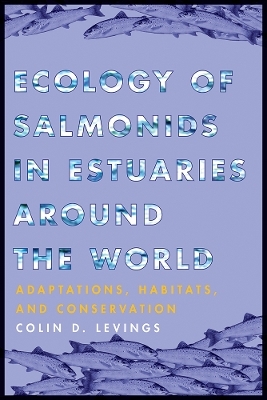
Ecology of Salmonids in Estuaries Around the World
University of British Columbia Press (Verlag)
978-0-7748-3173-4 (ISBN)
For centuries, biologists have marvelled at how anadromous salmonids – fish that pass from rivers into oceans and back again – survive as they migrate between these two very different environments. Yet, relatively little is understood about what happens to salmonid species (including salmon, steelhead, char, and trout) in the estuaries where they make this transition from fresh to salt water. This book explains the critical role estuaries play in salmonid survival.
Ecology of Salmonids in Estuaries around the World synthesizes information from a vast array of literature, to
describe the specific adaptation of eighteen anadromous salmonids in four genera (Hucho, Oncorhynchus, Salmo, and Salvelinus)
explain the ecological relationships between anadromous salmonids, the fish they coexist with, and their estuarine habitat
discuss key fitness elements salmonids need for survival (including those relating to osmoregulation, growth and feeding mechanisms, and biotic interactions)
provide guidance on how to conduct estuarine sampling and scientific aspects of management and recovery plans
offer directions for future research.
The critical reference is further enhanced by extensive supplementary appendices that are available online, including data tables, additional references on estuarine salmonids, and a primer on estuaries and salmonids for citizen scientists.
Colin D. Levings is a scientist emeritus at the Department of Fisheries and Oceans' Centre for Aquaculture and Environmental Research in West Vancouver, British Columbia, and an adjunct faculty member of the Institute for Resources, Environment, and Sustainability at the University of British Columbia. He has published over 200 papers and reports in international journals and report series and has served as an associate editor or editorial advisor for Marine Ecology Progress Series, Canadian Journal of Fisheries and Aquatic Sciences, Estuaries, and Journal of Oceanography (Japan). He has been a member of Canadian fisheries delegations to Russia and Korea; has participated in international exchanges with Norwegian, Korean, and Japanese estuarine scientists; and served as a member of the Marine Environmental Quality Working Group of the North Pacific Marine Science Organization (PICES). He is a founding member and past president of the Pacific Estuarine Research Society, a member of the Coastal and Estuarine Research Federation, and a member of the American Fisheries Society.
Preface
1 Why a Focus on Salmonids in Estuaries?
2 What Salmonids and Estuaries to Consider
3 Salmonid's-Eye View of the Estuary: Physical, Chemical, and Geological Aspects
4 What Habitats are Used by Salmonids in Estuaries?
5 Global Distribution of Salmonid Species and Local Salmonid Diversity in Estuaries
6 How Have Salmonid Abundance and Distribution Been Assessed in Estuaries?
7 How Do Salmonids Behave in Estuary Habitat?
8 Salmonid Growth in the Estuary
9 Smolting and Osmoregulation
10 Habitat-Based Food Webs Supporting Salmonids in the Natural Estuary
11 Biotic Interactions in the Natural Estuary
12 How Have Habitat and Water Properties Changed for Salmonids in Estuaries?
13 Salmonid Survival in Estuaries
14 Effects of Habitat and Community Change on Fitness Components for Survival in the Disrupted Estuary
15 Harvesting and Production of Salmonids and Other Ecosystem Services Provided by the Estuary
16 Health of Salmonids in Estuaries
17 What Shapes an Estuary for Salmonids?
18 Future Considerations for Conservation of Salmonids in Estuaries
19 Conclusion
Glossary; References; Index
| Erscheinungsdatum | 21.09.2016 |
|---|---|
| Zusatzinfo | 7 b&w photographs, 2 maps, 29 illustrations |
| Verlagsort | Vancouver |
| Sprache | englisch |
| Maße | 152 x 229 mm |
| Gewicht | 680 g |
| Themenwelt | Sachbuch/Ratgeber ► Natur / Technik ► Naturführer |
| Naturwissenschaften ► Biologie ► Ökologie / Naturschutz | |
| Weitere Fachgebiete ► Land- / Forstwirtschaft / Fischerei | |
| ISBN-10 | 0-7748-3173-1 / 0774831731 |
| ISBN-13 | 978-0-7748-3173-4 / 9780774831734 |
| Zustand | Neuware |
| Informationen gemäß Produktsicherheitsverordnung (GPSR) | |
| Haben Sie eine Frage zum Produkt? |
aus dem Bereich