


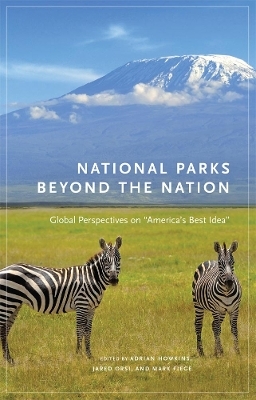
National Parks Beyond the Nation
Global Perspectives on ""America's Best Idea
Seiten
2016
University of Oklahoma Press (Verlag)
978-0-8061-5225-7 (ISBN)
University of Oklahoma Press (Verlag)
978-0-8061-5225-7 (ISBN)
Brings together the work of fifteen scholars and writers to reveal the tremendous diversity of the global national park experience - an experience sometimes influencing, sometimes influenced by, and sometimes with no reference whatever to the United States.
The idea of a national park was an American invention of historic consequences marking the beginning of a worldwide movement,"" the U.S. National Park Service asserts in its 2006 Management Policies. National Parks beyond the Nation brings together the work of fifteen scholars and writers to reveal the tremendous diversity of the global national park experience - an experience sometimes influencing, sometimes influenced by, and sometimes with no reference whatever to the United States.
Writer and historian Wallace Stegner once called national parks ""America's best idea."" The contributors to this volume use that exceptionalist claim as a starting point for thinking about an international history of national parks. They explore the historical interactions and influences - intellectual, political, and material - within and between national park systems in Canada, New Zealand, South Africa, Indonesia, Antarctica, Brazil, and other countries. What is the role of science in the history of these preserves? Of politics? What purposes do they serve: Conservation? Education? Reverence toward nature? Tourist pleasure?
People have thought differently about national parks at different times and in different places; and neat physical boundaries have been disrupted by wandering animals, human movements, the spread of disease, and climate change. Viewing parks around the world, at various scales and across national frontiers, these essays offer a panoptic view of the common and contrasting cultural and environmental features of national parks worldwide.
If national parks are, as Stegner said, ""absolutely American,"" they are no less part of the world at large. National Parks beyond the Nation tells us as much about the multifarious and changing ideas of nature and culture as about the framing of those ideas in geographic, temporal, and national terms.
The idea of a national park was an American invention of historic consequences marking the beginning of a worldwide movement,"" the U.S. National Park Service asserts in its 2006 Management Policies. National Parks beyond the Nation brings together the work of fifteen scholars and writers to reveal the tremendous diversity of the global national park experience - an experience sometimes influencing, sometimes influenced by, and sometimes with no reference whatever to the United States.
Writer and historian Wallace Stegner once called national parks ""America's best idea."" The contributors to this volume use that exceptionalist claim as a starting point for thinking about an international history of national parks. They explore the historical interactions and influences - intellectual, political, and material - within and between national park systems in Canada, New Zealand, South Africa, Indonesia, Antarctica, Brazil, and other countries. What is the role of science in the history of these preserves? Of politics? What purposes do they serve: Conservation? Education? Reverence toward nature? Tourist pleasure?
People have thought differently about national parks at different times and in different places; and neat physical boundaries have been disrupted by wandering animals, human movements, the spread of disease, and climate change. Viewing parks around the world, at various scales and across national frontiers, these essays offer a panoptic view of the common and contrasting cultural and environmental features of national parks worldwide.
If national parks are, as Stegner said, ""absolutely American,"" they are no less part of the world at large. National Parks beyond the Nation tells us as much about the multifarious and changing ideas of nature and culture as about the framing of those ideas in geographic, temporal, and national terms.
Adrian Howkins is an Associate Professor of History at Colorado State University, Fort Collins, is author of The Polar Regions: An Environmental History. Jared Orsi, is Professor of History at Colorado State University, is author of Hazardous Metropolis: Flooding and Urban Ecology in Los Angeles and Citizen Explorer: The Life of Zebulon Pike. Mark Fiege is Professor of History at Colorado State University and author of Irrigated Eden: The Making of an Agricultural Landscape in the American West and The Republic of Nature: An Environmental History of the United States. All three are council members of the Public Lands History Center.
| Erscheinungsdatum | 26.04.2016 |
|---|---|
| Reihe/Serie | Public Lands History |
| Zusatzinfo | 3 maps, 2 tables |
| Verlagsort | Oklahoma |
| Sprache | englisch |
| Maße | 156 x 235 mm |
| Gewicht | 653 g |
| Themenwelt | Geisteswissenschaften ► Geschichte ► Allgemeine Geschichte |
| Geisteswissenschaften ► Geschichte ► Regional- / Ländergeschichte | |
| Naturwissenschaften ► Biologie ► Ökologie / Naturschutz | |
| Sozialwissenschaften | |
| Technik ► Umwelttechnik / Biotechnologie | |
| Wirtschaft ► Allgemeines / Lexika | |
| Wirtschaft ► Volkswirtschaftslehre | |
| ISBN-10 | 0-8061-5225-7 / 0806152257 |
| ISBN-13 | 978-0-8061-5225-7 / 9780806152257 |
| Zustand | Neuware |
| Informationen gemäß Produktsicherheitsverordnung (GPSR) | |
| Haben Sie eine Frage zum Produkt? |
Mehr entdecken
aus dem Bereich



aus dem Bereich
eine Reise um die Welt zu außergewöhnlichen Persönlichkeiten, …
Buch | Softcover (2023)
Piper (Verlag)
CHF 25,20
Eine wahre Geschichte von Schiffbruch, Mord und Meuterei
Buch | Hardcover (2024)
C.Bertelsmann (Verlag)
CHF 34,95


