Practical Graph Analytics with Apache Giraph (eBook)
XIX, 315 Seiten
Apress (Verlag)
9781484212516 (ISBN)
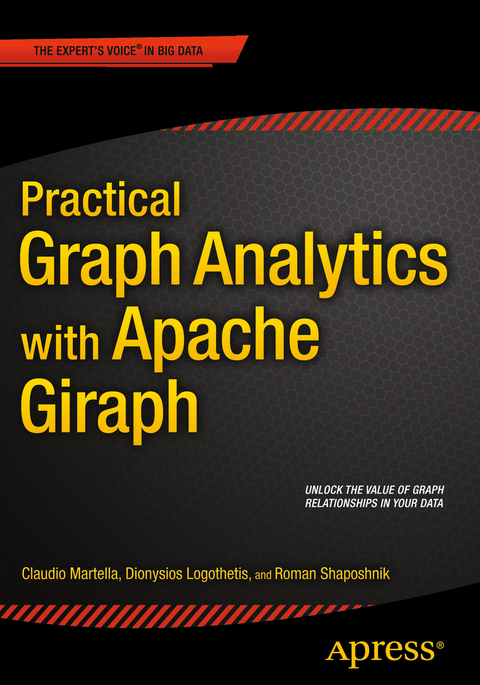
Practical Graph Analytics with Apache Giraph helps you build data mining and machine learning applications using the Apache Foundation's Giraph framework for graph processing. This is the same framework as used by Facebook, Google, and other social media analytics operations to derive business value from vast amounts of interconnected data points.
Graphs arise in a wealth of data scenarios and describe the connections that are naturally formed in both digital and real worlds. Examples of such connections abound in online social networks such as Facebook and Twitter, among users who rate movies from services like Netflix and Amazon Prime, and are useful even in the context of biological networks for scientific research. Whether in the context of business or science, viewing data as connected adds value by increasing the amount of information available to be drawn from that data and put to use in generating new revenue or scientific opportunities.
Apache Giraph offers a simple yet flexible programming model targeted to graph algorithms and designed to scale easily to accommodate massive amounts of data. Originally developed at Yahoo!, Giraph is now a top top-level project at the Apache Foundation, and it enlists contributors from companies such as Facebook, LinkedIn, and Twitter. Practical Graph Analytics with Apache Giraph brings the power of Apache Giraph to you, showing how to harness the power of graph processing for your own data by building sophisticated graph analytics applications using the very same framework that is relied upon by some of the largest players in the industry today.
Roman Shaposhnik is a vice-president and one of the lead developers of Apache Bigtop, a 100% open source and community-driven big data management distribution built on top of Apache Hadoop. He has been working on making Hadoop ecosystem components more accessible and easier to use, and he has contributed to a wide array of Apache projects from Avro to Zookeeper. In addition to his day job building Data Fabric APIs at Pivotal Inc., Roman currently serves as a vice-president of Apache Incubator, helping exciting and new open source projects join the Apache family.
Practical Graph Analytics with Apache Giraph helps you build data mining and machine learning applications using the Apache Foundation's Giraph framework for graph processing. This is the same framework as used by Facebook, Google, and other social media analytics operations to derive business value from vast amounts of interconnected data points. Graphs arise in a wealth of data scenarios and describe the connections that are naturally formed in both digital and real worlds. Examples of such connections abound in online social networks such as Facebook and Twitter, among users who rate movies from services like Netflix and Amazon Prime, and are useful even in the context of biological networks for scientific research. Whether in the context of business or science, viewing data as connected adds value by increasing the amount of information available to be drawn from that data and put to use in generating new revenue or scientific opportunities. Apache Giraph offers a simple yet flexible programming model targeted to graph algorithms and designed to scale easily to accommodate massive amounts of data. Originally developed at Yahoo!, Giraph is now a top top-level project at the Apache Foundation, and it enlists contributors from companies such as Facebook, LinkedIn, and Twitter. Practical Graph Analytics with Apache Giraph brings the power of Apache Giraph to you, showing how to harness the power of graph processing for your own data by building sophisticated graph analytics applications using the very same framework that is relied upon by some of the largest players in the industry today.
Roman Shaposhnik is a vice-president and one of the lead developers of Apache Bigtop, a 100% open source and community-driven big data management distribution built on top of Apache Hadoop. He has been working on making Hadoop ecosystem components more accessible and easier to use, and he has contributed to a wide array of Apache projects from Avro to Zookeeper. In addition to his day job building Data Fabric APIs at Pivotal Inc., Roman currently serves as a vice-president of Apache Incubator, helping exciting and new open source projects join the Apache family.
Part I: Giraph Building Blocks1. Introduction to Graphs and Giraph2. Modeling Graph Processing Use Cases3. The Giraph Programming Model4. Giraph Algorithmic Building BlocksPart II: Giraph Overview5. Working with Giraph6. Giraph Architecture7. Graph I/O Formats8. Beyond the Basic APIPart III: Advanced Topics9. Exposing Parallelism in Giraph10. Beyond HDFS11. Giraph Tuning12. Giraph in the Cloud
| Erscheint lt. Verlag | 19.11.2015 |
|---|---|
| Zusatzinfo | XIX, 315 p. 104 illus. |
| Verlagsort | Berkeley |
| Sprache | englisch |
| Themenwelt | Mathematik / Informatik ► Informatik ► Software Entwicklung |
| Informatik ► Theorie / Studium ► Künstliche Intelligenz / Robotik | |
| Naturwissenschaften ► Biologie | |
| ISBN-13 | 9781484212516 / 9781484212516 |
| Informationen gemäß Produktsicherheitsverordnung (GPSR) | |
| Haben Sie eine Frage zum Produkt? |
 PDF (Wasserzeichen)
DRM: Digitales Wasserzeichen
Dieses eBook enthält ein digitales Wasserzeichen und ist damit für Sie personalisiert. Bei einer missbräuchlichen Weitergabe des eBooks an Dritte ist eine Rückverfolgung an die Quelle möglich.
Dateiformat: PDF (Portable Document Format)
Mit einem festen Seitenlayout eignet sich die PDF besonders für Fachbücher mit Spalten, Tabellen und Abbildungen. Eine PDF kann auf fast allen Geräten angezeigt werden, ist aber für kleine Displays (Smartphone, eReader) nur eingeschränkt geeignet.
Systemvoraussetzungen:
PC/Mac: Mit einem PC oder Mac können Sie dieses eBook lesen. Sie benötigen dafür einen PDF-Viewer - z.B. den Adobe Reader oder Adobe Digital Editions.
eReader: Dieses eBook kann mit (fast) allen eBook-Readern gelesen werden. Mit dem amazon-Kindle ist es aber nicht kompatibel.
Smartphone/Tablet: Egal ob Apple oder Android, dieses eBook können Sie lesen. Sie benötigen dafür einen PDF-Viewer - z.B. die kostenlose Adobe Digital Editions-App.
Buying eBooks from abroad
For tax law reasons we can sell eBooks just within Germany and Switzerland. Regrettably we cannot fulfill eBook-orders from other countries.
aus dem Bereich