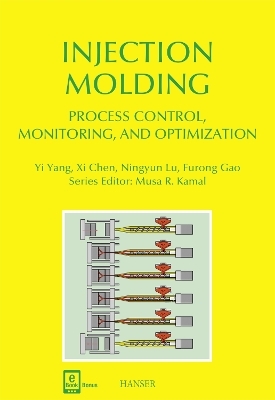
Injection Molding Process Control, Monitoring, and Optimization
Hanser Publications (Verlag)
978-1-56990-592-0 (ISBN)
Zu diesem Buch erhalten Sie kostenlos ein eBook dazu.
It is divided into four parts: the first part provides general background to introduce the injection molding process, the second covers the control of the process, the third is on the monitoring technology, and the fourth is concerned with the optimization of the process. Most the results within are from real engineering implementations and experimental tests.
With the purchase of this book, you also receive a free personal access code to download the eBook.
Dr. Furong Gao received his B.Eng. degree in Automation from the East China Institute of Petroleum in 1985 and M.Eng. and Ph.D. degrees in Chemical Engineering from McGill University, Canada, in 1989 and 1993, respectively. Currently, he is a Chair Professor of Chemical and Biomolecular Engineering at the Hong Kong University of Science and Technology (HKUST), and a “State Thousand Talents (B)” Professor at the Department of Control Science and Engineering, Zhejaing University, China. Concurrent to his professorial appointment, he serves HKUST also as the Associate Dean of Fok Ying Tung Graduate School, and the Director of the Division of Advanced Manufacturing and Automation. Professional Affiliations: Fellow, Society of Plastics Engineers; Consultant, Hong Kong Plastics Machinery Association; Funding Director, Society of Advanced Molding Technology; Member, International Federation of Automatic Control (IFAC) Technical Committee; Associate Editor, Journal of Process Control; Editorial Advisor, Industrial & Engineering Chemistry Research; Engineering Subject Editor, Arabian Journal of Engineering and Science; Editorial Member, China Plastics; Editorial Member, Control & Decision.
Chapter 1 INJECTION MOLDING: MACHINE AND PROCESS 1.1Introduction of general polymer processing 1.2Polymer material and characteristics 1.3Injection molding machine 1.4Injection molding process Chapter 2 EVOLUTION OF SYSTEMS TECHNOLOGIES IN INJECTION MOLDING 2.1 Introduction of systems technology 2.2 Evolution of process control technology in injection molding 2.3 Evolution of process monitoring technology in injection molding 2.4 Evolution of process optimization technology in injection molding Control Chapter 3 FEEDBACK CONTROL ALGORITHMS DEVELOPED FOR CONTINUOUS PROCESSES 3.1 Introduction of feedback control background 3.2 Traditional feedback control: PID 3.3 Adaptive control 3.4 Model predictive control: GPC 3.5 Optimal control 3.6 Fuzzy and Artificial Neural Networks control Chapter 4 LEARNING TYPE CONTROL DEVELOPED FOR REPETITIVE PROCESS 4.1 Introduction of learning type control background 4.2 Basic iterative learning control 4.3 Optimal iterative learning control Chapter 5 TWO-DIMENSIONAL CONTROL ALGORITHMS 5.1 Introduction of two-dimensional control background 5.2 Two-dimensional robust control 5.3 Two-dimensional optimal control 5.4 Two-dimensional model predictive control Chapter 6 FAULT-TOLERANT CONTROL IN INJECTION MOLDING 6.1 Introduction of fault-tolerant control injection molding 6.2 Active fault-tolerant control with sensor failure: an example Monitoring Chapter 7 STATISTICAL PROCESS MONITORING (SPM) 7.1 Process monitoring for continuous processes 7.2 Process monitoring for batch processes Chapter 8 SPM BASED ON PHASE RECOGNITION AND HARD PARTITION STRATEGY 8.1 Data-driven phase recognition and phase partition 8.2 Phase-based SPM in injection molding 8.3 SPM with limited modeling data 8.4 Quality-oriented process monitoring Chapter 9 SPM BASED ON SOFT PHASE PARTITION STRATEGY 9.1 Transition-based soft phase partition 9.2 Soft phase-based SPM in injection molding 9.3 Dissimilarity analysis based process monitoring 9.4 Dissimilarity analysis based nonlinear process monitoring 9.5 Adaptive process monitoring in injection molding Chapter 10 TWO-DIMENSIONAL MODEL-BASED PROCESS MONITORING & FAULT DIAGNOSIS 10.1 Two dimensional dynamic principal component analysis (2D-DPCA) 10.2 2D-DPCA based process monitoring 10.3 2D-DPCA based fault diagnosis Optimization Chapter 11 IN-MOLD CAPACITIVE TRANSDUCER FOR INJECTION MOLDING PROCESS 11.1Principle of capacitive transducers 11.2Hardware design of the in-mold capacitive transducer 11.3Detection of the melt flow in filling stage 11.4Detection of in-mold status in packing & cooling stage 11.5Application for online part weight prediction and fault detection Chapter 12 OPTIMAL PROFILING FOR FILLING STAGE 12.1Introduction 12.2Constant melt-front-velocity strategy 12.3Soft-sensor development of average-flow-length 12.4Uniform filling based on optimization 12.5Optimal profile of injection velocity for different mold shapes Chapter 13 OPTIMAL PROFILING FOR PACKING STAGE 13.1Introduction 13.2Online auto-detection of gate freezing-off point 13.3Influence of packing profile on part quality 13.4Profiling of packing pressure Chapter 14 PARAMETER SETTING FOR PLASTICATION STAGE 14.1Introduction 14.2Neural network modeling of melt temperature 14.3Optimal parameter setting Chapter 15 MODEL FREE OPTIMIZATION FOR PART QUALITY CONTROL 15.1Model free optimization strategy for injection molding process 15.2Gradient-based algorithm 15.3Non-gradient-based algorithm 15.4Part weight control via MFO 15.5Focal length control via MFO
| Erscheinungsdatum | 06.06.2016 |
|---|---|
| Sprache | englisch |
| Maße | 174 x 248 mm |
| Gewicht | 988 g |
| Themenwelt | Naturwissenschaften ► Chemie ► Technische Chemie |
| Technik ► Elektrotechnik / Energietechnik | |
| Technik ► Maschinenbau | |
| Technik ► Umwelttechnik / Biotechnologie | |
| Schlagworte | injection molding • Plastics Processing • Process Control • Spritzgießen • Systems Technology |
| ISBN-10 | 1-56990-592-4 / 1569905924 |
| ISBN-13 | 978-1-56990-592-0 / 9781569905920 |
| Zustand | Neuware |
| Informationen gemäß Produktsicherheitsverordnung (GPSR) | |
| Haben Sie eine Frage zum Produkt? |
aus dem Bereich