


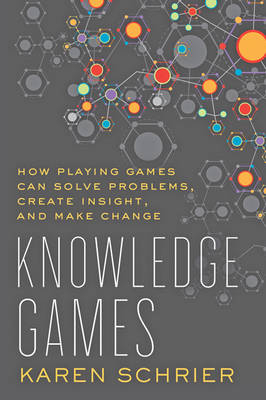
Knowledge Games
How Playing Games Can Solve Problems, Create Insight, and Make Change
Seiten
2016
Johns Hopkins University Press (Verlag)
978-1-4214-1920-6 (ISBN)
Johns Hopkins University Press (Verlag)
978-1-4214-1920-6 (ISBN)
- Titel z.Zt. nicht lieferbar
- Versandkostenfrei
- Auch auf Rechnung
- Artikel merken
This accessible book critiques the limits and implications of games and considers how they may redefine what it means to produce knowledge, to play, to educate, and to be a citizen.
Imagine if new knowledge and insights came not just from research centers, think tanks, and universities but also from games, of all things. Video games have been viewed as causing social problems, but what if they actually helped solve them? This question drives Karen Schrier's Knowledge Games, which seeks to uncover the potentials and pitfalls of using games to make discoveries, solve real-world problems, and better understand our world. For example, so-called knowledge games-such as Foldit, a protein-folding puzzle game, SchoolLife, which crowdsources bullying interventions, and Reverse the Odds, in which mobile game players analyze breast cancer data-are already being used by researchers to gain scientific, psychological, and humanistic insights. Schrier argues that knowledge games are potentially powerful because of their ability to motivate a crowd of problem solvers within a dynamic system while also tapping into the innovative data processing and computational abilities of games.
In the near future, Schrier asserts, knowledge games may be created to understand and predict voting behavior, climate concerns, historical perspectives, online harassment, susceptibility to depression, or optimal advertising strategies, among other things. In addition to investigating the intersection of games, problem solving, and crowdsourcing, Schrier examines what happens when knowledge emerges from games and game players rather than scientists, professionals, and researchers. This accessible book also critiques the limits and implications of games and considers how they may redefine what it means to produce knowledge, to play, to educate, and to be a citizen.
Imagine if new knowledge and insights came not just from research centers, think tanks, and universities but also from games, of all things. Video games have been viewed as causing social problems, but what if they actually helped solve them? This question drives Karen Schrier's Knowledge Games, which seeks to uncover the potentials and pitfalls of using games to make discoveries, solve real-world problems, and better understand our world. For example, so-called knowledge games-such as Foldit, a protein-folding puzzle game, SchoolLife, which crowdsources bullying interventions, and Reverse the Odds, in which mobile game players analyze breast cancer data-are already being used by researchers to gain scientific, psychological, and humanistic insights. Schrier argues that knowledge games are potentially powerful because of their ability to motivate a crowd of problem solvers within a dynamic system while also tapping into the innovative data processing and computational abilities of games.
In the near future, Schrier asserts, knowledge games may be created to understand and predict voting behavior, climate concerns, historical perspectives, online harassment, susceptibility to depression, or optimal advertising strategies, among other things. In addition to investigating the intersection of games, problem solving, and crowdsourcing, Schrier examines what happens when knowledge emerges from games and game players rather than scientists, professionals, and researchers. This accessible book also critiques the limits and implications of games and considers how they may redefine what it means to produce knowledge, to play, to educate, and to be a citizen.
Karen Schrier is an assistant professor of media arts, the director of the Play Innovation Lab, and the director of the Games and Emerging Media Program at Marist College. She is the editor of the Learning, Education, and Games series.
Acknowledgments
Introduction
Part I What Are Knowledge Games?
1. Contribution
2. Design
Part II Why Knowledge Games?
3. Problem Solving
4. Motivation
5. Social Interaction
Part III Perspectives, Potentials, and Pitfalls
6. Amateurs
7. Participation
8. Data
9. Knowledge
Appendix A. Categories and Example
Appendix B. Design Principles, Recommendations, Considerations, and Implications
Appendix C. Guiding Questions
Notes
Index
| Erscheinungsdatum | 07.07.2016 |
|---|---|
| Reihe/Serie | Tech.edu: A Hopkins Series on Education and Technology |
| Zusatzinfo | 18 Halftones, black and white |
| Verlagsort | Baltimore, MD |
| Sprache | englisch |
| Maße | 152 x 229 mm |
| Gewicht | 522 g |
| Themenwelt | Geschichte ► Teilgebiete der Geschichte ► Technikgeschichte |
| Naturwissenschaften | |
| Sozialwissenschaften ► Pädagogik | |
| ISBN-10 | 1-4214-1920-3 / 1421419203 |
| ISBN-13 | 978-1-4214-1920-6 / 9781421419206 |
| Zustand | Neuware |
| Informationen gemäß Produktsicherheitsverordnung (GPSR) | |
| Haben Sie eine Frage zum Produkt? |
Mehr entdecken
aus dem Bereich



aus dem Bereich
eine Geschichte der Fehlbarkeit von Mensch und Technologie
Buch | Hardcover (2025)
C.H.Beck (Verlag)
CHF 44,75
von Gutenberg bis zum Smartphone
Buch | Hardcover (2025)
Klett-Cotta (Verlag)
CHF 33,55
Buch | Softcover (2024)
Lehmanns Media (Verlag)
CHF 27,90


