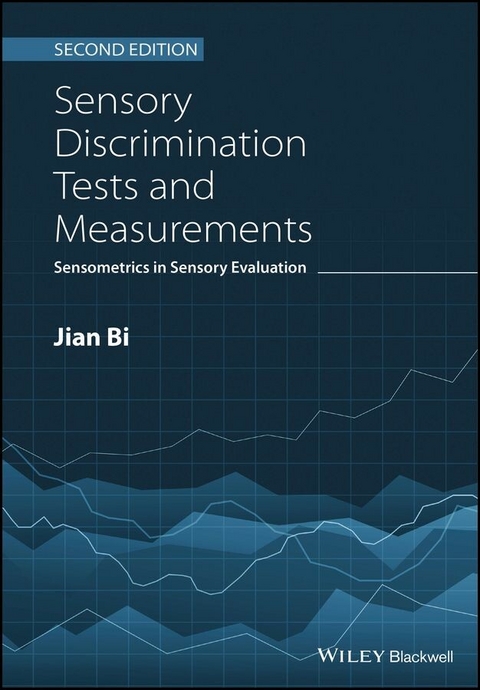
Sensory Discrimination Tests and Measurements (eBook)
John Wiley & Sons (Verlag)
978-1-118-99478-8 (ISBN)
Sensory testing and measurement are the main functions of sensory analysis. In recent years, the sensory and consumer field has evolved to include both difference testing and similarity testing, and new sensory discrimination methods such as the tetrads have received more attention in the literature.
This second edition of Sensory Discrimination Tests and Measurements is updated throughout and responds to these changes and includes:
- A wide range of sensory measurements:
- Measurements of sensory effect (d', R-index and Gini-index);
- Measurements of performance of trained sensory panel (Intraclass correlation coefficients and Cronbach?s coefficient alpha);
- Measurements of relative importance of correlated sensory and consumer attributes (drivers of consumer liking or purchase intent);
- Measurements of consumer emotions and psychographics;
- Measurements of time-intensity;
- Measurements of sensory thresholds;
- Measurements of sensory risk with negative sensory effects (Benchmark Dose, BMD, methodology)
- Measurements of sensory shelf life (SSL).
- A balanced introduction of sensory discrimination tests including difference tests and similarity tests.
- Bayesian approach to sensory discrimination tests.
- Modified and multiple-sample discrimination tests.
- Replicated discrimination tests using the beta-binomial (BB), corrected beta-binomial (CBB), and Dirichlet-multinomial (DM) models.
- Sensory discrimination methods including the tetrads and the ?M+N?.
- R and S-Plus codes for all the measurements and tests introduced in the book.
Mainly intended for researchers and practitioners in the sensory and consumer field, the book is a useful reference for modern sensory analysis and consumer research, especially for sensometrics.
Jian Bi is a consultant in sensometrics in the food and consumer product industries. From 1996 to 2000, he served as a Senior Statistician in the Institute for Perception in Richmond, VA, USA. Since 2000, he has, as an independent consultant, provided statistical consulting service and data analysis in sensory and consumer research for multiple companies, including Amway, Wrigley, Campbell Soup Company, Heinz, Kraft Foods, PepsiCo. Asia, and Mondelçz. He is the author or co-author of two books and more than 60 papers.
Sensory testing and measurement are the main functions of sensory analysis. In recent years, the sensory and consumer field has evolved to include both difference testing and similarity testing, and new sensory discrimination methods such as the tetrads have received more attention in the literature. This second edition of Sensory Discrimination Tests and Measurements is updated throughout and responds to these changes and includes: A wide range of sensory measurements: Measurements of sensory effect (d', R-index and Gini-index); Measurements of performance of trained sensory panel (Intraclass correlation coefficients and Cronbach's coefficient alpha); Measurements of relative importance of correlated sensory and consumer attributes (drivers of consumer liking or purchase intent); Measurements of consumer emotions and psychographics; Measurements of time-intensity; Measurements of sensory thresholds; Measurements of sensory risk with negative sensory effects (Benchmark Dose, BMD, methodology) Measurements of sensory shelf life (SSL). A balanced introduction of sensory discrimination tests including difference tests and similarity tests. Bayesian approach to sensory discrimination tests. Modified and multiple-sample discrimination tests. Replicated discrimination tests using the beta-binomial (BB), corrected beta-binomial (CBB), and Dirichlet-multinomial (DM) models. Sensory discrimination methods including the tetrads and the 'M+N'. R and S-Plus codes for all the measurements and tests introduced in the book. Mainly intended for researchers and practitioners in the sensory and consumer field, the book is a useful reference for modern sensory analysis and consumer research, especially for sensometrics.
Jian Bi is a consultant in sensometrics in the food and consumer product industries. From 1996 to 2000, he served as a Senior Statistician in the Institute for Perception in Richmond, VA, USA. Since 2000, he has, as an independent consultant, provided statistical consulting service and data analysis in sensory and consumer research for multiple companies, including Amway, Wrigley, Campbell Soup Company, Heinz, Kraft Foods, PepsiCo. Asia, and Mondelçz. He is the author or co-author of two books and more than 60 papers.
Preface xiii
Acknowledgements xv
About the companion website xvii
1 Introduction 1
2 Measurements of sensory difference/similarity: Thurstonian discriminal distance 8
3 Measurements of sensory difference/similarity: area under ROC curve in Signal Detection Theory 42
4 Difference testing 60
5 Similarity (equivalence) testing 98
6 Bayesian approach to discrimination tests 139
7 Modified discrimination tests 162
8 Multiple-sample discrimination tests 202
9 Replicated discrimination tests: beta-binomial model 255
10 Replicated discrimination tests: corrected beta-binomial model 283
11 Replicated discrimination tests: Dirichlet-multinomial (DM) model 301
12 Measurements of sensory thresholds 329
13 Measurements of sensory risk with negative sensory effects 345
14 Measurements of time intensity 365
15 Measurements of sensory shelf life 398
16 Measurements of the performance of a trained sensory panel and panelists 412
17 Measurements of consumer emotions and psychographics 444
18 Measurements of the relative importance of attributes 463
Appendix A List of R/S-Plus codes, data files, and packages used in the book 486
References 489
Author Index 517
Subject Index 525
Introduction
1.1 Sensometrics
This book is about sensometrics, focusing on sensory discrimination tests and measurements in the domain of sensory analysis. Sensometrics is a subfield of, or an area related to, sensory and consumer science. According to Brockhoff (2011), “Sensometrics is the scientific area that applies mathematical and statistical methods to model data from sensory and consumer science.” It is similar to psychometrics in psychology, biometrics in biology, chemometrics in chemistry, econometrics in economy, politimetrics in macropolitics, environmetrics in environmental sciences, and so on. Sensometrics has experienced rapid growth in both academia and industry within the last 2 or 3 decades. It plays an important role in modern sensory analysis and consumer research, especially in the coming Big Data era.
1.2 Sensory tests and measurements
The basic functions of sensory analysis are to provide reliable sensory measurements and to conduct valid tests. Statistical hypothesis testing is the theoretical basis of sensory tests. Statistical tests include both difference tests and similarity (equivalence) tests. The Thurstonian model (Thurstone 1927) and Signal Detection Theory (SDT) (Green and Swets 1966, Macmillan and Creelman 2005) are the theoretical basis for sensory effect measurement. Psychometric functions provide invariable indices that are independent of the methods used for measurements. Notably, the Thurstonian discriminal distance (or ) (ASTM 2012) and the area (R-index) under the receiver operating characteristic (ROC) curve in SDT have been widely accepted and are used in both food and sensory fields. Daniel M. Ennis (1993, 1998, 2003) and Michael O'Mahony (1979, 1992), among others, should be particularly thanked for their insight and foresight in introducing the methodologies into these fields and for tirelessly promoting their research and application over recent decades.
Sensory measurement takes on a broad range of meanings and contents. Besides sensory effect measurement using Thurstonian discriminal distance and area under ROC curve, the following measurements can also be regarded as different types of sensory measurement: sensory threshold measurement, sensory risk measurement, time intensity measurement, sensory shelf life measurement, trained sensory panel/panelist performance measurement, consumer emotions and psychographics measurement, and attribute relative importance measurement. Specific statistical methodologies are used for different types of sensory measurement.
1.3 A brief review of sensory analysis methodologies
Sensory analysis can be divided into two types: laboratory sensory analysis and consumer sensory analysis. In laboratory sensory analysis, a trained panel is used as an analytical instrument to measure the sensory properties of products. In consumer sensory analysis, a sample of a specified consumer population is used to test and predict consumer responses to products. These have different goals and functions, but share some methodologies.
Discriminative analysis and descriptive analysis are the main classes of methodology for both laboratory and consumer sensory analyses. Discriminative analysis includes discrimination tests and measurements. In this book, discrimination tests are used to determine whether a difference exists between treatments for confusable sensory properties of products (difference test), or whether a difference is smaller than a specified limit (similarity/equivalence test), usually using a two-point scale or a rating or ranking scale. Discrimination measurements are used to measure, on a particular index, the extent of the difference/similarity. There are two sources of sensory differences: intensity and preference. A discrimination test is used when testing difference/similarity of intensity; a preference test is used when testing difference/similarity of preference. Descriptive analysis is used to determine, on a rating scale, how much of a specific characteristic difference exists among products (quantitative descriptive analysis) or to characterize a product's sensory attributes (qualitative descriptive analysis). Quantitative descriptive analysis for preference is also called “acceptance testing.”
Acceptance or preference testing is of very limited value for a laboratory panel (Amerine et al. 1965) but is valuable in a consumer analysis setting. Laboratory discrimination testing, using a trained panel under controlled conditions, is referred to as “Sensory Evaluation I,” while consumer discrimination testing, using a sample of untrained consumers under ordinary consumption (eating) conditions, is referred to as “Sensory Evaluation II” (O'Mahony 1995). Confusion of the two will lead to misleading conclusions. Controversy over whether the consumer can be used for discrimination testing ignores the fact that laboratory and consumer discrimination tests have different goals and functions.
The distinction between discriminative analysis and quantitative descriptive analysis is not absolute from the viewpoint of modern sensory analysis. The Thurstonian model and SDT (see Chapters 2, 3) can be used for both discriminative analysis and quantitative descriptive analysis. The Thurstonian (or ), a measure of sensory difference/similarity, can be obtained from any kind of scale used in discriminative and descriptive analysis. A rating scale, typically used in descriptive analysis, is also used in some modified discrimination tests.
The following types of analysis are the important topics and methodologies of sensory analysis: sensory threshold analysis, sensory risk analysis, time intensity analysis, sensory shelf life analysis, trained sensory panel/panelist performance analysis, consumer emotions and psychographics analysis, and sensory attribute relative importance analysis.
This book is primarily concerned with methodology, mainly from a statistical point of view, of sensory discrimination tests and measurements, including laboratory and consumer sensory analyses.
1.4 Method, test, and measurement
In this book, a distinction is made among three terms: “sensory discrimination method,” “sensory discrimination test,” and “sensory discrimination measurement.”
In sensory discriminative analysis, certain procedures are used for experiments. These procedures are called discrimination methods (e.g., the Duo–Trio method, the Triangular method, the ratings method).
When discrimination procedures are used for statistical hypothesis testing, or when statistical testing is conducted for the data from a discrimination procedure, the procedure is called discrimination testing (e.g., the Duo–Trio test, the Triangular test, the ratings test). In this book, discrimination testing is referred to as both difference testing and similarity/equivalence testing for both preference and intensity (Chapters 4, 5). Bayesian statistical tests are also discussed, in Chapter 6. In Chapter 7, some modified discrimination tests are discussed. Multiple-sample discrimination tests are discussed in Chapter 8. Replicated discrimination tests are discussed in Chapters 9–11.
When discrimination procedures are used to measure, or, in other words, when an index (e.g., Thurstonian (or ) or R-index) is produced using the data from a discrimination procedure, the procedure is called a discrimination measurement (e.g., Duo–Trio measurement, Triangular measurement, ratings of the A–Not A measurement). Effect measurement includes distance measure and area measure R-index (or Gini-index). Besides the effect measurement discussed in Chapters 2, 3, other sensory measurements are discussed in Chapters 12–18. Both sensory testing and measurement are of importance and are useful. However, generally speaking, sensory measurement is more important and more useful in practice. Sensory measurements provide indices of the magnitude of sensory effects.
1.5 Commonly used discrimination methods
1.5.1 Forced-choice methods
- The Two-Alternative Forced Choice (2-AFC) method (Green and Swets 1966): This method is also called the paired comparison method (Dawson and Harris 1951, Peryam 1958). With this method, the panelist receives a pair of coded samples, A and B, for comparison on the basis of some specified sensory characteristic. The possible pairs are AB and BA. The panelist is asked to select the sample with the strongest (or weakest) sensory characteristic. The panelist is required to select one even if he or she cannot detect the difference.
- The Three-Alternative Forced Choice (3-AFC) method (Green and Swets 1966): Three samples of two products, A and B, are presented to each panelist. Two of them are the same. The possible sets of samples are AAB, ABA, BAA or ABB, BAB, BBA. The panelist is asked to select the sample with the strongest or the weakest characteristic. The panelist has to select a sample even if he or she cannot identify the one with the strongest or the weakest sensory characteristic.
- The Four-Alternative Forced Choice (4-AFC) method (Swets 1959): Four samples of two products, A and B, are presented to each panelist. Three of them are the same. The possible sets of samples are AAAB, AABA, ABAA, BAAA or BBBA, BBAB, BABB, ABBB. The panelist is asked to select the sample with the strongest or the weakest characteristic. The panelist is required to select a sample even if...
| Erscheint lt. Verlag | 22.9.2015 |
|---|---|
| Sprache | englisch |
| Themenwelt | Naturwissenschaften ► Biologie |
| Naturwissenschaften ► Chemie | |
| Technik ► Lebensmitteltechnologie | |
| Weitere Fachgebiete ► Land- / Forstwirtschaft / Fischerei | |
| Schlagworte | Angewandte Wahrscheinlichkeitsrechnung u. Statistik • Applied Probability & Statistics • Food Marketing & Product Development • Food Science & Technology • Lebensmittelforschung u. -technologie • Lebensmittelsensorik • Lebensmittel-Vermarktung u. -Produktentwicklung • Sensory Science • Sensory science, sensometrics, sensory testing, sensory measurement, sensory analysis, difference testing, similarity testing, sensory discrimination, statistics, consumer research • Statistics • Statistik |
| ISBN-10 | 1-118-99478-7 / 1118994787 |
| ISBN-13 | 978-1-118-99478-8 / 9781118994788 |
| Informationen gemäß Produktsicherheitsverordnung (GPSR) | |
| Haben Sie eine Frage zum Produkt? |
 EPUB (Adobe DRM)
Kopierschutz: Adobe-DRM
Adobe-DRM ist ein Kopierschutz, der das eBook vor Mißbrauch schützen soll. Dabei wird das eBook bereits beim Download auf Ihre persönliche Adobe-ID autorisiert. Lesen können Sie das eBook dann nur auf den Geräten, welche ebenfalls auf Ihre Adobe-ID registriert sind.
Details zum Adobe-DRM
Dateiformat: EPUB (Electronic Publication)
EPUB ist ein offener Standard für eBooks und eignet sich besonders zur Darstellung von Belletristik und Sachbüchern. Der Fließtext wird dynamisch an die Display- und Schriftgröße angepasst. Auch für mobile Lesegeräte ist EPUB daher gut geeignet.
Systemvoraussetzungen:
PC/Mac: Mit einem PC oder Mac können Sie dieses eBook lesen. Sie benötigen eine
eReader: Dieses eBook kann mit (fast) allen eBook-Readern gelesen werden. Mit dem amazon-Kindle ist es aber nicht kompatibel.
Smartphone/Tablet: Egal ob Apple oder Android, dieses eBook können Sie lesen. Sie benötigen eine
Geräteliste und zusätzliche Hinweise
Buying eBooks from abroad
For tax law reasons we can sell eBooks just within Germany and Switzerland. Regrettably we cannot fulfill eBook-orders from other countries.
aus dem Bereich