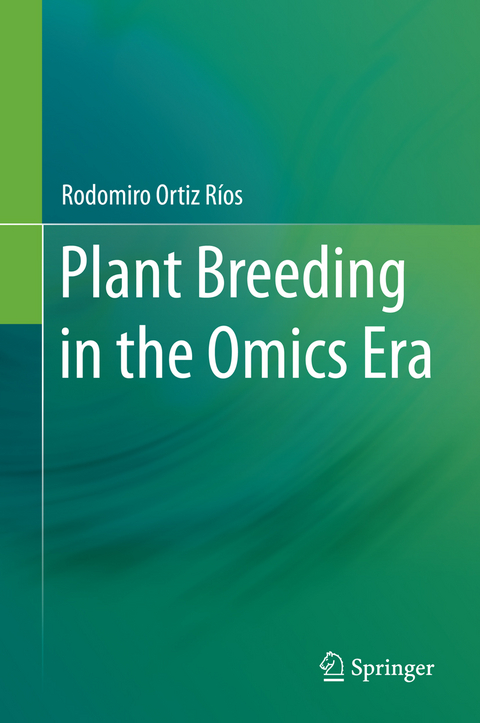
Plant Breeding in the Omics Era (eBook)
XI, 249 Seiten
Springer-Verlag
978-3-319-20532-8 (ISBN)
Rodomiro Ortiz is Professor of Genetics and Plant Breeding at the Swedish University of Agricultural Sciences (SLU) in Alnarp, Sweden. He worked as geneticist at Universidad Nacional Agraria La Molina (UNALM), Centro Internacional de la Papa (CIP, Lima, Perú), Rutgers University (Chatsworth, New Jersey, USA) and International Institute of Tropical Agriculture (IITA, Ibadan, Nigeria), held a Nordic professorship in plant genetic resources at the Danish Royal Veterinary and Agricultural University (merged now with the University of Copenhagen, Denmark), served as Director at the International Crops Research Institute for the Semi-Arid Tropics (ICRISAT, Patancheru, Telangana, India), IITA, and the Centro Internacional de Mejoramiento de Maíz y Trigo (CIMMYT, El Batán, México), and independent free-lance consultant for international, regional and national organizations engaged in agricultural research-for-development. CGIAR awarded IITA in 1994 the prestigious King Baudouin Award for the multidisciplinary research of the team working in plantain and banana improvement, in which Ortiz was both a hands-on researcher and program leader. His professional expertise includes genetics, genetic resources, germplasm enhancement, plant breeding, agro-biotechnology, biosafety, intellectual property rights, and developing agro-ecosystem and livelihood system approaches aiming sustainable intensification of agriculture in the developing world. His h-index was 44 according to Google Scholar at end 2014.
Contents 1. Introduction to Plant Breeding Plant Breeding and SocietyGenetics, Omics and Plant BreedingPopulationsGenetic DiversityDistances MeasuresGrouping GermplasmQuantitative VariationMapping TraitsGenotype-by-Environment InteractionPhenotypingPhenomicsReferences 2. Plant Genetic Resources for Food and Agriculture Crop Evolution and Plant Species Feeding the WorldGenebanksGene PoolsDescribing Variation and Identifying RedundancyGermplasm EvaluationDescriptorsDocumentation and BioinformaticsGeo-documentation to Identify GermplasmGenebank Sampling and Core SubsetsGenomics of Plant Genetic ResourcesPutting Genes into Usable FormsReferences 3. Inbred Development DNA markers for Mapping Quantitative Trait Loci (QTL) and Aided BreedingInbreeding and Line DevelopmentDoubled HaploidsAdaptability: Learning for Model Plant SystemsBreeding for Stress-prone Environments and Resource-use EfficiencyHost-plant Resistance BreedingParticipatory and Client-driven Plant BreedingReferences 4. Population Improvement Recurrent Selection and Breeding PopulationsGenome-wide Association and Quantitative Trait VariationPlant Genomics and Marker-assisted SelectionGenomic Selection and Prediction of Breeding ValuesReferences 5. Heterosis and Inter-Specific Hybridization Heterotic GroupsHybrid VigorHeterosis in Plant BreedingUnderstanding Hybrid Vigor in Model Plants and CropsOmics Research on HeterosisHybrids in Selfing SpeciesPolyploid HeterosisInterspecific hybridizationReferences 6. Mutations and Epigenetics Induced Mutations and Plant BreedingInduced Mutations and Genomics-led Plant BreedingTargeting Induced Local Lesions IN Genomes (TILLING)EpigeneticsReferences 7. Genetic Engineering and Transgenic Breeding Plant Genetic Engineering “Issues”Transgenic Crops “Risks”Transgene FlowPest Resistance and Impacts on Non-target OrganismsDetecting Genetically Modified Organisms and Other Safety AssessmentsTransgenic Agriculture and Co-existencePlant Genetic Engineering ImpactsTransgenic Agriculture OutlookNew Plant Breeding TechniquesReferences 8. DNA Sequencing, other Omics and Synthetic Biology DNA SequencingNext Generation SequencingGenotyping-by-SequencingOther Relevant Omics for Plant BreedingBreeding InformaticsCase Study: Omics-led Legume BreedingPlant Synthetic Biology: Another Tool for Plant Breeding?References 9. Breeding Self-fertilizing Plants: From Inbred to Hybrid Cultivars RiceDomesticationGenetic EnhancementGenomicsMarker-aided Selection (MAS)Stress BreedingInterspecific Hybridization and Participatory BreedingHybrid CultivarsPhenotypingGenetic Engineering WheatEvolution and DiversityGermplasm EnhancementResynthesizing WheatShuttle Breeding and Mega-environmentsGrain Yield PotentialPerennial WheatBiotechnologyEx ante and in silico BreedingTomatoReferences 10. Breeding Open Pollinated, Hybrid and Transgenic Outcrossing Species MaizeDomestication and DiversityGermplasm EnhancementBreedingInbred Line Development and HybridsDoubled HaploidsGenomics-led Improvement for Enhancing Genetic GainsDeveloping Stress-resilient GermplasmNutritious MaizePrediction of Breeding ValuesGenetic EngineeringCottonCassavaCase Study: Cassava Breeding in sub-Saharan AfricaReferences 11. Polyploidy and Plant Breeding PotatoOrigin, Diversity and TaxonomyPloidy ManipulationsGenetic Resources and BreedingTrue Potato SeedGenomicsGenetic EngineeringBanana/PlantainReferences 12. Seeds, Clones and Perennials Seed Development: Learning from a Model Plant SystemInbred and Open Pollinated Seed CultivarsHybrid SeedRapid Multiplication of Healthy and Improved Planting Material of Vegetatively Propagated CropsSeed HealthApomixis: Procreation without RecreationPerennial CropsReferences 13. Diversity, Intellectual Property and Plant Variety Protection Plant Genetic ResourcesThe Question of DerivativesMultinational Private and Public Seed SectorsManaging Agro-biotechnology Intellectual Property RightsReferences
| Erscheint lt. Verlag | 16.9.2015 |
|---|---|
| Zusatzinfo | XI, 249 p. 1 illus. |
| Verlagsort | Cham |
| Sprache | englisch |
| Themenwelt | Naturwissenschaften ► Biologie ► Botanik |
| Technik | |
| Schlagworte | Cultivar seeds • Genetics and Genomics • Metabolomics • Proteomics • Transcriptomics |
| ISBN-10 | 3-319-20532-3 / 3319205323 |
| ISBN-13 | 978-3-319-20532-8 / 9783319205328 |
| Informationen gemäß Produktsicherheitsverordnung (GPSR) | |
| Haben Sie eine Frage zum Produkt? |
 PDF (Wasserzeichen)
DRM: Digitales Wasserzeichen
Dieses eBook enthält ein digitales Wasserzeichen und ist damit für Sie personalisiert. Bei einer missbräuchlichen Weitergabe des eBooks an Dritte ist eine Rückverfolgung an die Quelle möglich.
Dateiformat: PDF (Portable Document Format)
Mit einem festen Seitenlayout eignet sich die PDF besonders für Fachbücher mit Spalten, Tabellen und Abbildungen. Eine PDF kann auf fast allen Geräten angezeigt werden, ist aber für kleine Displays (Smartphone, eReader) nur eingeschränkt geeignet.
Systemvoraussetzungen:
PC/Mac: Mit einem PC oder Mac können Sie dieses eBook lesen. Sie benötigen dafür einen PDF-Viewer - z.B. den Adobe Reader oder Adobe Digital Editions.
eReader: Dieses eBook kann mit (fast) allen eBook-Readern gelesen werden. Mit dem amazon-Kindle ist es aber nicht kompatibel.
Smartphone/Tablet: Egal ob Apple oder Android, dieses eBook können Sie lesen. Sie benötigen dafür einen PDF-Viewer - z.B. die kostenlose Adobe Digital Editions-App.
Buying eBooks from abroad
For tax law reasons we can sell eBooks just within Germany and Switzerland. Regrettably we cannot fulfill eBook-orders from other countries.
aus dem Bereich