Fluid-Structure Interaction (eBook)
John Wiley & Sons (Verlag)
978-1-118-92774-8 (ISBN)
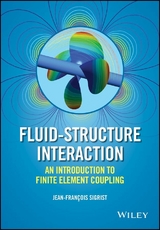
Fluid-Structure Interaction: An Introduction to Finite Element Coupling fulfils the need for an introductive approach to the general concepts of Finite and Boundary Element Methods for FSI, from the mathematical formulation to the physical interpretation of numerical simulations. Based on the author's experience in developing numerical codes for industrial applications in shipbuilding and in teaching FSI to both practicing engineers and within academia, it provides a comprehensive and self-contained guide that is geared toward both students and practitioners of mechanical engineering. Composed of six chapters,
Fluid-Structure Interaction: An Introduction to Finite Element Coupling progresses logically from formulations and applications involving structure and fluid dynamics, fluid and structure interactions and opens to reduced order-modelling for vibro-acoustic coupling. The author describes simple yet fundamental illustrative examples in detail, using analytical and/or semi-analytical formulation & designed both to illustrate each numerical method and also to highlight a physical aspect of FSI. All proposed examples are simple enough to be computed by the reader using standard computational tools such as MATLAB, making the book a unique tool for self-learning and understanding the basics of the techniques for FSI, or can serve as verification and validation test cases of industrial FEM/BEM codes rendering the book valuable for code verification and validation purposes.
Jean-François SIGRIST
DCNS Research, France
Fluid-Structure Interaction: An Introduction to Finite Element Coupling fulfils the need for an introductive approach to the general concepts of Finite and Boundary Element Methods for FSI, from the mathematical formulation to the physical interpretation of numerical simulations. Based on the author s experience in developing numerical codes for industrial applications in shipbuilding and in teaching FSI to both practicing engineers and within academia, it provides a comprehensive and self contained guide that is geared toward both students and practitioners of mechanical engineering. Composed of six chapters, Fluid Structure Interaction: An Introduction to Finite Element Coupling progresses logically from formulations and applications involving structure and fluid dynamics, fluid and structure interactions and opens to reduced order-modelling for vibro-acoustic coupling. The author describes simple yet fundamental illustrative examples in detail, using analytical and/or semi analytical formulation & designed both to illustrate each numerical method and also to highlight a physical aspect of FSI. All proposed examples are simple enough to be computed by the reader using standard computational tools such as MATLAB, making the book a unique tool for self learning and understanding the basics of the techniques for FSI, or can serve as verification and validation test cases of industrial FEM/BEM codes rendering the book valuable for code verification and validation purposes.
Jean-François SIGRIST, DCNS Research, France.
| Erscheint lt. Verlag | 19.8.2015 |
|---|---|
| Sprache | englisch |
| Themenwelt | Naturwissenschaften ► Physik / Astronomie ► Mechanik |
| Technik ► Maschinenbau | |
| Schlagworte | academia • Analytical • Applications • Applied Mathematics in Engineering • Applied Mathmatics in Engineering • basics techniques • BEM • boundary element methods • Comprehensive • Computational • Computational / Numerical Methods • Concepts • Engineering • engineers • Examples • FEM • Finite Element Coupling • Finite-Element-Methode • Finite Element Methods • Fluid • Fluid Dynamics • fluid mechanics • Formulation • FSI • Guide • Interactions • Maschinenbau • Mathematical • Mathematics • Mathematik • Mathematik in den Ingenieurwissenschaften • MATLAB • mechanical engineering • Numerical • Numerical Codes • numerical method • Numerisches Verfahren • Practitioners • Rechnergestützte / Numerische Verfahren im Maschinenbau • Rechnergestützte / Numerische Verfahren im Maschinenbau • reduced order-modelling • Self-contained • Shipbuilding • Simulations • Strömungsmechanik • Strömungsmechanik • Structure • students • test cases • Tools • Validation • verification • vibro-acoustic coupling |
| ISBN-10 | 1-118-92774-5 / 1118927745 |
| ISBN-13 | 978-1-118-92774-8 / 9781118927748 |
| Informationen gemäß Produktsicherheitsverordnung (GPSR) | |
| Haben Sie eine Frage zum Produkt? |
 PDF (Adobe DRM)
Kopierschutz: Adobe-DRM
Adobe-DRM ist ein Kopierschutz, der das eBook vor Mißbrauch schützen soll. Dabei wird das eBook bereits beim Download auf Ihre persönliche Adobe-ID autorisiert. Lesen können Sie das eBook dann nur auf den Geräten, welche ebenfalls auf Ihre Adobe-ID registriert sind.
Details zum Adobe-DRM
Dateiformat: PDF (Portable Document Format)
Mit einem festen Seitenlayout eignet sich die PDF besonders für Fachbücher mit Spalten, Tabellen und Abbildungen. Eine PDF kann auf fast allen Geräten angezeigt werden, ist aber für kleine Displays (Smartphone, eReader) nur eingeschränkt geeignet.
Systemvoraussetzungen:
PC/Mac: Mit einem PC oder Mac können Sie dieses eBook lesen. Sie benötigen eine
eReader: Dieses eBook kann mit (fast) allen eBook-Readern gelesen werden. Mit dem amazon-Kindle ist es aber nicht kompatibel.
Smartphone/Tablet: Egal ob Apple oder Android, dieses eBook können Sie lesen. Sie benötigen eine
Geräteliste und zusätzliche Hinweise
Buying eBooks from abroad
For tax law reasons we can sell eBooks just within Germany and Switzerland. Regrettably we cannot fulfill eBook-orders from other countries.
aus dem Bereich