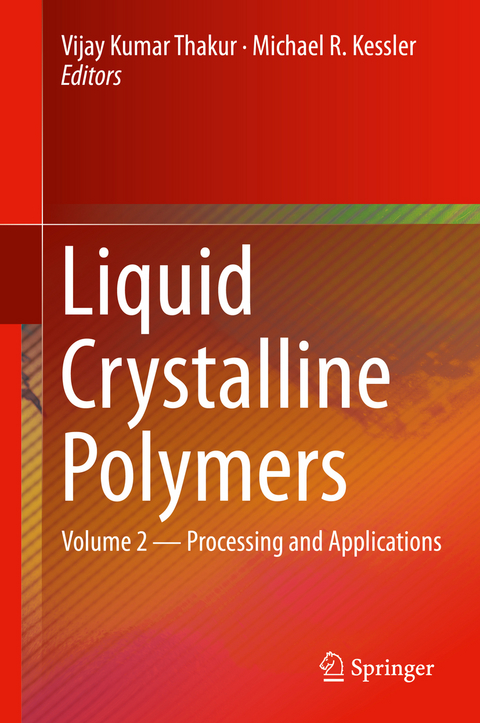
Liquid Crystalline Polymers (eBook)
XII, 535 Seiten
Springer International Publishing (Verlag)
978-3-319-20270-9 (ISBN)
Drs. Vijay Kumar Thakur and Michael R. Kessler are both at the School of Mechanical and Materials Engineering, Washington State University.
Drs. Vijay Kumar Thakur and Michael R. Kessler are both at the School of Mechanical and Materials Engineering, Washington State University.
Preface 6
Contents 8
About the Editors 12
Chapter 1: Liquid Crystals Order in Polymeric Microchannels 14
1.1 Introduction 14
1.2 Surface Anchoring 15
1.3 Rubbing 17
1.4 Evaporation of SiOx 18
1.5 Photoalignment 18
1.6 POLICRYPS Composite Structures 19
1.7 POLICRYPS Realization 20
1.8 Universal Soft-Matter Template 23
1.9 Conclusion 25
References 26
Chapter 2: Novel Liquid Crystal Polymers with Tailored Chemical Structure for High Barrier, Mechanical and Tribological Perfor... 28
2.1 High Performance Liquid Crystal Polymer (HP-LCP) 28
2.1.1 Introduction 28
2.1.2 Synthesis of High Performance Liquid Crystal Polymer 31
2.1.3 Properties of HP-LCP 32
2.1.3.1 Thermal Analysis of HP-LCP 32
2.1.3.2 Melt Viscosity of HP-LCP 33
2.1.3.3 Melt Tension of HP-LCP 34
2.1.3.4 Physical Properties of HP-LCP 34
2.1.3.5 Hydrolysis Resistance of HP-LCP 36
2.2 Soluble LCP (sLCP) 37
2.2.1 Introduction 37
2.2.2 Film Preparation and Molecular Orientation of Soluble Liquid Crystal Polymer 38
2.3 Applications and Potential Applications 39
2.3.1 Film Applications of HP-LCP and sLCP 39
2.3.2 Microcellular Foam Injection Molding of HP-LCP 41
2.3.3 Filler Reinforced HP-LCP Composite for Injection Molding 41
2.3.4 Tribological Application of HP-LCP Composites 42
2.3.5 Substrates of sLCP for Electronic Devices 46
2.3.6 Coatings of sLCP for Tribological Application 46
2.4 Conclusions and Future Perspectives 49
References 50
Chapter 3: Selected Mechanical Properties of Uniaxial Side Chain Liquid Crystalline Elastomers 53
3.1 Introduction and Historical Overview 53
3.2 Piezoelectric Rheometer 56
3.3 Materials: Preparation and Characterization 56
3.4 Theoretical Overview 59
3.4.1 Mechanical Properties Predicted by the Conventional Linear Theory 59
3.4.2 Soft and Semi-soft Elasticity Concept 59
3.4.3 Stress Associated with the Reorientation Transition Induced by a Strain lambda Applied in a Direction Perpendicular to t... 60
3.4.4 Models Describing the Behavior of the Shear Modulus for the Reorientation Transition Induced by a Strain lambda Applied... 62
3.4.5 Behavior of the Stress-Strain Relationship and of the Effective Shear Modulus Predicted by the Bifurcation-Type Model fo... 63
3.5 Behavior of the Shear Moduli of the Dry and Swollen NEs for the Planar and the Homeotropic Geometries 64
3.5.1 Shear Mechanical Experiments Performed on Dry NEs 64
3.5.2 Shear Mechanical Experiments Performed on NEs Swollen by a Nematic Solvent 67
3.5.2.1 Influence of Swelling on the Mechanical Properties of NEs Prepared by the Two-Step Cross-linking Process 68
3.5.2.2 Influence of Swelling on the Mechanical Properties of NEs Prepared by Photo Cross-linking a NP Oriented Either by an E... 69
3.5.3 Consequence of the Gaussian or Non-Gaussian Character of the Elasticity on the Stress-Strain Curve Associated with the R... 70
3.5.3.1 Analysis of the Stress-Strain Curves Associated with NEs Prepared by Photo Cross-Linking a NP Oriented by an E-field o... 71
3.5.3.2 Analysis of the Stress Strain Curves Associated with NEs prepared by the Two-Step Cross-Linking Process and Oriented b... 72
3.5.4 Shear Mechanical Experiments Performed on a NE Mechanically Stretched in a Direction Perpendicular to the Initial Orient... 74
3.6 Conclusions and Future Perspective 76
References 78
Chapter 4: Recent Advances in the Rheology of Thermotropic Liquid Crystal Polymers 81
4.1 Introduction 81
4.1.1 Liquid Crystal Polymer 81
4.1.2 Types of LCPs and Fillers 82
4.1.3 Phases and Order Parameter in LCP 82
4.1.4 Morphology and Orientation in LCPs 83
4.1.5 Phase Transition in LCPs 83
4.2 Fundamentals of Rheology 85
4.2.1 Steady Shear Measurements 86
4.2.2 Dynamic Shear Measurement 87
4.2.3 Extensional Rheological Measurement 88
4.2.4 Orientation of Fillers and LCPs with Shear 88
4.2.5 Thermo-rheological Behaviour of TLCPs 89
4.2.6 Anomalous Rheological Behaviour of TLCPs 90
4.2.7 Rheological Models of LCPs 90
4.3 Materials 91
4.4 Shear Rheology for Filled and Unfilled LCPs 92
4.4.1 Relaxation Time and Zero Shear Viscosity 94
4.4.2 First Normal Stress Difference 96
4.4.3 Molecular Weight Distribution (MWD) in TLCPs 98
4.4.4 Dynamic Shear Rheology 100
4.4.5 Shear Induced Crystallization 103
4.4.6 Extensional Rheology of TLCPs 104
4.4.7 Leonov´s Model for TLCPs 105
4.5 Concluding Remarks 109
References 110
Chapter 5: Liquid Crystalline Polymer and Its Composites: Chemistry and Recent Advances 115
5.1 Introduction 115
5.1.1 Structure and Architecture of Liquid Crystal Polymers 119
5.1.2 Properties of Liquid Crystalline Polymers 123
5.1.3 Liquid Crystalline Polymer Blends 124
5.2 Rheology of Liquid Crystal Polymers and Its Blends 125
5.3 Morphology of Liquid Crystalline Polymer in Blends 126
5.4 Processing Conditions for Liquid Crystalline Polymers 128
5.5 Processing of Liquid Crystal Polymer Blends 130
5.6 Compatibility of Liquid Crystalline Polymer Blends 131
5.7 Factors for Liquid Crystalline Polymer Fibrillation in Blends 132
5.8 Effect of Fillers on Liquid Crystal Polymers 133
5.8.1 Nanofillers 134
5.8.2 Effect of Nanofiller 135
5.8.3 Interaction of Nanosilica with Liquid Crystalline Polymer 137
5.8.4 Nanofiller Reinforcement 138
5.8.5 Other Types of Nanofillers 138
5.9 In-Situ Reinforcement of Liquid Crystalline Polymers 139
5.10 Conclusion 140
References 140
Chapter 6: Effect of Polymer Network in Polymer Dispersed Ferroelectric Liquid Crystals (PSFLC) 144
6.1 Introduction 144
6.2 Free Volume Model and Free Energy of the System 145
6.3 Rotational Viscosity 151
6.4 Polarization Profile and Dielectric Constant 154
6.5 Origin of Memory States and Cross-link Modeling 158
6.6 Construction of Free Energy and Tilt Angle Variation 160
6.7 Multistability and Resolution of Memory States and Rotational Viscosity 167
6.8 Cross-link Conformations and Polarization Profile 170
6.9 Concluding Remarks 173
References 174
Chapter 7: Electro-optic and Dielectric Responses in PDLC Composite Systems 179
7.1 Introduction 179
7.2 Polymer Dispersed Liquid Crystal (PDLC) 180
7.2.1 Methods of Preparation of PDLC Films 181
7.2.1.1 Solvent-Induced Phase Separation (SIPS) 182
7.2.1.2 Polymerization Induced Phase Separation (PIPS) 182
7.2.1.3 Thermally Induced Phase Separation (TIPS) 183
7.3 LC Solubility in Polymer Matrix 183
7.4 Droplet Morphology 184
7.4.1 Theoretical Aspects of Droplet Configurations 184
7.4.2 In-Situ Measurement of Droplet Morphology 186
7.4.3 Morphological Evolution of PDLC Composite Films 186
7.4.4 Morphological Evolution of Dye Doped PDLC Composite Films 188
7.5 Electro-optical (EO) Properties 190
7.6 Hysteresis Effect 196
7.7 Dielectric Properties 198
7.8 Conclusion and Future Perspective 200
References 201
Chapter 8: UV-Cured Networks Containing Liquid Crystalline Phases: State of the Art and Perspectives 206
8.1 Photocrosslinkable Liquid-Crystalline Polymers 206
8.2 Synthesis of Photocrosslinkable LC Polymers 211
8.3 Effect of the LC Structure on the Photopolymerization Reaction, Morphology and Final Properties of the Obtained UV-Cured N... 215
8.4 Recent Applications of UV-Cured Networks Containing Liquid Crystalline Phases 221
8.5 Conclusions and Future Perspective 225
References 226
Chapter 9: Liquid Crystal Diffraction Gratings Using Photocrosslinkable Liquid Crystalline Polymer Films as Alignment Layers 229
9.1 Introduction 229
9.2 Two-Step Exposure Method Using a Photomask 232
9.3 Polarization Holographic Recording 236
9.3.1 One-Dimensional Grating 236
9.3.2 Two-Dimensional Grating 239
9.4 One-Step Polarizer-Rotation Exposure Method 241
9.5 Conclusions and Future Perspective 244
References 245
Chapter 10: Liquid Crystalline Polymer Blends as Fillers for Self-Reinforcing Polymer Composites 249
10.1 Introduction 249
10.2 Liquid Crystalline Polymer as Self-Reinforcing Fillers for Polymeric Materials 250
10.3 Properties of LCP-Based Self-Reinforced Polymer Composites 251
10.3.1 Mechanical Properties 251
10.3.2 Rheological Properties 254
10.4 Experimental Procedures for Preparation of TP/LCP Self-Reinforced Composites 258
10.4.1 Materials 258
10.4.2 Batch Mixing of PET/LCP Blends 259
10.4.3 Injection Molding Procedure to Produce PET/LCP Self-Reinforced Composite 259
10.4.4 Self-Reinforced Composite from Liquid Crystalline Oligomers via Reactive Extrusion Process 260
10.4.5 Mechanical Property Measurement 260
10.5 Morphology Analysis of Self-Reinforced Composites 260
10.5.1 Sample Preparation for Morphology Examination 261
10.5.2 Optical and Scanning Electron Microscopy Analysis of Morphology 261
10.5.2.1 Effects of Mixing Shear Rates on Morphology 261
10.5.2.2 Tensile Modulus Dependence of Mixing Speed 262
10.5.3 Morphological Development During Injection Molding of PET/LCP Blends 263
10.5.3.1 Mechanical Properties of Injection Molded PET/LCP Blends 264
10.6 Micromechanics Model for Self-Reinforcing Composites 264
10.7 Conclusions and Future Perspective 269
References 270
Chapter 11: Optical Fredericks Transition in a Nematic Liquid Crystal Layer 273
11.1 Introduction and Overview 273
11.2 The Classical Fredericks Transitions in a Nematic Liquid Crystal Cell 277
11.2.1 Twist Geometry and Single-Constant Assumption 280
11.2.2 Bend and Splay Geometries 288
11.2.3 Extension to Electric Fields 290
11.3 Optical Fredericks Transition with Coupled Orientation and Electromagnetic Fields 290
11.3.1 Maxwell Equations 291
11.3.2 Free Energy Minimization 294
11.3.3 Boundary Conditions and Intensity 296
11.4 Numerical Method and Results 299
11.5 Conclusion and Future Perspective 301
References 302
Chapter 12: New Liquid Crystalline Poly(azomethine esters) Derived from PET Waste Bottles 304
12.1 Liquid Crystal 304
12.2 Liquid Crystal Polyesters 305
12.3 Polyethylene Terephthalate (PET) 306
12.4 Liquid Crystal Poly(azomethine esters) 307
12.5 Materials and Methods 309
12.5.1 Materials 309
12.5.2 Instrumentation 309
12.6 Monomer Synthesis 309
12.6.1 Synthesis of Azomethine Bisphenol 1 (a) 309
12.6.2 Synthesis of Azomethine Bisphenol 1 (b) 310
12.6.3 Synthesis of Azomethine Bisphenol 1 (c) 310
12.6.4 Synthesis of Azomethine Bisphenol 1 (d) 310
12.6.5 Regeneration of Terephthalic Acid (TPA) from PET Waste Bottles 310
12.7 Preparation of LC Poly(azomethine esters) 3 (a-d) 311
12.8 Results and Discussion 311
12.8.1 Thermotropic LC Properties of the Polymers 3 (a-d) 315
12.9 Conclusion 319
References 319
Chapter 13: Liquid Crystalline Polymer Composites for Optoelectronics 321
13.1 Structural Diversity in Liquid Crystalline Polymer 322
13.2 Liquid Crystalline Polymer Based Blends 325
13.3 Liquid Crystalline Polymer in Micro and Opto-Electronics 330
13.4 Liquid Crystalline Polymer Nanocomposite for Organic Nanophotonics 332
13.5 Self Assembled Liquid Crystalline Polymer Nanocomposite 333
13.6 Inorganic Organic Polymer Dispersed Liquid Crystalline Nanocomposite 336
13.7 International Trends/Recent Advance in Liquid Crystalline Polymer Composite 337
13.8 Conclusion 338
References 340
Chapter 14: Functional Materials from Liquid Crystalline Cellulose Derivatives: Synthetic Routes, Characterization and Applica... 345
14.1 Introduction 345
14.1.1 Cellulose: Chemical Versatility 345
14.1.2 Cellulose Liquid Crystal 347
14.2 Synthesis of Liquid Crystalline Esters Derivatives of Hydroxypropylcellulose 350
14.2.1 Hydroxypropylcellulose 350
14.2.2 Thermotropic Esters HPC-Derivatives 351
14.3 Characterization of HPC and Its Ester Derivatives 356
14.3.1 Thermotropic HPC: Structure, Thermal and Optical Properties 357
14.3.2 Effect of the Side-Chain Length on the Structure 357
14.3.3 Thermal Properties of Esters of HPC 359
14.3.3.1 Effect of Substituent Length 359
14.3.3.2 Effect of Degree of Esterification 361
14.3.4 Optical Properties: Temperature Dependence of the Pitch 361
14.3.4.1 Effect of Substituent Length 362
14.3.4.2 Effect of Degree of Esterification 364
14.3.4.3 Effect of Degree of Polymerization (DP): Effect of Molecular Weight 364
14.4 Recent Advances in Applications of Liquid Crystalline HPC and Its Esters Derivatives 365
14.5 Conclusions 369
References 370
Chapter 15: Liquid Crystal Polymers as Matrices for Arrangement of Inorganic Nanoparticles 375
15.1 Introduction 375
15.2 Phase Separation in Composites of NPs Embedded in LC Systems 377
15.3 Structure of LC Polymer: NPs Composites 378
15.3.1 Smectic Matrices/QDs 378
15.3.2 Smectic Matrix/Nanorods (NRs) 381
15.3.3 Nematic and Cholesteric Matrices 382
15.4 Photoluminescence of Nanocomposites 383
15.5 Conclusions and Future Perspective 388
References 389
Chapter 16: Side Chain Liquid Crystalline Polymers: Advances and Applications 394
16.1 Liquid Crystals (LCs) 394
16.2 Historical Background of Liquid Crystals 395
16.3 Classification of Liquid Crystals 395
16.3.1 Lyotropic Liquid Crystals 396
16.3.2 Thermotropic Liquid Crystals 396
16.4 Shape of Molecules and Their Mesophases 396
16.4.1 Conventional Shaped Liquid Crystal 396
16.4.1.1 Calamitic Liquid Crystals 396
16.4.1.2 Discotic Liquid Crystals 397
Nematic Discotic Phase 398
Columnar Phase 399
16.4.2 Non-conventional Shaped Liquid Crystals 399
16.4.2.1 Banana-Shaped Mesogens 399
16.5 Liquid Crystalline Polymers (LCPs) 401
16.5.1 Main Chain Liquid Crystalline Polymers 403
16.5.2 Side Chain Liquid Crystal Polymers 403
16.6 Bent-Core Side Chain Liquid Crystalline Polymers (BCLCPs) 408
16.7 Mesogenic-Jacketed Liquid Crystalline Polymers (MJLCPs) 410
16.8 Liquid Crystal Elastomers (LCEs) 412
16.9 Conclusion and Future Perspective 413
References 413
Chapter 17: Liquid Crystalline Semiconducting Polymers for Organic Field-Effect Transistor Materials 421
17.1 Introduction 421
17.2 Fundamentals of Organic Field Effect Transistors 423
17.3 LC Materials for Organic Field-Effect Transistors 425
17.3.1 Small Molecule LC Materials for OFET Materials 425
17.3.2 Liquid Crystalline Polymers for OFET Materials 427
17.3.2.1 Fluorene Based LC Polymers for OFET Materials 427
17.3.2.2 Thiophene Based Liquid Crystal Polymers for OFET Materials 430
17.3.2.3 Thiazole Based LC Polymer as OFET Materials 435
17.4 Summary 437
References 437
Chapter 18: Azobenzene-Containing Liquid Single Crystal Elastomers for Photoresponsive Artificial Muscles 441
18.1 What Are Liquid Crystals? 441
18.2 Azobenzenes: Excellent Light-Sensitive Molecules for Photoactuation in Liquid-Crystalline Materials 442
18.3 Artificial Muscle-Like Actuators with Polysiloxane-Based Liquid Single Crystal Elastomers: Thermo- and Photo-Mechanical E... 444
18.4 Mechanical Efficiency of Polysiloxane Azobenzene-Based Artificial Muscle-Like Actuators 448
18.4.1 Opto-Mechanical Efficiency of Azobenzene-Containing Main-Chain LSCEs 449
18.4.2 Mechanical Efficiency of Side-Chain LSCEs Where the Azo Photochromes Act as Photoactive Cross-Linking Points 450
18.4.3 Mechanical Efficiency in Side-Chain LSCEs Where the Azo Moieties Operate as Photoactive Pendant Groups 453
18.5 Response Time of Polysiloxane Azobenzene-Based Artificial Muscle-Like Actuators 454
18.5.1 Photoactive Artificial Muscle-Like Actuators Based on Push-Pull Azoderivatives 455
18.5.2 Photoactive Artificial Muscle-Like Actuators Based on Azophenolic Dyes 457
18.6 Conclusions and Future Perspectives 459
References 460
Chapter 19: Liquid Crystalline Epoxy Resin Based Nanocomposite 462
19.1 Chemical and Physical Properties of LCERs 463
19.1.1 Effect of Substituent and Spacer on TLC of LCER 474
19.1.2 Mechanical and Thermal Properties of Cured LCERs 476
19.1.3 Permeability of Cured LCER 478
19.2 Processing of Nanocomposite 478
19.2.1 Nanofiller 479
19.2.2 Processing 479
19.3 Applications and Properties of Nanocomposites 481
19.3.1 Encapsulation Materials for Electrical and Electronic Applications 481
19.3.2 Light Weight Structure Material 482
19.3.3 LCER as Biomaterials for Medical Application 482
19.4 Conclusions and Future Perspective 484
References 486
Chapter 20: Synthesis of Functional Liquid Crystalline Polymers for Exfoliated Clay Nanocomposites 491
20.1 Introduction 491
20.2 Fundamental Mechanism for the Exfoliation of Nanoclays in Functional Liquid Crystalline Polymers 493
20.2.1 Rationale of Molecular Design for Functional Liquid Crystalline Polymers 493
20.2.2 Hydrogen Bonding Induced Exfoliation of Nanoclays in Functional Liquid Crystalline Polymers 494
20.2.3 Coulombic Interactions Induced Exfoliation of Nanoclays in Liquid Crystalline Polymers 501
20.3 Rheological Behaviors of Exfoliated Functional Liquid Crystalline Polymer/Clay Nanocomposites 504
20.4 Conclusions and Perspectives 508
References 509
Chapter 21: Liquid Crystalline Polymers as Tools for the Formation of Nanohybrids 512
21.1 Introduction 512
21.2 Stabilization of Preformed Nanoparticles 513
21.2.1 Hybrid Liquid Crystalline Polymers 514
21.2.2 Hybrid Liquid Crystalline Polymers and Elastomers for Soft Actuation 517
21.3 In Situ Synthesis of Nanoparticles 523
21.3.1 Solvent Mediated In Situ Formation of Nanoparticles/Liquid Crystal Hybrids 524
21.3.2 Solvent-Free In Situ Formation of Nanoparticles/Liquid Crystal Hybrids 524
21.3.3 Effect of LC Organization on Nanoparticles Growth 526
21.4 Conclusions and Future Perspectives 530
References 531
ERRATUM 533
Index 534
| Erscheint lt. Verlag | 25.8.2015 |
|---|---|
| Zusatzinfo | XII, 535 p. 195 illus., 109 illus. in color. |
| Verlagsort | Cham |
| Sprache | englisch |
| Themenwelt | Naturwissenschaften ► Physik / Astronomie |
| Technik ► Maschinenbau | |
| Wirtschaft | |
| Schlagworte | Calamatic • Diblock Copolymers • Discotic • Elastomer • gelation • In Situ Photopolymerization • Isotropic Phase-equilibria • Liquid Crystalline Polymers • Macromolecules • Main-chain Polymers • Side-chain Polymers |
| ISBN-10 | 3-319-20270-7 / 3319202707 |
| ISBN-13 | 978-3-319-20270-9 / 9783319202709 |
| Informationen gemäß Produktsicherheitsverordnung (GPSR) | |
| Haben Sie eine Frage zum Produkt? |
 PDF (Wasserzeichen)
DRM: Digitales Wasserzeichen
Dieses eBook enthält ein digitales Wasserzeichen und ist damit für Sie personalisiert. Bei einer missbräuchlichen Weitergabe des eBooks an Dritte ist eine Rückverfolgung an die Quelle möglich.
Dateiformat: PDF (Portable Document Format)
Mit einem festen Seitenlayout eignet sich die PDF besonders für Fachbücher mit Spalten, Tabellen und Abbildungen. Eine PDF kann auf fast allen Geräten angezeigt werden, ist aber für kleine Displays (Smartphone, eReader) nur eingeschränkt geeignet.
Systemvoraussetzungen:
PC/Mac: Mit einem PC oder Mac können Sie dieses eBook lesen. Sie benötigen dafür einen PDF-Viewer - z.B. den Adobe Reader oder Adobe Digital Editions.
eReader: Dieses eBook kann mit (fast) allen eBook-Readern gelesen werden. Mit dem amazon-Kindle ist es aber nicht kompatibel.
Smartphone/Tablet: Egal ob Apple oder Android, dieses eBook können Sie lesen. Sie benötigen dafür einen PDF-Viewer - z.B. die kostenlose Adobe Digital Editions-App.
Buying eBooks from abroad
For tax law reasons we can sell eBooks just within Germany and Switzerland. Regrettably we cannot fulfill eBook-orders from other countries.
aus dem Bereich