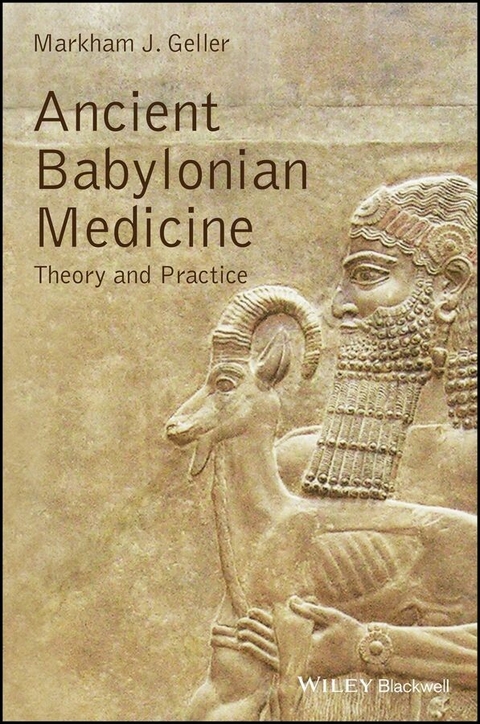
Ancient Babylonian Medicine (eBook)
John Wiley & Sons (Verlag)
978-1-119-06254-7 (ISBN)
- Represents the first overview of Babylonian medicine utilizing cuneiform sources, including archives of court letters, medical recipes, and commentaries written by ancient scholars
- Attempts to reconcile the ways in which medicine and magic were related
- Assigns authorship to various types of medical literature that were previously considered anonymous
- Rejects the approach of other scholars that have attempted to apply modern diagnostic methods to ancient illnesses
Markham J. Geller is Professor of Semitic Languages at University College London and Professor for the History of Science at the Free University Berlin. He is the author of Evil Demons: Canonical Utukk? Lemn?tu Incantations (2007) and Melothesia in Babylonia (2014), editor of Melammu, the Ancient World in an Age of Globalization (2014), and co-editor of Disease in Babylonia(2007) and Imagining Creation (2008).
Utilizing a great variety of previously unknown cuneiform tablets, Ancient Babylonian Medicine: Theory and Practice examines the way medicine was practiced by various Babylonian professionals of the 2nd and 1st millennium B.C. Represents the first overview of Babylonian medicine utilizing cuneiform sources, including archives of court letters, medical recipes, and commentaries written by ancient scholars Attempts to reconcile the ways in which medicine and magic were related Assigns authorship to various types of medical literature that were previously considered anonymous Rejects the approach of other scholars that have attempted to apply modern diagnostic methods to ancient illnesses
Markham J. Geller is Professor of Semitic Languages at University College London and Professor for the History of Science at the Free University Berlin. He is the author of Evil Demons: Canonical Utukku Lemnutu Incantations (2007) and Melothesia in Babylonia (2014), editor of Melammu, the Ancient World in an Age of Globalization (2014), and co-editor of Disease in Babylonia(2007) and Imagining Creation (2008).
List of Illustrations viii
List of Abbreviations x
Acknowledgments xii
Introduction to Babylonian Medicine and Magic 1
1 Medicine as Science 11
2 Who Did What to Whom? 43
3 The Politics of Medicine 56
4 Medicine as Literature 89
5 Medicine and Philosophy 118
6 Medical Training: MD or PhD? 130
7 Uruk Medical Commentaries 141
8 Medicine and Magic as Independent Approaches to Healing 161
Appendix: An Edition of a Medical Commentary 168
Notes 177
References 202
Subject Index 211
Selective Index of Akkadian and Greek Words 217
Index of Akkadian Personal Names 220
Introduction to Babylonian Medicine and Magic
If a man has pain in his kidney, his groin constantly hurts him, and his urine is white like donkey-urine, and later on his urine shows blood, that man suffers from “discharge” (muû-disease). You boil 2 shekels of myrrh, 2 shekels of baluhhu-resin, (and) 2 sila-measures of vinegar together in a jug; cool it and mix it in equal measure in pressed oil. You pour half into his urethra via a copper tube, half mix in premium beer, you leave it out overnight and he drinks it on an empty stomach and he will get better.
Babylonian recipe for disease of the kidneys, BAM 7 35
[If a] man has intestinal colic, he constantly scratches himself, he retains wind in his anus, food and fluids are regurgitated (and) he suffers from constipation of the rectum – its “redness” is raised and troubles him [without] giving him relief – you desiccate a lion skin and mix it with lion fat, you dry (it) a second time, crush and mix it in cedar oil, make a pessary and insert it into his anus.
Babylonian recipe for disease of the anus, BAM 7 151
Medicine today is technological and scientific, often making it difficult to cast our minds back to earlier ages when medicine was less understood and less successful. Actually, we need not go back very far in time, since any physician trained in medicine before the discovery of penicillin would attest to how relatively unsophisticated medicine still was, even by the middle of the twentieth century. As one physician recalls,
I graduated from medical school in 1938. Even in those days, medicine was more a priesthood than a science. A favorite examination question was, “If you are lost on a desert island with only six drugs, which drugs would suffice for good medical practice?” The answer was arsenicals for syphilis, quinine for malaria, insulin for diabetes, liver for pernicious anemia, digitalis for the heart, and morphine for pain. All other medicines were pure placebo. (Rosenbaum 1988: 198)
After the discovery of modern life-saving drugs, therapy dramatically improved in most aspects of medicine, to the extent that medicine has made more rapid and successful progress during the past 60 years than in the entire cumulative previous history of Western medicine, from Galen to the twentieth century.
Nevertheless, we do not yet have the answers to all medical questions, and in some significant areas we are hardly better informed about human behavior and medical practice than were ancient and medieval practitioners. Medicine remains an art, and tracing back the history of this art can help us better understand the processes of discovery and treatment.
Let us take one example, the problem of diet and health. Obesity has recently been recognized as one of the scourges of modern times, with little overall consensus as to how one should understand and act upon the issues involved. According to one expert, our modern ideas of diet were developed and promoted after the Second World War by the American Heart Association, based upon studies comparing cholesterol and heart attack rates in countries around the world. The research concluded that high levels of fat in modern diets were specifically responsible for obesity and heart disease, and recommended a low-fat, high-carbohydrate diet.1 After a low-fat diet did not have the anticipated effect, new diets were introduced to improve health and reduce obesity, one requiring total fat restriction while another recommended exactly the opposite, a high-fat low-carbohydrate diet. Subsequent studies embraced contradictory advice, advocating diets based upon a theory of “good” and “bad” fats as well as “good” and “bad” carbohydrates (Agatston 2003: 16–21).
Our modern scientific world dispenses a great deal of confusing information about health and prevention of disease, which is a trait modern medicine shares with its ancient counterpart. Moreover, diets and trendy medications tend to be the obsessions of wealthier classes in society, and this situation hardly differs from antiquity, when the best medical advice was only on offer to those patients who could afford the costly services.
When we turn to ancient Babylonian medicine, one question often asked is whether any part of Babylonian medicine was actually effective. Did it work? We have hundreds of drugs cited in Babylonian medical recipes, in addition to long lists of plants and minerals used for medicinal purposes, often with descriptions of the drugs and of the diseases for which they could be used. We have no idea, however, how such data was compiled, since there were no clinical trials. How would ancient physicians know which plants were effective against which diseases? We can surmise that plants were identified over a very long period, perhaps going back to Neolithic times, and the use of such plants was determined by a hit-or-miss means of trying something to see what happens, and then keeping careful records of the results. The crucial point was to remember, later on, if the drug seemed to work.
One redeeming feature of Babylonian medicine is the lack of surgery, because of the substantial risks involved. Almost all Babylonian medical texts are limited to pharmacological preparations administered mostly as potions, salves, ointments, fumigations, or suppositories. Surgery would have been dangerous without either proper antiseptics or anesthesia, nor is there any firm evidence from Babylonia of bloodletting. For this reason, the Babylonian physician probably caused less harm to his patient than his later colleagues in medieval Europe.
Dissection and Disease Taxonomy
As we go back in time, the relationship between magic and medicine alters considerably, although not fundamentally. The technological basis for what we know as modern medicine has a long and tedious history, which actually made precious little advancement over many centuries. The major breakthrough leading to a scientific understanding of medicine came relatively late, in the fifteenth century, with dissection of the human body providing more precise knowledge of human anatomy. Meanwhile, autopsies were primarily an academic exercise, carried out exceptionally by some noted Greek physicians in Alexandria in the third century BC (von Staden 1998: 52). There are various practical reasons why the taboo of cutting open the human body was usually observed, even by Galen. First, before the invention of rubber gloves, dissection could have been dangerous since the researcher could easily contract a disease which had been the patient’s cause of death (see Geller 2007: 187f.). Second, religious taboos no doubt played an important role, since disfiguring the human body was thought to have affected how the soul might appear in the afterlife. In Homer, for instance, the soldier in Hades is seen with his battle scars (Bernstein 1993: 30, 65). Apart from the taboo itself, the most probable reason for the lack of interest in dissection in ancient and medieval medicine was the fact that knowledge of internal anatomy did not actually help in healing the patient. Knowing where the organs were located and how the blood circulated were important discoveries in themselves, but how did one convert this knowledge into effective treatment?
It is not particularly easy to classify diseases within Babylonian medicine, although they fall generally within similar categories in Hippocratic medicine. Some diseases are simply associated with parts of the body, such as head disease, tooth disease, eye disease, nose disease, even foot disease, as well as kidney disease and anus disease. Baldness was treated as a disease. There are varieties of skin diseases, including rashes and pocks, as well as leprosy-like conditions affecting the nose and mouth, but it is impossible to diagnose these conditions according to modern disease terminology.
A major development in understanding disease only came with the discovery of morbid anatomy in the eighteenth century in Padua and at St George’s Hospital, London, where physicians began to realize that autopsies after diagnosis could provide important clues to diagnosing disease correctly (Porter 1997: 263f.). It took centuries, however, for this idea to develop from the days of Egyptian mummification, which was the last period when dissections were carried out on a regular basis as part of embalming, or from third-century BC Alexandria, where a few Greek physicians practiced vivisection on prisoners.
What this effectively means is that ancient and medieval medicine had much in common, and that the fundamental relationship between doctor and patient remained fairly constant over the centuries. The relationship between magic and medicine – the psychological and technical approaches to healing – was always present and was constantly evolving. We will see that although real technological advancement in medicine was slow in developing, knowledge about disease and healing improved over time, and theories about disease and healing were changing as well. Not every new idea is an advancement or an improvement on what came before, but the complex relationship between magic and medicine is usually affected by new theories of healing, or even by skepticism towards accepted theories.
Another factor determining how magic and medicine relate to each other is the complex relationship between doctor and patient, in the ancient world as in our own society. Within Mesopotamia, there is much we do not know about this relationship. Was the doctor paid, and how much? What was his status within society? Would men and...
| Erscheint lt. Verlag | 21.7.2015 |
|---|---|
| Reihe/Serie | Ancient Cultures |
| Ancient Cultures | Ancient Cultures |
| Sprache | englisch |
| Themenwelt | Literatur |
| Geschichte ► Allgemeine Geschichte ► Vor- und Frühgeschichte | |
| Geschichte ► Allgemeine Geschichte ► Altertum / Antike | |
| Geisteswissenschaften ► Geschichte ► Regional- / Ländergeschichte | |
| Geisteswissenschaften ► Sprach- / Literaturwissenschaft ► Anglistik / Amerikanistik | |
| Geisteswissenschaften ► Sprach- / Literaturwissenschaft ► Literaturwissenschaft | |
| Studium ► Querschnittsbereiche ► Geschichte / Ethik der Medizin | |
| Naturwissenschaften | |
| Sozialwissenschaften ► Soziologie ► Gender Studies | |
| Schlagworte | ancient babylon • Ancient Culture • Ancient medicine • Babylon • Babylon /Alte Geschichte • Babylonian medicine • Classical Studies • Geschichte • Geschichte der Medizin u. Naturwissenschaften • History • History of Science & Medicine • Humanistische Studien • Klassisches Altertum • Medizingeschichte |
| ISBN-10 | 1-119-06254-3 / 1119062543 |
| ISBN-13 | 978-1-119-06254-7 / 9781119062547 |
| Informationen gemäß Produktsicherheitsverordnung (GPSR) | |
| Haben Sie eine Frage zum Produkt? |
 EPUB (Adobe DRM)
Kopierschutz: Adobe-DRM
Adobe-DRM ist ein Kopierschutz, der das eBook vor Mißbrauch schützen soll. Dabei wird das eBook bereits beim Download auf Ihre persönliche Adobe-ID autorisiert. Lesen können Sie das eBook dann nur auf den Geräten, welche ebenfalls auf Ihre Adobe-ID registriert sind.
Details zum Adobe-DRM
Dateiformat: EPUB (Electronic Publication)
EPUB ist ein offener Standard für eBooks und eignet sich besonders zur Darstellung von Belletristik und Sachbüchern. Der Fließtext wird dynamisch an die Display- und Schriftgröße angepasst. Auch für mobile Lesegeräte ist EPUB daher gut geeignet.
Systemvoraussetzungen:
PC/Mac: Mit einem PC oder Mac können Sie dieses eBook lesen. Sie benötigen eine
eReader: Dieses eBook kann mit (fast) allen eBook-Readern gelesen werden. Mit dem amazon-Kindle ist es aber nicht kompatibel.
Smartphone/Tablet: Egal ob Apple oder Android, dieses eBook können Sie lesen. Sie benötigen eine
Geräteliste und zusätzliche Hinweise
Buying eBooks from abroad
For tax law reasons we can sell eBooks just within Germany and Switzerland. Regrettably we cannot fulfill eBook-orders from other countries.
aus dem Bereich