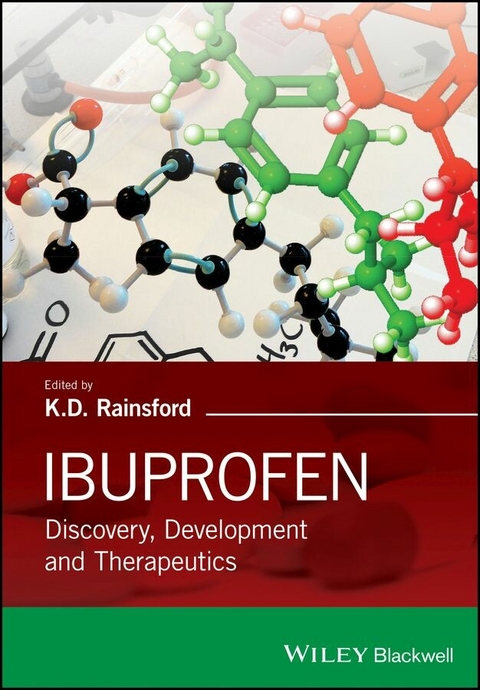
Ibuprofen (eBook)
John Wiley & Sons (Verlag)
978-1-118-74358-4 (ISBN)
Ibuprofen has become one of the foremost pain-relieving medications world-wide with its proven safety and efficacy in a wide variety of painful and inflammatory conditions. It has also been widely investigated for application in a variety of painful and non-pain inflammatory states including cancer and neurodegenerative conditions, reflecting the unique and novel properties of the drug that would never have been foreseen from knowledge of the properties when it was initially discovered.
- Edited by leading world expert with over 40 years record in research, teaching and as a scientific advisor in the field of anti-inflammatory/analgesic agents. Professor Kim Rainsford is also the founding Editor-in-Chief of the journal, Inflammopharmacology, as well as being an Associate Editor of The Journal of Pharmacy & Pharmacology.
- Provides a thorough coverage of the medicinal chemistry and pharmaceutics of ibuprofen, and its pharmacokinetics in both humans and animals.
- Includes molecular, pharmacological and toxicological studies, and discusses the safety and efficacy of non-prescription ibuprofen, including its side effects.
Ibuprofen: Discovery, Development & Therapeutics provides a definitive reference on all the main aspects of the chemical and pharmaceutical properties, mechanisms of action and therapeutic uses of ibuprofen including its role in the prevention and treatment of rheumatic conditions, cancer and neurodegenerative conditions such as Alzheimer’s and Parkinson’s diseases. The book has its origins in a volume first published in 1999, since when there have been considerable advances in research and clinical studies on ibuprofen in the treatment of many inflammatory and even non-inflammatory states. This book will prove invaluable to scientists, clinicians, pharmacists and all those who need to know about the actions and uses of anti-inflammatory and analgesic drugs.
Ibuprofen has become one of the foremost pain-relieving medications world-wide with its proven safety and efficacy in a wide variety of painful and inflammatory conditions. It has also been widely investigated for application in a variety of painful and non-pain inflammatory states including cancer and neurodegenerative conditions, reflecting the unique and novel properties of the drug that would never have been foreseen from knowledge of the properties when it was initially discovered. Edited by leading world expert with over 40 years record in research, teaching and as a scientific advisor in the field of anti-inflammatory/analgesic agents. Professor Kim Rainsford is also the founding Editor-in-Chief of the journal, Inflammopharmacology, as well as being an Associate Editor of The Journal of Pharmacy & Pharmacology. Provides a thorough coverage of the medicinal chemistry and pharmaceutics of ibuprofen, and its pharmacokinetics in both humans and animals. Includes molecular, pharmacological and toxicological studies, and discusses the safety and efficacy of non-prescription ibuprofen, including its side effects. Ibuprofen: Discovery, Development & Therapeutics provides a definitive reference on all the main aspects of the chemical and pharmaceutical properties, mechanisms of action and therapeutic uses of ibuprofen including its role in the prevention and treatment of rheumatic conditions, cancer and neurodegenerative conditions such as Alzheimer s and Parkinson s diseases. The book has its origins in a volume first published in 1999, since when there have been considerable advances in research and clinical studies on ibuprofen in the treatment of many inflammatory and even non-inflammatory states. This book will prove invaluable to scientists, clinicians, pharmacists and all those who need to know about the actions and uses of anti-inflammatory and analgesic drugs.
Professor K.D Rainsford, Professor Emeritus of Biomedical Sciences, Sheffield Hallam University.
1
History and Development of Ibuprofen
K.D. Rainsford
Biomedical Research Centre, Sheffield Hallam University, UK
Summary
Ibuprofen was discovered over half a century ago following pioneering approaches by Professor Stuart Adams OBE for the identification of anti-inflammatory properties of drugs related to aspirin and later screening of a range of acidic compounds that were synthesized by the late Dr John Nicholson. The subsequent clinical assessments of the anti-rheumatic activities of ibuprofen were initially as a prescription-only medication for treating rheumatoid arthritis. With extensive trials in various other rheumatic and painful states the drug consistently proved to be effective and relatively safe. By the early 1980s the data amassed on the safety of ibuprofen set the basis for granting by the health authorities in the United Kingdom and United States of America as a non-prescription drug for over-the-counter (OTC) sale by pharmacies at the half-prescription (1200 mg/day) dose for short-term use by the lay public. Later OTC sale was approved by a large number of drug regulatory agencies worldwide and this has since been extended to it being available in stores under the general sales list (GSL) regulations in a large number of countries. Ibuprofen has become amongst the most widely used pain-relieving medication worldwide with its proven safety and efficacy. The drug has also been widely investigated for application in a variety of painful and non-pain inflammatory states including cancer, Parkinson’s disease and dementias, reflecting the unique and novel properties of the drug that would never have been foreseen from knowledge of the properties when it was initially discovered.
1.1 Introduction
The history of ibuprofen began over 50 years ago and has been inextricably linked to understanding of the concepts of the pathogenesis of inflammatory diseases and the actions of therapeutic agents used at that time (Rainsford, 2011). The principal initiator of this research leading to the discovery of ibuprofen was Dr Stewart Adams (Figure 1.1), a pharmacologist in the Research Department of The Boots Pure Drug Company Ltd at Nottingham, United Kingdom. His aim was to find analgesic drugs with improved efficacy over aspirin. As with all major discoveries, there is an important personal element and what has been attempted here is to bring together information to show what were the most significant events and thoughts that were important for the discovery process. I am most indebted to Stewart Adams for a considerable amount of information and historical detail that enabled me to write this important chapter. I am also especially grateful to him for discussing what have been most interesting historical details and for giving me an insight into those earlier years and the thinking behind the discovery of ibuprofen.
Figure 1.1 A photograph of Dr Stewart Adams taken in 1987 (a) and a recent photograph taken in 2012 (b).
Stewart Adams has written a detailed account of the pharmacological aspects of the discovery of the propionic acids (Adams, 1992). It is worth noting that the discovery of ibuprofen occurred in the period before the discovery by Vane and colleagues in 1971–1973 of prostaglandins as targets for the anti-inflammatory actions of non-steroidal anti-inflationary drugs NSAIDs (Vane, 1971; Flower et al., 1972; Ferreira, Moncada and Vane, 1973; Moncada, Ferreira and Vane, 1973). Thus there was no biochemical or cellular target established that could have been employed in the identification of anti-inflammatory actions of ibuprofen and its precursors. The animal models that were employed in the discovery of propionic acids and other NSAIDs were the only means then available for identifying their anti-inflammatory activity. The late Dr John Nicholson (Figure 1.2), who first synthesized ibuprofen, reviewed in depth the medicinal chemistry of the propionic acids and the chemical discovery process underlying the development of ibuprofen (Nicholson, 1982). It is not proposed to give a total account of what these expert authors have already reviewed in depth. I hope more to emphasize the main thinking at the time and key events involved in the discovery of what has been one of the most successful NSAIDs developed since aspirin.
The standard drugs for treating rheumatoid arthritis and other painful arthritic diseases at the time when Stewart Adams started his research were aspirin and cortisone. The pioneering studies supported by the Empire Rheumatism Council (later to become the Arthritis and Rheumatism Council) and the Medical Research Council in the United Kingdom had established the efficacy of cortisone and aspirin in the relief of pain and soft-tissue swelling in rheumatoid arthritis. However, the shortcomings of both drugs were becoming strikingly evident even at the time of these reports.
In the 1950s when Boots were beginning this research, only a few other companies had begun research programmes into aspirin-type drugs, notably Dr T.Y. Shen at Merck and Company (Rahway, NJ, USA) and Dr Steve Winder at Parke Davis (Ann Arbor, MI, USA). Before this Dr G. Wilhelmi at J R Geigy AG (Basel, Switzerland) had worked on derivatives of amidopyrine and other pyrazoles. In 1958 Winder and his colleagues published an important paper indicating their thinking about the use of the ultraviolet (UV) erythema technique for determining the anti-inflammatory activity of novel compounds. This assay was similar to that in use at Boots and they had, moreover, obtained similar results with standard drugs (e.g. aspirin). The Parke Davis group eventually produced mefenamic acid, flufenamic acid and other fenamates as a result of the initial testing of compounds in this assay.
Boots, however, started with a distinct disadvantage with their meagre resources as their Pharmacology Department was housed in a group of old rambling buildings attached to a Victorian house located in the outskirts of Nottingham (Figures 1.3 to 1.5). It was moved there at the beginning of the Second World War from the centre of Nottingham as a precaution against bombing – a wise move since part of the Research Department was destroyed in an air raid in 1941. The first six years of the research on new aspirin-type drugs was thus carried out under most unsatisfactory conditions. Adams’ laboratory (Figure 1.3) was in one of the ‘front rooms’ of the house and later he was able to acquire the kitchen and larder (Figure 1.4) as additional accommodation.
Figure 1.2 The ‘ibuprofen team’ comprising Stewart Adams (centre) with his technician, Colin Burrows (right) and John Nicholson (left).
Figure 1.3 Stewart Adams with John Nicholson, Colin Burrows (right) in the mid-1960s.
Figure 1.4 Part of the laboratory (‘kitchen’) in 1957 showing the Kromayer ultraviolet lamp in the background and guinea-pig holding cages on either side.
Figure 1.5 The house where Stewart Adams had his laboratory in Rutland Road, West Bridgford, Nottingham and where the early pharmacological studies leading to the discovery of ibuprofen were performed.
1.2 Historical Background
It has been said that the road to drug development is a minefield, the path through which is both tortuous and dangerous. One of the leading medicinal chemists in the field of inflammatory drug research, T.Y. Shen, who developed the NSAIDs indomethacin, sulindac and diflunisal at Merck and Company (USA), described the period, 1955–1970, during which the earlier NSAIDs such as ibuprofen and indomethacin were developed as the ‘golden era’ of Edisonian empiricism (Shen, 1984). Without doubt this era set the stage for the later proliferation of NSAIDs in the 1970s and 1980s, many of which were discovered serendipitously (Shen, 1984) and are considered by some to represent little advance over those drugs developed previously. The mechanisms underlying the development of the rheumatic diseases for which these drugs were intended were little understood. The drugs available for treating pain and inflammation in rheumatic diseases in the 1950s to 1960s included aspirin, the other salicylates, aminophenols (phenacetin) and pyrazolones, which dated from the beginning of the century; phenylbutazone (which was originally used to solubilize aminopyrine and accidently discovered as an effective anti-inflammatory drug); and the corticosteroids discovered in the 1950s (Shen, 1984). Gold salts had also been found in the 1930s to have disease-modifying activity in rheumatoid and related arthropathies, though in the 1950s they were regarded as very toxic.
Thus, with the current remedies for rheumatic diseases being aspirin, corticosteroids, phenylbutazone and, to a lesser extent, gold salts, the need was readily identified in the 1950s for a more potent drug than aspirin, one that would not produce the potentially fatal side-effect of agranulocytosis seen with phenylbutazone or the serious side-effects with corticosteroids. Indeed a report (No. 848 entitled ‘The Testing of Non-hormonal Anti-rheumatic Compounds’ by Adams from the Pharmacology and Physiology Division of...
| Erscheint lt. Verlag | 1.7.2015 |
|---|---|
| Sprache | englisch |
| Themenwelt | Medizin / Pharmazie ► Gesundheitsfachberufe |
| Medizin / Pharmazie ► Medizinische Fachgebiete ► Pharmakologie / Pharmakotherapie | |
| Naturwissenschaften ► Chemie | |
| Technik | |
| Schlagworte | analgesic agents • anti-inflammatory • Biochemie • biochemistry • Biowissenschaften • Chemie • Chemistry • Ibuprofen • Life Sciences • Medical Science • Medicine • Medizin • neurodegenerative conditions • Pharmaceutical • Pharmaceutical & Medicinal Chemistry • pharmacology • Pharmacy • Pharmazeutische u. Medizinische Chemie • Pharmazie • Toxicology |
| ISBN-10 | 1-118-74358-X / 111874358X |
| ISBN-13 | 978-1-118-74358-4 / 9781118743584 |
| Informationen gemäß Produktsicherheitsverordnung (GPSR) | |
| Haben Sie eine Frage zum Produkt? |
 EPUB (Adobe DRM)
Kopierschutz: Adobe-DRM
Adobe-DRM ist ein Kopierschutz, der das eBook vor Mißbrauch schützen soll. Dabei wird das eBook bereits beim Download auf Ihre persönliche Adobe-ID autorisiert. Lesen können Sie das eBook dann nur auf den Geräten, welche ebenfalls auf Ihre Adobe-ID registriert sind.
Details zum Adobe-DRM
Dateiformat: EPUB (Electronic Publication)
EPUB ist ein offener Standard für eBooks und eignet sich besonders zur Darstellung von Belletristik und Sachbüchern. Der Fließtext wird dynamisch an die Display- und Schriftgröße angepasst. Auch für mobile Lesegeräte ist EPUB daher gut geeignet.
Systemvoraussetzungen:
PC/Mac: Mit einem PC oder Mac können Sie dieses eBook lesen. Sie benötigen eine
eReader: Dieses eBook kann mit (fast) allen eBook-Readern gelesen werden. Mit dem amazon-Kindle ist es aber nicht kompatibel.
Smartphone/Tablet: Egal ob Apple oder Android, dieses eBook können Sie lesen. Sie benötigen eine
Geräteliste und zusätzliche Hinweise
Buying eBooks from abroad
For tax law reasons we can sell eBooks just within Germany and Switzerland. Regrettably we cannot fulfill eBook-orders from other countries.
aus dem Bereich