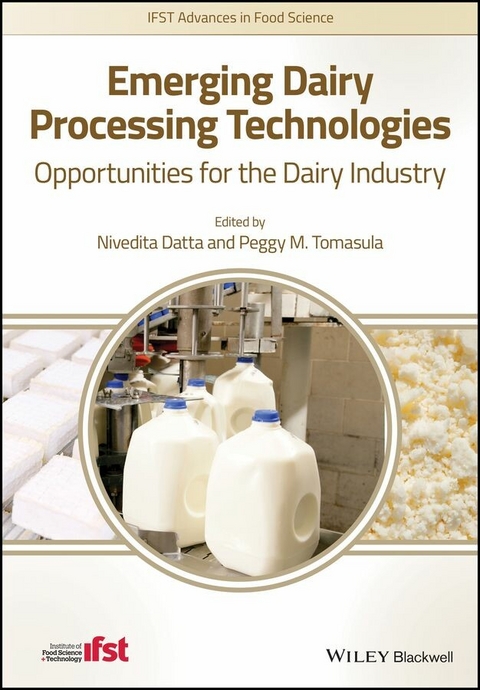
Emerging Dairy Processing Technologies (eBook)
John Wiley & Sons (Verlag)
978-1-118-56044-0 (ISBN)
Dr Nivedita Datta is a Lecturer in Food Science and Technology in the College of Health and Biomedicine
at Victoria University, Melbourne, Australia.
Dr Peggy M. Tomasula is Research Leader of the Dairy and Functional Foods Research Unit (DFFRU) at
USDA/ARS/ERRC in Wyndmoor, Pennsylvania, USA.
Fluid milk processing is energy intensive, with high financial and energy costs found all along the production line and supply chain. Worldwide, the dairy industry has set a goal of reducing GHG emissions and other environmental impacts associated with milk processing. Although the major GHG emissions associated with milk production occur on the farm, most energy usage associated with milk processing occurs at the milk processing plant and afterwards, during refrigerated storage (a key requirement for the transportation, retail and consumption of most milk products). Sustainable alternatives and designs for the dairy processing plants of the future are now being actively sought by the global dairy industry, as it seeks to improve efficiency, reduce costs, and comply with its corporate social responsibilities. Emerging Dairy Processing Technologies: Opportunities for the Dairy Industry presents the state of the art research and technologies that have been proposed as sustainable replacements for high temperature-short time (HTST) and ultra-high temperature (UHT) pasteurization, with potentially lower energy usage and greenhouse gas emissions. These technologies include pulsed electric fields, high hydrostatic pressure, high pressure homogenization, ohmic and microwave heating, microfiltration, pulsed light, UV light processing, and carbon dioxide processing. The use of bacteriocins, which have the potential to improve the efficiency of the processing technologies, is discussed, and information on organic and pasture milk, which consumers perceive as sustainable alternatives to conventional milk, is also provided. This book brings together all the available information on alternative milk processing techniques and their impact on the physical and functional properties of milk, written by researchers who have developed a body of work in each of the technologies. This book is aimed at dairy scientists and technologists who may be working in dairy companies or academia. It will also be highly relevant to food processing experts working with dairy ingredients, as well as university departments, research centres and graduate students.
Dr Nivedita Datta is a Lecturer in Food Science and Technology in the College of Health and Biomedicine at Victoria University, Melbourne, Australia. Dr Peggy M. Tomasula is Research Leader of the Dairy and Functional Foods Research Unit (DFFRU) at USDA/ARS/ERRC in Wyndmoor, Pennsylvania, USA.
1
Crossflow Microfiltration in the Dairy Industry
Peggy M. Tomasula and Laetitia M. Bonnaillie
Dairy and Functional Foods Research Unit, United States Department of Agriculture/Agricultural Research Service/Eastern Regional Research Center, USA
1.1 Introduction
1.1.1 Membrane Types
Since their introduction in the 1960s, pressure driven, crossflow or tangential filtration membrane technologies have become important in the food processing industries. The dairy industry currently uses crossflow membrane technologies for applications such as fractionation of the casein and whey proteins, whey protein concentration, demineralization of whey, removal of somatic cells and bacteria from milk, and milk concentration to save transport costs (Pouliot, 2008; Gésan-Guiziou, 2010). Membranes are also used alone or with the evaporation step in the manufacture of milk powders, and are increasingly being used in the development of new dairy-based beverages, fermented milk beverages and yogurt products. They are also finding a place in clean-in-place (CIP) processes to recover cleaning agents or to recover water used in processing (Alvarez et al., 2007; Luo et al., 2012).
Four types of membranes are used by the dairy industry: reverse osmosis (RO), nanofiltration (NF), ultrafiltration (UF) and microfiltration (MF). The operating parameters for crossflow filtration membranes are shown in Figure 1.1. The pressure-driven feed, with flow rate, QF, flows through the membrane channel parallel to the surface of the membrane. The applied pressure, PF, must overcome the osmotic pressure, πF, of the feed solution (Cheryan, 1998). The crossflow velocity (CFV), the velocity of the feed as it flows parallel to the membrane through the channel, has a sweeping effect that minimizes build-up of the feed particles on the membrane surface.
Some of the feed stream containing the smaller molecules flows through the walls of the membrane leaving as the permeate, with flow rate, QP, and pressure PP. QP is often reported as the permeate flux, J, defined as the volume of permeate per unit membrane surface area per time. PP has a gauge pressure reading of 0.0 if the stream is open to the atmosphere. The remainder of the stream, called the retentate, with flow rate, QR, and pressure, PR, flows out the end of the membrane. This stream may be entirely or partially recycled back to the feed. The size distribution of the particles in the permeate and the retentate depend on the pore size distribution of the membrane. The pressure-driving force is reported in terms of the transmembrane pressure (TMP) and is given by:
Figure 1.1 Parameters for crossflow filtration. Cross-section of a crossflow microfiltration housing for multiple membrane tubes shown.
(1.1)Table 1.1 shows the sizes of the milk nutrients, somatic cells and species that may populate milk, such as bacteria, spores, yeasts and moulds, and the corresponding types of membranes that would be used to separate them from smaller milk components. The wide ranges in sizes for bacteria and spores reported in Table 1.1 account for their possible lengths and widths (Garcia et al., 2013). The operating pressure ranges and the separation technologies that compete with the particular membrane type are also listed. Particles smaller than the rating or pore or cut-off size leave in the permeate stream, particles larger than the pore size remain in the retentate. For RO and NF, the membranes are rated by salt rejection standards defined by the manufacturer. UF membranes are rated by a molecular weight cut-off size (MWCO) and MF membranes are rated by pore size.
RO, which may be used for milk or cheese whey concentration and to concentrate milk to save on transport costs, mostly retains the milk solutes, allowing only water to pass through the membrane. NF, which is also known as leaky RO, since it allows monovalent ions to pass through the membrane along with water, can also be used for concentration and, for example, in whey demineralization to purify lactose from cheese whey by removing salt, or to reduce water hardness in dairy plants (Cheryan, 1998; Pouliot, 2008; Gésan-Guiziou, 2010). The driving force for RO and NF is osmotic pressure. Depending on the cut-off size, UF, the most commonly used membrane process in the dairy industry, produces a retentate of proteins and fat, with the permeate containing minerals, nonprotein nitrogen and lactose. UF is used for protein standardization of cheese milk, to concentrate whey, for lactose-reduced milk and to fractionate the whey proteins. MF, depending on the membrane pore size, has been used to pretreat whey to remove fat, casein fines and bacteria prior to manufacture of whey protein concentrates by UF (Cheryan, 1998), to remove bacteria from milk and for production of micellar casein and whey protein from milk.
Table 1.1 Membrane pore size and operating pressure ranges, milk component sizes, size range and alternative processing methods. The corresponding MW range is in parentheses
Currently, MF has limited use in the dairy industry, with an installed membrane area of 15 000 m2 compared to that of UF with an installed area of 350 000 m2 (Garcia et al., 2013). This chapter reviews the theory and experimental techniques used in research on MF and then focuses on the current status of MF for removal of bacteria from milk to create extended shelf life (ESL) milk, processes which use MF to separate milk into value-added enriched fractions and newer developments in MF applications. The greenhouse gas emissions, energy use and estimated costs for a fluid milk processing plant are compared to those for the same plant with an MF installation.
1.1.2 MF Membranes
Membranes used in the dairy industry are semipermeable and are manufactured to achieve various pore sizes and pore size distributions tailored for a particular application. MF membranes for dairy applications have a well defined pore size distribution and are manufactured from ceramic materials or polymeric materials. Milk MF is usually performed with membranes in tubular form (ceramic membranes) or, in limited applications, a spiral-wound (SW) design (polymeric) to fit laboratory, pilot plant and commercial scale equipment.
Ceramic membranes have an asymmetric structure consisting of two layers. The top layer, also known as the skin layer or active membrane layer, is very thin and, depending on the pore size and pore size distribution, is a factor in determining the performance of the membrane in terms of fouling. Fouling lowers the permeate flux, J, and may also prevent or alter the transmission of the feed components to the permeate. The bottom layer is a macroporous support structure for the membrane (Figure 1.2). Ceramic membranes are made from metal oxides such as zirconia, titania, or alumina and silica and formed into tubes. MF membranes for dairy applications are usually made from alpha-alumina. Polymeric SW membranes for MF are manufactured mainly from poly(vinylidene fluoride) (PVDF). Their manufacture is not discussed here but details can be found elsewhere (Cheryan, 1998).
Regardless of membrane type, membranes for the dairy industry must be able to withstand the rigorous cycling of chemicals and high temperatures during cleaning. The PVDF SW membranes can withstand temperatures up to about 60° C but are susceptible to chemical cleaning, which limits their use to about one year (Cheryan, 1998). Ceramic MF membranes are more expensive than the SW membranes and can withstand liquid temperatures of up to approximately 95° C, but the actual temperature limits are set by the tolerances of the gaskets and o-rings to the higher temperatures and chemical cleaning. These membranes can last for up to 10 years (Cheryan, 1998).
Hydrophilic membranes are chosen for milk processing applications because they minimize protein binding by the hydrophobic proteins that contribute to fouling and affect permeability (Bowen, 1993). Their high surface tension attracts water molecules to the surface; this helps to prevent protein fouling. Ceramic membranes are naturally hydrophilic, since they are derived from the hydrophilic metal oxides. PVDF membranes are hydrophobic but are available in modified form to reduce hydrophobicity (Liu et al., 2011).
Figure 1.2 Cross-section of a ceramic membrane tube.
In addition to hydrophilicity, the charge, surface roughness and morphological properties of the membrane and the sizes and tortuosity of the membrane pores have also been shown to affect the extent of fouling by proteins (Bowen, 1993; Cheryan, 1998). For example, milk has a pH of 6.6, with many of its proteins negatively charged. It would be expected that a negatively charged membrane would be more preferable for milk processing than a positively charged membrane. However, many of the ionic species in milk, particularly calcium, would bind to the membrane and, in turn facilitate, binding of the negative proteins and phosphates (Bowen, 1993).
The selectivity is also an important consideration when choosing a membrane. Selectivity may be adversely affected by the pore size distribution, uneven TMP across the membrane and fouling (Brans et al., 2004). A large pore size distribution may result in undesired transmission or retention of milk components adversely affecting permeate composition. Uneven TMP across ceramic membranes, typically caused...
| Erscheint lt. Verlag | 1.7.2015 |
|---|---|
| Reihe/Serie | IFST Advances in Food Science |
| IFST Advances in Food Science | IFST Advances in Food Science |
| Sprache | englisch |
| Themenwelt | Naturwissenschaften ► Biologie |
| Technik ► Lebensmitteltechnologie | |
| Weitere Fachgebiete ► Land- / Forstwirtschaft / Fischerei | |
| Schlagworte | carbon dioxide processing • Dairy Food • dairy industry • Dairy processing • Food Processing, Production & Manufacture • Food Science & Technology • Herstellung u. Verarbeitung von Lebensmitteln • High hydrostatic pressure • high pressure homogenization • Lebensmittelforschung u. -technologie • Lebensmittelverarbeitung • Microfiltration • Milcherzeugnis • Milchprodukte • ohmic and microwave heating • pasteurization • Pulsed electric fields • Pulsed light • sustainability • UV light processing |
| ISBN-10 | 1-118-56044-2 / 1118560442 |
| ISBN-13 | 978-1-118-56044-0 / 9781118560440 |
| Informationen gemäß Produktsicherheitsverordnung (GPSR) | |
| Haben Sie eine Frage zum Produkt? |
 EPUB (Adobe DRM)
Kopierschutz: Adobe-DRM
Adobe-DRM ist ein Kopierschutz, der das eBook vor Mißbrauch schützen soll. Dabei wird das eBook bereits beim Download auf Ihre persönliche Adobe-ID autorisiert. Lesen können Sie das eBook dann nur auf den Geräten, welche ebenfalls auf Ihre Adobe-ID registriert sind.
Details zum Adobe-DRM
Dateiformat: EPUB (Electronic Publication)
EPUB ist ein offener Standard für eBooks und eignet sich besonders zur Darstellung von Belletristik und Sachbüchern. Der Fließtext wird dynamisch an die Display- und Schriftgröße angepasst. Auch für mobile Lesegeräte ist EPUB daher gut geeignet.
Systemvoraussetzungen:
PC/Mac: Mit einem PC oder Mac können Sie dieses eBook lesen. Sie benötigen eine
eReader: Dieses eBook kann mit (fast) allen eBook-Readern gelesen werden. Mit dem amazon-Kindle ist es aber nicht kompatibel.
Smartphone/Tablet: Egal ob Apple oder Android, dieses eBook können Sie lesen. Sie benötigen eine
Geräteliste und zusätzliche Hinweise
Buying eBooks from abroad
For tax law reasons we can sell eBooks just within Germany and Switzerland. Regrettably we cannot fulfill eBook-orders from other countries.
aus dem Bereich