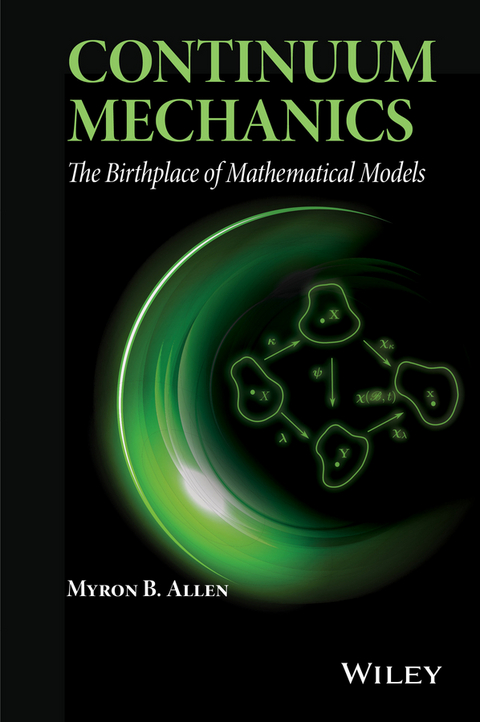
Continuum Mechanics (eBook)
John Wiley & Sons (Verlag)
978-1-118-90934-8 (ISBN)

Presents a self-contained introduction to continuum mechanics that illustrates how many of the important partial differential equations of applied mathematics arise from continuum modeling principles
Written as an accessible introduction, Continuum Mechanics: The Birthplace of Mathematical Models provides a comprehensive foundation for mathematical models used in fluid mechanics, solid mechanics, and heat transfer. The book features derivations of commonly used differential equations based on the fundamental continuum mechanical concepts encountered in various fields, such as engineering, physics, and geophysics.
The book begins with geometric, algebraic, and analytical foundations before introducing topics in kinematics. The book then addresses balance laws, constitutive relations, and constitutive theory. Finally, the book presents an approach to multiconstituent continua based on mixture theory to illustrate how phenomena, such as diffusion and porous-media flow, obey continuum-mechanical principles.
Continuum Mechanics: The Birthplace of Mathematical Models features:
- Direct vector and tensor notation to minimize the reliance on particular coordinate systems when presenting the theory
- Terminology that is aligned with standard courses in vector calculus and linear algebra
- The use of Cartesian coordinates in the examples and problems to provide readers with a familiar setting
- Over 200 exercises and problems with hints and solutions in an appendix
- Introductions to constitutive theory and multiconstituent continua, which are distinctive for books at this level
Myron B. Allen, PhD, is Professor of Mathematics at the University of Wyoming, Consulting Editor for Wiley's Pure and Applied Mathematics book series, and past provost and vice president for Academic Affairs. His research interests include numerical analysis, mathematical modeling, and fluid mechanics in porous media.
CHAPTER 1
GEOMETRIC SETTING
Physicists recognize two branches of mechanics: classical and quantum. For the past century, the quantum view, emphasizing the corpuscular nature of matter at atomic and finer scales, has played a dominant role in most universities' physics curricula. In those settings, classical mechanics enjoys a distinguished mathematical pedigree, being based on ideas developed by Galileo Galilei, Johannes Kepler, Isaac Newton, Leonhard Euler, Joseph Louis Lagrange, William Rowan Hamilton, and others. Nevertheless, many academic physics departments treat classical mechanics as a mathematical training ground for undergraduates preparing to study the principles of subatomic particles and quantum fields, subjects commonly regarded as more fundamental.
Applied mathematicians and engineers tend to view classical mechanics from a different perspective. While the most elementary formulations of Newton's laws and the Lagrangian and Hamiltonian formalisms focus on idealized particles with mass, many natural phenomena appear to macroscopic observers—those whose scales of observation are significantly larger than meters—as continuous in space and time. For these phenomena, fruitful mathematical descriptions typically arise from extensions of classical mechanics pioneered, most notably, by Leonhard Euler and Augustin-Louis Cauchy and refined during the last half of the twentieth century by a large community of scientists, some of whom are mentioned in the preface. In these extensions, matter appears to be continuous, in a sense to be made more precise in the next chapter.
Continuum mechanics embodies these extensions, furnishing useful mathematical models of fluids, elastic solids, and viscoelastic materials. These models describe phenomena that we see and feel in our everyday interactions with the world: rocks in the Earth's crust, water on and beneath its surface, weather, the structures that humans build, and the biological tissues that we occupy. The models typically take the form of partial differential equations describing rates of change with respect to spatial position and time. Advances in our ability to understand and solve these types of equations—especially using high-performance computers—have made continuum mechanics one of the most powerful tools in applied mathematics and engineering. For this reason, in developing the elements of the subject, this book frequently draws connections between its core concepts and the qualitative theory of partial differential equations.
1.1 VECTORS AND EUCLIDEAN POINT SPACE
From a mathematical perspective, continuum mechanics has roots in geometry. In the most natural geometric setting, basic principles do not depend on any observer's particular frame of reference or choice of coordinate systems. One aim of this book is to develop the rudiments of continuum mechanics in a manner that minimizes reliance on particular coordinates, recognizing that using these concepts in specific problems often requires the adoption of a well-chosen coordinate system.
The geometric setting here is relatively simple, relying on ideas familiar to anyone who has studied multivariable calculus and linear algebra. For a more sophisticated approach, refer to [38].
1.1.1 Vectors
Fundamental to continuum mechanics is the three-dimensional Euclidean vector space over the field of real numbers. This space, which we denote as , has features that do not depend on any system for assigning numbers to the vectors in it. In particular, has three attributes beyond those common to all vector spaces. Although the attributes are elementary, it is useful to review them in coordinate-free language and to show how coordinates arise.
- Inner product. possesses an inner product, that is, a binary operation that maps each pair of vectors onto a real number with the following properties:
Geometry in arises from the inner product. It allows us to associate with each vector in a length,
and, when , a direction . Two nonzero vectors x and y have angle given by
Two vectors x and y are orthogonal if . For two arbitrary vectors , with , the orthogonal projection of y onto x is
See Figure 1.1.
- Orthonormal basis. There is an orthonormal basis for , that is, a basis such that for and . when .
Figure 1.1 The orthogonal projection of y onto x.
The basis , shown in Figure 1.2, establishes a Cartesian coordinate system on . Using this system, we represent any vector as a point in the vector space of ordered triples of real numbers: if , then
denotes its representation in with respect to the basis. A different choice of basis vectors for —even a different choice of orthonormal basis—yields a different representation in , but the vector in remains fixed in magnitude and direction. For this reason we distinguish from .
Figure 1.2 Standard orthonormal basis vectors defining a Cartesian coordinate system.
Exercise 1
For a given orthonormal basis , it is possible to determine the coefficients knowing the vector x. Show that .
For consistency with the conventions of matrix multiplication, discussed later, we write representations of vectors in as column arrays. Under this convention, when the basis for is understood, we sometimes abuse notation by writing as if the vector equals its representation:
For typesetting convenience we sometimes denote column vectors as formal transposes of row vectors, for example,
With respect to the orthonormal basis . the inner product of two vectors has the value
The following exercise gives a coordinate-free expression for the inner product in terms of lengths.
Exercise 2
Prove the polarization identity:
- Cross product. admits a second form of vector multiplication. If have angle then their cross product is the vector that has length and direction orthogonal to both x and y, with sense given by the right-hand rule, as illustrated in Figure 1.3.
Figure 1.3 The cross product , showing the right-hand rule.
As a binary operation on vectors, the cross product is endemic to three space dimensions, as discussed further in Section 3.3. In all that follows, we assume that the orthonormal basis for has positive orientation, meaning that whenever or (2, 3, 1) or (3, 1, 2), that is, whenever is an even permutation of (1, 2, 3). Under this convention, with respect to the basis , the cross product has the value
Later sections explore additional algebraic and geometric interpretations of the cross product.
Representations with respect to the basis can be useful for calculations, but two caveats are in order. First, they are not the only numerical representations available for vectors Infinitely many orthonormal bases exist for and it is possible to construct infinitely many nonorthonormal, non-Cartesian bases. Second, the principles of continuum mechanics do not require any choice of basis or associated coordinate system. Nevertheless, this book frequently uses and the Cartesian coordinate system it defines to discuss examples, since this basis furnishes a computationally familiar setting. The remainder of this chapter reviews further aspects of the algebra and geometry of with an attempt to minimize unnecessary references to coordinates.
Subsequent chapters refer to vectors that have a variety of physical dimensions. For example, the dimension of position vectors is length, denoted by [L], while velocity vectors have dimension length/time, or . Fastidious readers may anticipate some apparent anomalies associated with algebraic operations involving pairs of vectors having different physical dimensions. Section 1.2 proposes a resolution.
1.1.2 Euclidean Point Space
As fundamental as the Euclidean vector space may be to the mathematics of continuum mechanics, the objects of interest—sets of material points defined in Chapter 2—do not reside there. Instead, consistent with experience, these objects occupy points P in a type of space that has no intrinsic algebraic structure. To apply the tools of algebra and calculus, we attach the vector space to choosing a point to serve as the origin and assigning to every point a vector in that translates into This approach allows us to refer to points in a way that facilitates the mathematical analysis available for vectors This subsection furnishes details of the association between and the space .
Recognizing the distinction between the set of points and the algebraic structure may seem pedantic. But without doing so, we cannot correctly account for disparate descriptions made by different observers, who assign vectors to points in different ways. Sections 3.5 and 6.3 examine the effects of such differences.
Definition
A set of points is a Euclidean point space over if there is a translation mapping d : having the following properties:
- for every
- for all
- For every fixed the mapping is one-to-one and onto. In other words, for every point and...
| Erscheint lt. Verlag | 13.7.2015 |
|---|---|
| Sprache | englisch |
| Themenwelt | Mathematik / Informatik ► Mathematik ► Analysis |
| Mathematik / Informatik ► Mathematik ► Angewandte Mathematik | |
| Naturwissenschaften ► Physik / Astronomie ► Mechanik | |
| Technik ► Maschinenbau | |
| Schlagworte | Applied mathematics • Computational / Numerical Methods • Differential Equations • Differentialgleichung • Differentialgleichungen • Electrical & Electronics Engineering • Elektrotechnik u. Elektronik • Engineering • fluid mechanics • Geophysics • heat transfer • Kontinuumsmechanik • <p>continuum mechanics • Maschinenbau • Mathematical Modeling • Mathematics • Mathematik • mechanical engineering • Numerical Methods & Algorithms • Numerische Methoden u. Algorithmen • Partial differential equations • Physics • porous media</p> • Rechnergestützte / Numerische Verfahren im Maschinenbau • Rechnergestützte / Numerische Verfahren im Maschinenbau • solid mechanics |
| ISBN-10 | 1-118-90934-8 / 1118909348 |
| ISBN-13 | 978-1-118-90934-8 / 9781118909348 |
| Informationen gemäß Produktsicherheitsverordnung (GPSR) | |
| Haben Sie eine Frage zum Produkt? |
 EPUB (Adobe DRM)
Kopierschutz: Adobe-DRM
Adobe-DRM ist ein Kopierschutz, der das eBook vor Mißbrauch schützen soll. Dabei wird das eBook bereits beim Download auf Ihre persönliche Adobe-ID autorisiert. Lesen können Sie das eBook dann nur auf den Geräten, welche ebenfalls auf Ihre Adobe-ID registriert sind.
Details zum Adobe-DRM
Dateiformat: EPUB (Electronic Publication)
EPUB ist ein offener Standard für eBooks und eignet sich besonders zur Darstellung von Belletristik und Sachbüchern. Der Fließtext wird dynamisch an die Display- und Schriftgröße angepasst. Auch für mobile Lesegeräte ist EPUB daher gut geeignet.
Systemvoraussetzungen:
PC/Mac: Mit einem PC oder Mac können Sie dieses eBook lesen. Sie benötigen eine
eReader: Dieses eBook kann mit (fast) allen eBook-Readern gelesen werden. Mit dem amazon-Kindle ist es aber nicht kompatibel.
Smartphone/Tablet: Egal ob Apple oder Android, dieses eBook können Sie lesen. Sie benötigen eine
Geräteliste und zusätzliche Hinweise
Buying eBooks from abroad
For tax law reasons we can sell eBooks just within Germany and Switzerland. Regrettably we cannot fulfill eBook-orders from other countries.
aus dem Bereich