


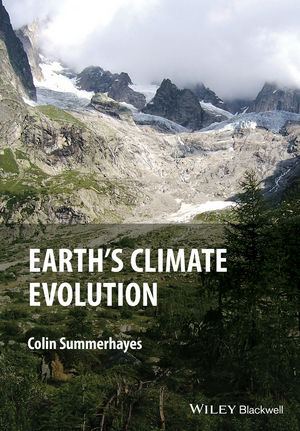
Earth's Climate Evolution (eBook)
John Wiley & Sons (Verlag)
978-1-118-89737-9 (ISBN)
To understand climate change today, we first need to know how Earth's climate changed over the past 450 million years. Finding answers depends upon contributions from a wide range of sciences, not just the rock record uncovered by geologists. In Earth's Climate Evolution, Colin Summerhayes analyzes reports and records of past climate change dating back to the late 18th century to uncover key patterns in the climate system. The book will transform debate and set the agenda for the next generation of thought about future climate change.
The book takes a unique approach to the subject providing a description of the greenhouse and icehouse worlds of the past 450 million years since land plants emerged, ignoring major earlier glaciations like that of Snowball Earth, which occurred around 600 million years ago in a world free of land plants. It describes the evolution of thinking in palaeoclimatology and introduces the main players in the field and how their ideas were received and, in many cases, subsequently modified. It records the arguments and discussions about the merits of different ideas along the way. It also includes several notes made from the author's own personal involvement in palaeoclimatological and palaeoceanographic studies, and from his experience of working alongside several of the major players in these fields in recent years.
This book will be an invaluable reference for both undergraduate and postgraduate students taking courses in related fields and will also be of interest to historians of science and/or geology, climatology and oceanography. It should also be of interest to the wider scientific and engineering community, high school science students, policy makers, and environmental NGOs.
Reviews:
'Outstanding in its presentation of the facts and a good read in the way that it intersperses the climate story with the author's own experiences. [This book] puts the climate story into a compelling geological history.'
-Dr. James Baker
'The book is written in very clear and concise prose, [and takes] original, enlightening, and engaging approach to talking about 'ideas' from the perspective of the scientists who promoted them.'
-Professor Christopher R. Scotese
'A thrilling ride through continental drift and its consequences.'
- Professor Gerald R. North
'Written in a style and language which can be easily understood by laymen as well as scientists.'
- Professor Dr Jörn Thiede
'What makes this book particularly distinctive is how well it builds in the narrative of change in ideas over time.'
- Holocene book reviews, May 2016
'This is a fascinating book and the author's biographical approach gives it great human appeal.'
- E Adlard
Colin Summerhayes is an Emeritus Associate of the Scott Polar Research Institute of Cambridge University. He has carried out research on past climate change in both academia and industry: at Imperial College London; the University of Cape Town; the Woods Hole Oceanographic Institution; the UK's Institute of Oceanographic Sciences Deacon Laboratory; the UK's Southampton (now National) Oceanography Centre; the Exxon Production Research Company; and the BP Research Company. He has managed research programmes on climate change for the UK's Natural Environment Research Council, the Intergovernmental Oceanographic Commission of UNESCO, and the Scientific Committee on Antarctic Research of the International Council for Science. He has co-edited several books relating to aspects of past or modern climate, including North Atlantic Palaeoceanography (1986), Upwelling Systems: Evolution Since the Early Miocene (1992), Upwelling in the Oceans (1995), Oceanography: An Illustrated Guide (1996), Understanding the Oceans (2001), Oceans 2020: Science, Trends and the Challenge of Sustainability (2002), Antarctic Climate Change and the Environment (2009), and Understanding Earth's Polar Challenges: International Polar Year 2007-2008 (2011).
To understand climate change today, we first need to know how Earth s climate changed over the past 450 million years. Finding answers depends upon contributions from a wide range of sciences, not just the rock record uncovered by geologists. In Earth s Climate Evolution, Colin Summerhayes analyzes reports and records of past climate change dating back to the late 18th century to uncover key patterns in the climate system. The book will transform debate and set the agenda for the next generation of thought about future climate change. The book takes a unique approach to the subject providing a description of the greenhouse and icehouse worlds of the past 450 million years since land plants emerged, ignoring major earlier glaciations like that of Snowball Earth, which occurred around 600 million years ago in a world free of land plants. It describes the evolution of thinking in palaeoclimatology and introduces the main players in the field and how their ideas were received and, in many cases, subsequently modified. It records the arguments and discussions about the merits of different ideas along the way. It also includes several notes made from the author s own personal involvement in palaeoclimatological and palaeoceanographic studies, and from his experience of working alongside several of the major players in these fields in recent years. This book will be an invaluable reference for both undergraduate and postgraduate students taking courses in related fields and will also be of interest to historians of science and/or geology, climatology and oceanography. It should also be of interest to the wider scientific and engineering community, high school science students, policy makers, and environmental NGOs.Reviews:"e;Outstanding in its presentation of the facts and a good read in the way that it intersperses the climate story with the author's own experiences. [This book] puts the climate story into a compelling geological history."e; -Dr. James Baker "e;The book is written in very clear and concise prose, [and takes] original, enlightening, and engaging approach to talking about 'ideas' from the perspective of the scientists who promoted them."e; -Professor Christopher R. Scotese"e;A thrilling ride through continental drift and its consequences."e;- Professor Gerald R. North"e;Written in a style and language which can be easily understood by laymen as well as scientists."e;- Professor Dr J rn Thiede"e;What makes this book particularly distinctive is how well it builds in the narrative of change in ideas over time."e;- Holocene book reviews, May 2016"e;This is a fascinating book and the author s biographical approach gives it great human appeal."e; - E Adlard
Colin Summerhayes is an Emeritus Associate of the Scott Polar Research Institute of Cambridge University. He has carried out research on past climate change in both academia and industry: at Imperial College London; the University of Cape Town; the Woods Hole Oceanographic Institution; the UK's Institute of Oceanographic Sciences Deacon Laboratory; the UK's Southampton (now National) Oceanography Centre; the Exxon Production Research Company; and the BP Research Company. He has managed research programmes on climate change for the UK's Natural Environment Research Council, the Intergovernmental Oceanographic Commission of UNESCO, and the Scientific Committee on Antarctic Research of the International Council for Science. He has co-edited several books relating to aspects of past or modern climate, including North Atlantic Palaeoceanography (1986), Upwelling Systems: Evolution Since the Early Miocene (1992), Upwelling in the Oceans (1995), Oceanography: An Illustrated Guide (1996), Understanding the Oceans (2001), Oceans 2020: Science, Trends and the Challenge of Sustainability (2002), Antarctic Climate Change and the Environment (2009), and Understanding Earth's Polar Challenges: International Polar Year 2007-2008 (2011).
"What makes this book particularly distinctive is how well it builds in the narrative of change in ideas over time." (Holocene book reviews, May 2016)
"This is a fascinating book and the author's biographical approach gives it great human appeal." (E Adlard 2016)
"I would recommend this book to all those with an interest in the climate (which should be all of us)" - Edward R. Adlard, Chromatographia 2016
"This is a marvelous book: the best serious, all-round, indepth book on palaeoclimate I have encountered. If you have space on your bookshelf for just one properly substantial volume on this huge and manyfaceted topic - well, look no further. This is it." Jan Zalasiewicz, Geoscientist Online, 2018
"Outstanding in its presentation of the facts and a good read in the way that it intersperses the climate story with the author's own experiences. [This book] puts the climate story into a compelling geological history." -Dr. James Baker
"The book is written in very clear and concise prose, [and takes] original, enlightening, and engaging approach to talking about 'ideas' from the perspective of the scientists who promoted them."
-Professor Christopher R. Scotese
Chapter 1
Introduction
In almost every churchyard, you'll find gravestones so old that their inscriptions have disappeared. Over the years, drop after drop of a mild acid has eaten away the stone from which many old gravestones were carved, obliterating the names of those long gone. We know this mild acid as rainwater, formed by the condensation of water vapour containing traces of atmospheric gases like carbon dioxide (CO2) and sulphur dioxide (SO2). It's the gases that make it acid. Rain eats rock by weathering.
Weathering is fundamental to climate change. Over time, it moves mountains. Freezing and thawing cracks new mountain rocks apart. Roots penetrate cracks as plants grow. Rainwater penetrates surfaces, dissolving as it goes. The CO2 in the dissolved products of weathering eventually reaches the sea, where it forms food for plankton, and the seabed, in the remains of dead organisms. Once there, it goes on to form the limestones and hydrocarbons of the future; one day, volcanoes will spew that CO2 back into the atmosphere and the cycle will begin all over again.
The carbon cycle includes the actions of land plants, which extract CO2 from the air by photosynthesis. When plants die, they rot, returning their CO2 to the air. Some are buried, preserving their carbon from that same fate, until heat from the Earth's interior turns them back into CO2, which returns to the air. This natural cycle has been in balance for millions of years. We have disturbed it by burning fossil carbon in the form of coal, oil or gas.
This book is the story of climate change as revealed by the geological record of the past 450 million years (450 Ma). It is a story of curiosity about how the world works and of ingenuity in tackling the almost unimaginably large challenge of understanding climate change. The task is complicated by the erratic nature of the geological record. Geology is like a book whose pages recount tales of the Earth's history. Each copy of this book has some pages missing. Fortunately, the American, African, Asian, Australasian and European editions all miss different pages. Combining them lets us assemble a good picture of how Earth's climate has changed through time. Year by year, the picture becomes clearer, as researchers develop new methods to probe its secrets.
As we explore the evolution of Earth's climate, we will follow the guidance of one of the giants of 18th-century science, Alexander von Humboldt, who wrote in 1788, ‘The most important result of research is to recognize oneness in multiplicity, to grasp comprehensively all individual constituents, and to analyze critically the details without being overwhelmed by their massiveness’1. All too often, those who seek to deny the reality of modern climate change ignore his integrative approach to understanding nature by focusing on just one or two aspects where the evidence seems, at the moment, to be less than compelling.
Can the history of Earth's climate tell us anything about how it might evolve if we go on emitting gigatonnes (Gt) of CO2 and other greenhouse gases into the atmosphere? That is the key question behind the title to this book. I wrote it because I have spent most of my career working on past climate change, and it worries me that few of the results of the growing body of research on that topic reach the general public. Even many professional Earth scientists I meet, from both academia and industry, know little of what the most up-to-date Earth science studies tell us about climate change and global warming. For the most part, they have specialised in those aspects of the Earth sciences that were relevant to their careers. Unfortunately, their undoubted expertise in these topics does not prevent some of them from displaying their ignorance of developments in the study of past climate change by trotting out the brainless mantra, ‘the climate is always changing’. Well, of course it is, but that ignores the all-important question: Why?
What we really need to know is in what ways the climate has been changing, at what rates, with what regional variability, and in response to what driving forces. With these facts, we can establish with reasonable certainty the natural variability of Earth's climate, and determine how it is most likely to evolve as we pump greenhouse gases into the atmosphere. This book attempts to address these issues in a way that should be readily understandable to anyone with a basic scientific education. It describes a voyage of discovery by scientists obsessed with exposing the deepest secrets of our changing climate through time. I hope that readers will find the tale as fascinating as I found the research that went into it.
The drive to understand climate change is an integral part of the basic human urge to understand our surroundings. As in all fields of science, the knowledge necessary to underpin that understanding accumulates gradually. At first we see dimly, but eventually the subject matter becomes clear. The process is a journey through time, in which each generation makes a contribution. Imagination and creativity play their parts. The road is punctuated by intellectual leaps. Exciting discoveries change its course from time to time. No one person could have discovered in his or her lifetime what we now know about the workings of the climate system. Thousands of scientists have added their pieces to the puzzle. Developing our present picture of how the climate system works has required contributions from an extraordinary range of different scientific disciplines, from astronomy to zoology. The breadth of topics that must be understood in order for us to have a complete picture has made the journey slow, and still makes full understanding of climate change and global warming difficult to grasp for those not committed to serious investigation of a very wide-ranging literature. The pace of advance is relentless, and for many it is difficult to keep up. And yet, as with most fields of scientific enquiry, there is still much to learn – mostly, these days, about progressively finer levels of detail. Uncertainties remain. We will never know everything. But we do know enough to make reasonably confident statements about what is happening now and what is likely to happen next. Looking back at the progress that has been made is like watching a timelapse film of the opening of a flower. Knowledge of the climate system unfolds through time, until we find ourselves at the doorstep of the present day and looking at the future.
While the story of Earth's climate evolution has a great deal to teach us, it is largely ignored in the ongoing debate on global warming. The idea of examining the past in order to discover what the future may hold is not a new one. It was first articulated in 1795 by one of the ‘fathers of geology’, James Hutton. But it is not something the general public hears much about when it comes to understanding global warming. This book is a wake-up call, introducing the reader to what the geological record tells us.
Information about the climate of the past is referred to as ‘palaeoclimate data’ (American spelling drops the second ‘a’). As it has mushroomed in recent years, it has come to claim more attention from Working Group I of the Intergovernmental Panel on Climate Change (IPCC). The Working Group comprises an international group of scientists, which surveys the published literature every 5 years or so to come up with a view on the current state of climate science. It has been reporting roughly every 5 years since its first report in 1990. Each of its past two reports, in 20072 and 20133, incorporated a chapter on palaeoclimate data. The Working Group's report is referred to as a ‘consensus’, meaning the broad agreement of the group of scientists who worked on it. Just one chapter in a 1000-page report does not constitute a major review of Earth's climate evolution: the subject deserves a book of its own, and there are several, as you will see from the Appendix to the present book.
The study of past climates used to be the exclusive province of geologists. They would interpret past climate from the character of rocks: coals represented humid climates; polished three-sided pebbles and cross-bedded red-stained sands represented deserts; grooved rocks indicated the passage of glaciers; corals indicated tropical conditions; and so on. Since the 1950s, we have come to rely as well on geochemists using oxygen isotopes and the ratios of elements such as magnesium to calcium (Mg/Ca) to tell us about past ocean temperatures. And in recent years we have come to realise that cores of ice contain detailed records of past climate change, as well as bubbles of fossil air; glaciologists have joined the ranks.
Climate modellers have also contributed. Since the 1950s, our ability to use computers has advanced apace. We now use them not only to process palaeoclimate data and find correlations, but also to run numerical models of past climate systems, testing the results against data from the rock record. Applying numerical models to past climates that were much colder or much warmer than today's has an additional benefit: it helps climate modellers to test the robustness of the models they use to analyse today's climate and to project change into the future. One of my reasons for writing this book is to underscore how research into past climates by both of these research streams, the practical and the theoretical, adds to our confidence in understanding the workings of Earth's climate system and in predicting its likely...
| Erscheint lt. Verlag | 13.7.2015 |
|---|---|
| Sprache | englisch |
| Themenwelt | Naturwissenschaften ► Geowissenschaften ► Meteorologie / Klimatologie |
| Technik | |
| Schlagworte | climate history, climatology, The Early Earth, 9781118860571, Reconstructing Earth's Climate History, 9781118232941, climate evolution, primordial climate, cosmochemistry, geochemistry, experimental petrology, experimental physics, theoretical physics, mineral physics, geodynamics, planetary building blocks, planetary dynamic modeling, magma ocean evolution, crystallization, core formation, terrestrial planet formation, geological timescales, Earth core, deep mantle science, deep earth, Earth evolution, pal • Climatology & Palaeoclimatology • earth sciences • Geologie • Geologie u. Geophysik • Geology & Geophysics • Geowissenschaften • Klimatologie • Klimatologie u. Paläoklimatologie • Klimatologie u. Paläoklimatologie |
| ISBN-10 | 1-118-89737-4 / 1118897374 |
| ISBN-13 | 978-1-118-89737-9 / 9781118897379 |
| Informationen gemäß Produktsicherheitsverordnung (GPSR) | |
| Haben Sie eine Frage zum Produkt? |
 PDF (Adobe DRM)
Größe: 12,6 MB
Kopierschutz: Adobe-DRM
Adobe-DRM ist ein Kopierschutz, der das eBook vor Mißbrauch schützen soll. Dabei wird das eBook bereits beim Download auf Ihre persönliche Adobe-ID autorisiert. Lesen können Sie das eBook dann nur auf den Geräten, welche ebenfalls auf Ihre Adobe-ID registriert sind.
Details zum Adobe-DRM
Dateiformat: PDF (Portable Document Format)
Mit einem festen Seitenlayout eignet sich die PDF besonders für Fachbücher mit Spalten, Tabellen und Abbildungen. Eine PDF kann auf fast allen Geräten angezeigt werden, ist aber für kleine Displays (Smartphone, eReader) nur eingeschränkt geeignet.
Systemvoraussetzungen:
PC/Mac: Mit einem PC oder Mac können Sie dieses eBook lesen. Sie benötigen eine
eReader: Dieses eBook kann mit (fast) allen eBook-Readern gelesen werden. Mit dem amazon-Kindle ist es aber nicht kompatibel.
Smartphone/Tablet: Egal ob Apple oder Android, dieses eBook können Sie lesen. Sie benötigen eine
Geräteliste und zusätzliche Hinweise
Zusätzliches Feature: Online Lesen
Dieses eBook können Sie zusätzlich zum Download auch online im Webbrowser lesen.
Buying eBooks from abroad
For tax law reasons we can sell eBooks just within Germany and Switzerland. Regrettably we cannot fulfill eBook-orders from other countries.
 EPUB (Adobe DRM)
Kopierschutz: Adobe-DRM
Adobe-DRM ist ein Kopierschutz, der das eBook vor Mißbrauch schützen soll. Dabei wird das eBook bereits beim Download auf Ihre persönliche Adobe-ID autorisiert. Lesen können Sie das eBook dann nur auf den Geräten, welche ebenfalls auf Ihre Adobe-ID registriert sind.
Details zum Adobe-DRM
Dateiformat: EPUB (Electronic Publication)
EPUB ist ein offener Standard für eBooks und eignet sich besonders zur Darstellung von Belletristik und Sachbüchern. Der Fließtext wird dynamisch an die Display- und Schriftgröße angepasst. Auch für mobile Lesegeräte ist EPUB daher gut geeignet.
Systemvoraussetzungen:
PC/Mac: Mit einem PC oder Mac können Sie dieses eBook lesen. Sie benötigen eine
eReader: Dieses eBook kann mit (fast) allen eBook-Readern gelesen werden. Mit dem amazon-Kindle ist es aber nicht kompatibel.
Smartphone/Tablet: Egal ob Apple oder Android, dieses eBook können Sie lesen. Sie benötigen eine
Geräteliste und zusätzliche Hinweise
Buying eBooks from abroad
For tax law reasons we can sell eBooks just within Germany and Switzerland. Regrettably we cannot fulfill eBook-orders from other countries.
aus dem Bereich


