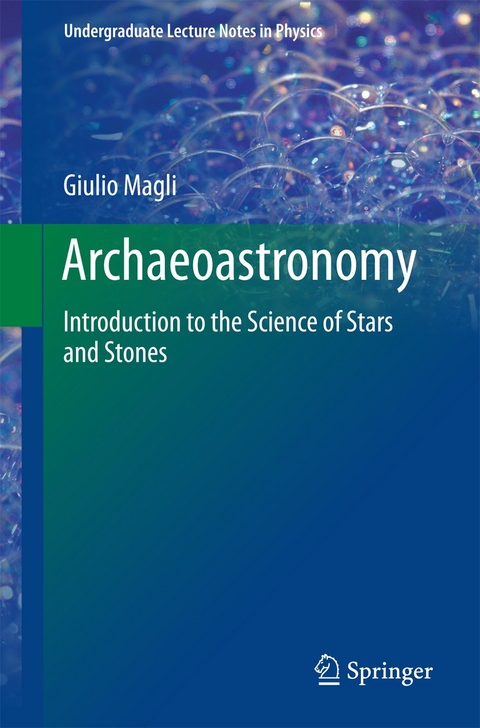
Archaeoastronomy
Springer International Publishing (Verlag)
978-3-319-22881-5 (ISBN)
- Titel erscheint in neuer Auflage
- Artikel merken
Giulio Magli is an Italian astrophysicist/archaeoastronomer who works primarily on the relationship between the architecture of ancient cultures and the sky. After receiving his PhD in Mathematical Physics at the University of Milan, he initially conducted research in Relativistic Astrophysics but gradually moved toward Archaeoastronomy, with a special interest in the relationship between architecture, landscape, and the mathematical/astronomical lore of ancient cultures, especially among the Ancient Egyptians but also among the Incas and in the Mediterranean. He became full professor of Mathematical Physics at the Politecnico of Milan in 2005, and he is currently Professor there. Since 2009 he has taught the only official course on Archaeoastronomy ever established in an Italian University. His previous books include Mysteries and Discoveries of Archaeoastronomy (Springer 2009) and Architecture, Astronomy and Sacred Landscape in Ancient Egypt (Cambridge University Press 2013). He has taught the first massive open online course on Archaeoastronomy ever developed. The course is freely available (from February 2016) on the MOOC platform of the Politecnico of Milan.
Introduction: What is Archaeoastronomy, and why studying it.- Ideas.- Astronomy and people.- Astronomy and power.- Astronomy and afterworld.- Astronomy and architecture.- Astronomy and landscape.- Methods.- The celestial coordinates.- The apparent motion of the Sun.- The apparent motion of the stars.- The apparent motion of the Moon and the planets.- The observation of celestial bodies at the horizon.- The use of astronomical software in aa.- The methods for making measures in aa.- The methods for analyzing measures in aa.- Places.- Stonehenge.- Giza.- Chichen Itza.- The Island of the Sun.- The Campus Martius.- The Valley of the Temples of Agrigento.- Menorca.- Chimney Rock.
"This book provides information on what kind of celestial motions can be followed with the naked eye and what kind of significance they might have had for the people who built these magnificent structures. In addition to the exposition we also get a glimpse of how archaeoastronomy is done and the reader is also provided with some tools and resources ... to gain a better understanding of the nature of both archaeoastronomy and the historic sites mentioned in the book." (AstroMadness.com, August, 2017)
| Erscheint lt. Verlag | 20.11.2015 |
|---|---|
| Reihe/Serie | Undergraduate Lecture Notes in Physics |
| Zusatzinfo | XIII, 246 p. 164 illus., 111 illus. in color. |
| Verlagsort | Cham |
| Sprache | englisch |
| Maße | 155 x 235 mm |
| Themenwelt | Naturwissenschaften ► Physik / Astronomie ► Astronomie / Astrophysik |
| Schlagworte | Archaeoastronomy Textbook • Archaeology of the Landscape in the Archaeoastrono • Archaeology of the Landscape in the Archaeoastronomy Textbook • Architectural History and Theory • Astronomical Software in the Archaeoastronomy Text • Astronomical Software in the Archaeoastronomy Textbook • Astronomical Value of Cultural Heritage • Astronomy, Astrophysics and Cosmology • cultural heritage • History and Philosophical Foundations of Physics • History of Ancient Astronomy • Methods of Archaeoastronomy • Physics and Astronomy • Relationship between Architecture and Astronomy • Stonehenge Astronomy |
| ISBN-10 | 3-319-22881-1 / 3319228811 |
| ISBN-13 | 978-3-319-22881-5 / 9783319228815 |
| Zustand | Neuware |
| Informationen gemäß Produktsicherheitsverordnung (GPSR) | |
| Haben Sie eine Frage zum Produkt? |
aus dem Bereich