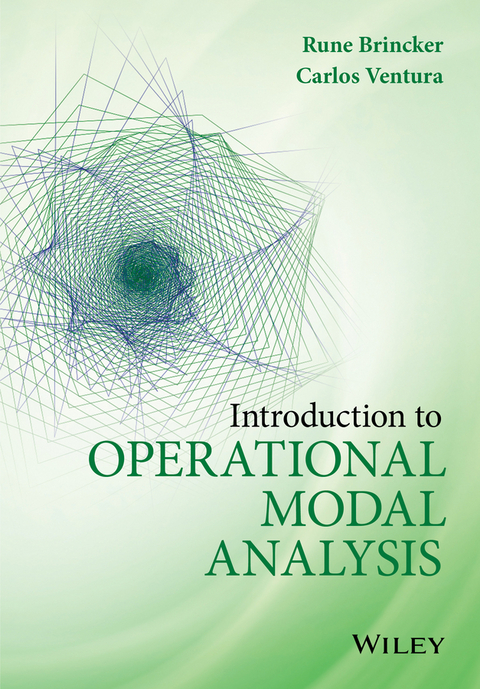
Introduction to Operational Modal Analysis (eBook)
John Wiley & Sons (Verlag)
978-1-118-53515-8 (ISBN)
- Covers all important aspects that are needed to understand why OMA is a practical tool for modal testing
- Covers advanced topics, including closely spaced modes, mode shape scaling, mode shape expansion and estimation of stress and strain in operational responses
- Discusses practical applications of Operational Modal Analysis
- Includes examples supported by MATLAB® applications
- Accompanied by a website hosting a MATLAB® toolbox for Operational Modal Analysis
Rune Brincker is a civil engineer and received his M.Sc and Ph.D. from the Technical University of Denmark in 1977 and 1981, respectively. Since then he has been conducting research on various aspects of structural mechanics. Rune has been employed as associate and full professor at several Danish universities. Presently he is a Professor of Structural Dynamics at Aarhus University, Denmark. During the last 30 years his research has been focused on operational modal analysis (OMA), and one of his major contributions to this field has been the development of the frequency domain decomposition (FDD) identification technique, which has been used in many practical applications of OMA. Rune Brincker is a co-founder of Structural Vibration Solutions (SVS) founded in 1999; and he is the founding chair of the International Operational Modal Analysis Conference (IOMAC) which started in 2005.
Carlos Ventura is a Civil Engineer with specializations in structural dynamics and earthquake engineering. He has been a faculty member of the Department of Civil Engineering at the University of British Columbia (UBC) in Canada since 1992. He is currently the Director of the Earthquake Engineering Research Facility (EERF) at UBC, and is the author of more than 450 papers and reports on earthquake engineering, structural dynamics and modal testing. He has conducted research about earthquakes and structural dynamics for more than thirty years. In addition to his academic activities, Carlos Ventura is a recognized international consultant on structural vibrations and safety of large Civil Engineering structures. He is a member of the Canadian Academy of Engineering and Fellow of Engineers Canada, also a member of several national and international professional societies, advisory committees and several building and bridge code committees.
Comprehensively covers the basic principles and practice of Operational Modal Analysis (OMA). Covers all important aspects that are needed to understand why OMA is a practical tool for modal testing Covers advanced topics, including closely spaced modes, mode shape scaling, mode shape expansion and estimation of stress and strain in operational responses Discusses practical applications of Operational Modal Analysis Includes examples supported by MATLAB applications Accompanied by a website hosting a MATLAB toolbox for Operational Modal Analysis
Rune Brincker is a civil engineer and received his M.Sc and Ph.D. from the Technical University of Denmark in 1977 and 1981, respectively. Since then he has been conducting research on various aspects of structural mechanics. Rune has been employed as associate and full professor at several Danish universities. Presently he is a Professor of Structural Dynamics at Aarhus University, Denmark. During the last 30 years his research has been focused on operational modal analysis (OMA), and one of his major contributions to this field has been the development of the frequency domain decomposition (FDD) identification technique, which has been used in many practical applications of OMA. Rune Brincker is a co-founder of Structural Vibration Solutions (SVS) founded in 1999; and he is the founding chair of the International Operational Modal Analysis Conference (IOMAC) which started in 2005. Carlos Ventura is a Civil Engineer with specializations in structural dynamics and earthquake engineering. He has been a faculty member of the Department of Civil Engineering at the University of British Columbia (UBC) in Canada since 1992. He is currently the Director of the Earthquake Engineering Research Facility (EERF) at UBC, and is the author of more than 450 papers and reports on earthquake engineering, structural dynamics and modal testing. He has conducted research about earthquakes and structural dynamics for more than thirty years. In addition to his academic activities, Carlos Ventura is a recognized international consultant on structural vibrations and safety of large Civil Engineering structures. He is a member of the Canadian Academy of Engineering and Fellow of Engineers Canada, also a member of several national and international professional societies, advisory committees and several building and bridge code committees.
"This is an interesting book for anybody dealing with vibrations, density functions, and with data and signal processing.......I certainly recommend it as a textbook for graduate study in universities." (Zentralblatt MATH 2016)
Chapter 1
Introduction
“Torture numbers and they'll confess to anything”
– Gregg Easterbrook
The engineering field that studies the modal properties of systems under ambient vibrations or normal operating conditions is called Operational Modal Analysis (OMA) and provides useful methods for modal analysis of many areas of structural engineering. Identification of modal properties of a structural system is the process of correlating the dynamic characteristics of a mathematical model with the physical properties of the system derived from experimental measurements.
It is fair to say that processing of data in OMA is challenging; one can even say that this is close to torturing the data, and it is also fair to say that fiddling around long enough with the data might lead to some strange or erroneous results that might look like reasonable results. One of the aims of this book is to help people who use OMA techniques avoid ending up in this situation, and instead obtain results that are valid and reasonable.
In OMA, measurement data obtained from the operational responses are used to estimate the parameters of models that describe the system behavior. To fully understand this process, one should have knowledge of classical structural mechanics, matrix analysis, random vibration concepts, application-specific simplifying assumptions, and practical aspects related to vibration measurement, data acquisition, and signal processing.
OMA testing techniques have now become quite attractive, due to their relatively low cost and speed of implementation and the recent improvements in recording equipment and computational methods. Table 1.1 provides a quick summary of the typical applications of OMA and how these compare with classical modal testing, also denoted experimental modal analysis (EMA), which is based on controlled input that is measured and used in the identification process.
Table 1.1 General characteristics of structural response
| Mechanical engineering | Civil engineering |
| EMA | Artificial excitation | Artificial excitation |
| Impact hammer Shakers (hydraulic, electromechanical, etc.) Controlled blasts Well-defined measured input | Shakers, mainly hydraulic Drop weights Pull back tests Eccentric shakers and exciters Well defined, measured, or unmeasured inputs Controlled blasts |
| OMA | Artificial excitation | Natural excitation |
| Scratching device Air flow Acoustic emissions Unknown signal, random in time and space | Wind Waves Traffic Unknown signal, random in time and space, with some spatial correlation |
Source: Adapted from American National Standard: “Vibration of Buildings – guidelines for the measurement of vibrations and their effects on buildings,” ANSI S2.47-1990 (ASA 95-1990).
The fundamental idea of OMA testing techniques is that the structure to be tested is being excited by some type of excitation that has approximately white noise characteristics, that is, it has energy distributed over a wide frequency range that covers the frequency range of the modal characteristics of the structure. However, it does not matter much if the actual loads do not have exact white noise characteristics, since what is really important is that all the modes of interest are adequately excited so that their contributions can be captured by the measurements.
Referring to Figure 1.1, the concept of nonwhite, but broadband loading can be explained as follows. The loading is colored, thus does not necessarily have an ideal flat spectrum, but the colored loads can be considered as the output from an imaginary (loading) filter that is loaded by white noise.
Figure 1.1 Illustration of the concept of OMA. The nonwhite noise loads are modeled as the output from a filter loaded by a white noise load
It can be proved that the concept of including an additional filter describing the coloring of the loads does not change the physical modes of the system, see Ibrahim et al. [1] and Sections 7.2.7 and 8.3.7. The coloring filter concept shows that in general what we are estimating in OMA is the modal model for “the whole system” including both the structural system and the loading filter.
When interpreting the modal results, this has to be kept in mind, because, some modes might be present due to the loading conditions and some might come from the structural system. We should also note that in practice we often estimate a much larger number of modes than the expected physical number of modes of the considered system.
This means that we need to find ways to justify which modes belong to the structural system, which modes might describe the coloring of the loading, and finally which modes are just noise modes that might not have any physical meaning. These kinds of considerations are important in OMA, and will be further illustrated later in this book.
We can conclude these first remarks by saying that OMA is the process of characterizing the dynamic properties of an elastic structure by identifying its natural modes of vibration from the operating responses. Each mode is associated with a specific natural frequency and damping factor, and these two parameters can be identified from vibration data from practically any point on the structure. In addition, each mode has a characteristic “mode shape,” which defines the spatial distribution of movement over the entire structure.
1.1 Why Conduct Vibration Test of Structures?
Vibration measurements are made for a variety of reasons. They could be used to determine the natural frequencies of a structure, to verify analytical models of the structure, to determine its dynamic response under various environmental conditions, or to monitor the condition of a structure under various loading conditions. As structural analysis techniques continually evolve and become increasingly sophisticated, awareness grows of potential shortcomings in their representation of the structural behavior. This is prevalent in the field of structural dynamics. The justification and technology exists for vibration testing and analysis of structures.
Large civil engineering structures are usually too complex for accurate dynamic analysis by hand. It is typical to use matrix algebra based solution methods, using the finite element method of structural modeling and analysis, on digital computers. All linear models have dynamic properties, which can be compared with testing and analysis techniques such as OMA.
1.2 Techniques Available for Vibration Testing of Structures
Let us discuss in some detail the two main types of modal testing: the EMA that uses controlled input forces and the OMA that uses the operational forces.
Both forced vibration and in-operation methods have been used in the past and are capable of determining the dynamic characteristics of structures. Forced vibration methods can be significantly more complex than in-operation vibration tests, and are generally more expensive than in-operation vibration tests, especially for large and massive structures. The main advantage of forced vibration over in-operation vibration is that in the former the level of excitation and induced vibration can be carefully controlled, while for the latter one has to rely on the forces of nature and uncontrolled artificial forces (i.e., vehicle traffic in bridges) to excite the structure, sometimes at very low levels of vibration. The sensitivity of sensors used for in-operation vibration measurements is generally much higher than those required for forced vibration tests.
By definition, any source of controlled excitation being applied to any structure in order to induce vibrations constitutes a forced vibration test. In-operation tests that rely on ambient excitation are used to test structures such as bridges, nuclear power plants, offshore platforms, and buildings. While ambient tests do not require traffic shutdowns or interruptions of normal operations, the amount of data collected is significant and it can be a complex task to analyze this data thoroughly.
The techniques for data analysis are different. The theory for forced vibration tests of large structures is well developed and is almost a natural extension of the techniques used in forced vibration tests of mechanical systems. In contrast, the theory for ambient vibration tests still requires further development.
1.3 Forced Vibration Testing Methods
Forced vibration tests or EMA methods are generally used to determine the dynamic characteristics of small and medium size structures. In rare occasions, these methods are used on very large structures because of the complexity associated with providing significant levels of excitation to a large, massive structure. In these tests, controlled forces are applied to a structure to induce vibrations. By measuring the structure's response to these known forces, one can determine the structure's dynamic properties. The measured excitation and acceleration response time histories are used to compute frequency response functions (FRFs) between a measured point and the point of input. These FRFs can be used to determine the natural frequencies, mode shapes, and damping values of the structure using well-established...
| Erscheint lt. Verlag | 1.7.2015 |
|---|---|
| Sprache | englisch |
| Themenwelt | Naturwissenschaften ► Physik / Astronomie ► Mechanik |
| Technik ► Bauwesen | |
| Technik ► Elektrotechnik / Energietechnik | |
| Technik ► Maschinenbau | |
| Schlagworte | Aeronautic & Aerospace Engineering • Ambient response • application • Bauingenieur- u. Bauwesen • Civil Engineering & Construction • closely spaced modes • Correlation function • Damping • discrete time solutions • Electrical & Electronics Engineering • Elektrotechnik u. Elektronik • Experimental dynamics • Festkörpermechanik • Frequency Domain Decomposition • Identification • Identification techniques • Luft- u. Raumfahrttechnik • Maschinenbau • MATLAB applications • matrix theory • mechanical engineering • modal analysis • modal parameters • modal properties • Modal Testing • mode shape expansion • mode shape scaling • Oma • operating response • Operational Modal Analysis • operational response • Output only • probability modeling • random modeling • random response • Regression • Signal Processing • Signalverarbeitung • solid mechanics • Spectral density • Strain • Stress • structural dynamics • Structures • Tragwerke • Vibration |
| ISBN-10 | 1-118-53515-4 / 1118535154 |
| ISBN-13 | 978-1-118-53515-8 / 9781118535158 |
| Informationen gemäß Produktsicherheitsverordnung (GPSR) | |
| Haben Sie eine Frage zum Produkt? |
 EPUB (Adobe DRM)
Kopierschutz: Adobe-DRM
Adobe-DRM ist ein Kopierschutz, der das eBook vor Mißbrauch schützen soll. Dabei wird das eBook bereits beim Download auf Ihre persönliche Adobe-ID autorisiert. Lesen können Sie das eBook dann nur auf den Geräten, welche ebenfalls auf Ihre Adobe-ID registriert sind.
Details zum Adobe-DRM
Dateiformat: EPUB (Electronic Publication)
EPUB ist ein offener Standard für eBooks und eignet sich besonders zur Darstellung von Belletristik und Sachbüchern. Der Fließtext wird dynamisch an die Display- und Schriftgröße angepasst. Auch für mobile Lesegeräte ist EPUB daher gut geeignet.
Systemvoraussetzungen:
PC/Mac: Mit einem PC oder Mac können Sie dieses eBook lesen. Sie benötigen eine
eReader: Dieses eBook kann mit (fast) allen eBook-Readern gelesen werden. Mit dem amazon-Kindle ist es aber nicht kompatibel.
Smartphone/Tablet: Egal ob Apple oder Android, dieses eBook können Sie lesen. Sie benötigen eine
Geräteliste und zusätzliche Hinweise
Buying eBooks from abroad
For tax law reasons we can sell eBooks just within Germany and Switzerland. Regrettably we cannot fulfill eBook-orders from other countries.
aus dem Bereich