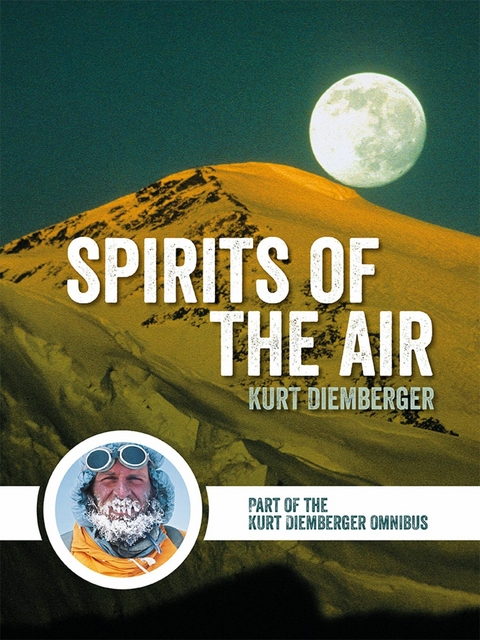
Spirits of the Air (eBook)
Vertebrate Publishing (Verlag)
978-1-910240-04-5 (ISBN)
Kurt Diemberger belongs to an elite mountaineering club. He is one of only two climbers to have made first ascents of two 8,000-metre peaks - Broad Peak and Dhaulagiri. His Broad Peak ascent was the first eight-thousander climbed in alpine style without oxygen. He had climbed the major Alps north faces (the Eiger, Matterhorn and Grandes Jorasses) by 1958 and was awarded the fifth Piolets d'Or lifetime achievement award. But Diemberger's adventures revolve around more than climbing, as Spirits of the Air reveals. Of course, there is plenty of mountaineering - expeditions to Makalu and Everest, America and the Hindu Kush. But there are also rickety aeroplanes which inevitably crash, anacondas to wrestle and bar-room meetings with Reinhold Messner. And there is Diemberger's filmmaking. A pioneering filmmaker, he has shot on the top of Everest and in the Arctic circle, making several mountaineering film firsts and becoming one of the best cameramen of the genre. In Spirits of the Air Diemberger describes his life and adventures after the 1986 K2 disaster, which affected him greatly, and some earlier episodes. He reflects on the contrasts between his life in Europe and the always-beckoning Himalaya, and on family, loves and friendships. Describing his experiences with a tremendous zest for life that is both endearing and compelling, Diemberger creates a very readable and very different mountaineering autobiography.
I Can Never Give Up the Mountains
We are climbing up Nanga Parbat, my daughter Hildegard and I, entering the Great Couloir of the Diamir face. Behind us rear the wild summits of the Mazeno ridge, a fiercely serrated wing of blue ice and steep rock jutting from high on the main body of the mighty mountain. Way below glints the green of the Diamir valley.
Here, all is steepness and shadow. We keep plunging our axes into the snow, and of course, we are wearing our crampons. Hildegard – blonde, twenty-five years old – is a confident climber, even if, as an ethnologist, her deeper interest lies with the people of the mountains. She has come with me this time to the peak that was Hermann Buhl’s dream – and, who knows, the two of us may reach as far as 6,000 metres. Perhaps, in a few days, I might even go to 7,000 metres, but I am not pinning my hopes any higher. I have no idea how my K2 frostbite will bear up at altitude. It was only just before Christmas that I had the amputations to my right hand – and with my damaged toes I cannot entertain any hopes of the summit. Yet neither can I accept the prospect of staying down. There is no way I can give up climbing mountains.
Below us, on the slope, Benoît has just come into view, the young French speed-climber attached to our expedition … tack, tack, tack, tack … his movements are like clockwork, as is the rhythmic throb of his front-points and his axe in the steep ice of the couloir. He wants to climb the 8,125 metres of Nanga Parbat in a single day. But not today – today he is only practising.
Quickly he draws nearer.
‘Who goes slowly, goes well – who goes well, goes far … ’ Whatever became of that old proverb? The wisdom of the old mountain guides, it seems, is now out of date. Tack, tack – tack, tack, tack, tack – tack, tack … Benoît is a nice guy and has remained refreshingly modest, despite his prodigious skills; he is small, fine-boned, gentle. I like him, even if some of his opinions send shivers down my spine. Others I have reluctantly to accept (not wanting to start any arguments up here! But what is the point in all this running? What good are records up here?). It must make some sort of sense to him.
Here he is! Benoît Chamoux. The speed artist, the phenomenon! He pants a little, greets us, laughing, and we exchange news; then I fish in my rucksack for the sixteen-millimetre camera. My job is filming, but it’s my pleasure, too. Showing other people what the world is like up here … that is part of what mountaineering means for me. Not this alone, of course …
Still, I want to bring down truth, not fiction! And if, for some bright spark, happiness is running up mountains – then he, too, is part of this world of Nanga Parbat. (My daughter, I must say, has thought so for quite some while – perhaps that’s an ethnological observation?)
I film the young sprinter: well, it looks fantastic, I think, eye to the viewfinder, the way that guy comes up! So I have him do it three times more, up and back again – the way film-makers do, and he is in training, after all.
Before I can dream up further variations, big clouds start rolling in. A change in the weather? Nothing unusual for Nanga Parbat. We descend.
Base Camp, down where it’s green …
Only the Spirits of the Air know how this will turn out for me. I contemplate my discoloured toes – all red and blue – as I swish them round in a bowl of water. Our cook, the good Ali, has tipped at least half a kilo of salt into the water, anxious to do what is best for me. How long will it take till I am fit again? Months, or years?
This is not the first time I have felt all is nearly over, that I am stretching life thinly: coming down from Chogolisa after Hermann’s death, or during the emergency landing I made with Charlie – what I call our ‘second birthday’. But this time? This time it is different.
Do I still enjoy climbing? It can never be as it was before.
And I will never come to terms with what happened on K2. Up on our dream mountain I lost Julie, lost my climbing companion of so many years, sharer of storms and tempests, joys and hopes on the highest mountains of the world. How often did we count the stars together, or look for faces in the clouds?
And then, suddenly …
So many people died on K2 that summer. Julie and I had been in such fine form, we were perfectly acclimatised – we ought not to have lost a single day! But I’ve no wish to set off that spinning wheel of thoughts again … It’s over. Nothing can be changed. The dream summit was ours – and then came the end.
Life, somehow, goes on. The mountains, like dear friends, have always helped me before. Whenever it was possible. Where is the way forward now?
Agostino da Polenza, our expedition leader on K2, was here at Base Camp until a few days ago. Then he dashed off to get another project under way, one on which I am again to be cameraman: re-measuring Everest and K2 for the Italian Consortium of Research (CNR) – or, more accurately, for Ardito Desio, the remarkable ninety-year-old professor who, as long ago as 1929, pushed into the secret valley of the Shaksgam beyond the 8,000-metre Karakorum peaks till he was stopped by the myriad ice towers of the Kyagar glacier. Yes, it’s true, the secrets are not only to be found on the summits …
They wait also behind the mountains. And I think of years that have long past, adventures in the jungle, in Greenland, but in more ‘developed’ areas, too, places like Canada; or the Grand Canyon with its rocky scenery – where time is turned into stone. I remember Death Valley. And expeditions to the Hindu Kush … that first glimpse into hidden corners of the glacier … the first circuit of Tirich Mir.
There was an eighteen-year gap between my second 8,000 metre peak and my third. But I have no regrets about that: it was time well spent. Many chapters of this book bear witness to that.
‘Guarda lassu – there they are!’ Hildegard turns her head excitedly from the camera tripod, swinging her long blonde hair, ‘Look!’ She points up at Nanga Parbat, which even from this distance fills the sky above the treetops. ‘They’re almost up!’ Her eyes are shining. We are in a small summer village in the Diamir valley, surrounded by cattle-sheds, herdsmen, women, many children … and goats, goats and more goats: two or three hundred of them! You can scarcely hear yourself speak over the sound of bleating. There are millions of flies, too, but they do not seem to bother Hildegard. I flick them irritably from my forehead and press my left eye to the viewfinder to peer through the 1,200-millimetre lens: yes, I see them! Three tiny dots, and a fourth one, lower down, right in the middle of the steep summit trapezium. They are going to make it!
We are beside ourselves with joy. Those lucky sods – lucky mushrooms, as we say in Austria – just the right day they’ve picked for it! And I feel a twinge of sadness not to be up there with them. But not for long: as we watch our companions inch higher, happiness suffuses every other feeling. But one dot is missing up there. It worries us at first, then we tell ourselves it must be Benoît. He will not have left Base until the others reached their high camp.
He is bound to catch up with them before long!
Then the clouds swallow everything.
We scoop up our belongings and hurry away, anxious to get to Base Camp before the others come down; we want to prepare a welcome-home party, a summit feast.
Two days later: they are all down. Soro, Gianni and Tullio all made it to the summit – shortly after the clouds cut them from our view. Only Giovanna, the lowest dot, turned back before then. And Benoît? He had a real epic up there …
At first all went well. He reached the summit as planned in a single day from Base Camp. (Normally – if you can speak of normality in terms of Nanga Parbat – it takes at least three days for an ascent.) But then began a chain of misfortune: during the descent, Benoît was overtaken by darkness and lost his way in the giant Bazhin basin. All night long he wandered backwards and forwards up there at around 7,000 metres because, with his lightweight equipment, he dared not sit down for a bivouac. He did not discover his companions’ final camp until morning …
Benoît looked thin and drawn, almost transparent, as he staggered finally into Base … but an incredible willpower still burned in his eyes. We flung our arms round him, so happy to have him back.
***
The sun is shining, its light reflecting off the small stream which runs across the sloping meadow on which our base camp stands. A good place: protected by a moraine bank from the air blast of the many enormous avalanches which thunder down from the upper slopes and teetering ice balconies of Nanga Parbat and the Mazeno peaks. Here, at 4,500 metres, frost binds our little brook every night, covering it with an embroidery of wonderful ice crystals. But in the morning, when the sun appears behind the inky blue bulk of the mountain, it flashes and sparkles everywhere and, as the crystals and plates of ice crackle and split, gradually the murmur of the little stream starts up again between the tents. Gianni and Tullio, inseparable as ever, stroll across the grass and kneel on its bank, dipping their hands in the icy water and splashing it over their faces … they chatter and laugh; Soro and Giovanna stretch out in the sunshine; Hildegard, lost in thought, wanders over the moraine, and Benoît sleeps, and sleeps, and sleeps. He has earned it. The good Ali prepares...
| Erscheint lt. Verlag | 5.6.2015 |
|---|---|
| Verlagsort | London |
| Sprache | englisch |
| Themenwelt | Sachbuch/Ratgeber ► Sport |
| Naturwissenschaften ► Geowissenschaften ► Geografie / Kartografie | |
| Schlagworte | Alfred Wegener • eight thousanders • himalaya books • kurt diemberger k2 • reinhold messner ebook • summits and secrets • the endless knot |
| ISBN-10 | 1-910240-04-4 / 1910240044 |
| ISBN-13 | 978-1-910240-04-5 / 9781910240045 |
| Informationen gemäß Produktsicherheitsverordnung (GPSR) | |
| Haben Sie eine Frage zum Produkt? |
 EPUB (Adobe DRM)
Kopierschutz: Adobe-DRM
Adobe-DRM ist ein Kopierschutz, der das eBook vor Mißbrauch schützen soll. Dabei wird das eBook bereits beim Download auf Ihre persönliche Adobe-ID autorisiert. Lesen können Sie das eBook dann nur auf den Geräten, welche ebenfalls auf Ihre Adobe-ID registriert sind.
Details zum Adobe-DRM
Dateiformat: EPUB (Electronic Publication)
EPUB ist ein offener Standard für eBooks und eignet sich besonders zur Darstellung von Belletristik und Sachbüchern. Der Fließtext wird dynamisch an die Display- und Schriftgröße angepasst. Auch für mobile Lesegeräte ist EPUB daher gut geeignet.
Systemvoraussetzungen:
PC/Mac: Mit einem PC oder Mac können Sie dieses eBook lesen. Sie benötigen eine
eReader: Dieses eBook kann mit (fast) allen eBook-Readern gelesen werden. Mit dem amazon-Kindle ist es aber nicht kompatibel.
Smartphone/Tablet: Egal ob Apple oder Android, dieses eBook können Sie lesen. Sie benötigen eine
Geräteliste und zusätzliche Hinweise
Buying eBooks from abroad
For tax law reasons we can sell eBooks just within Germany and Switzerland. Regrettably we cannot fulfill eBook-orders from other countries.
aus dem Bereich