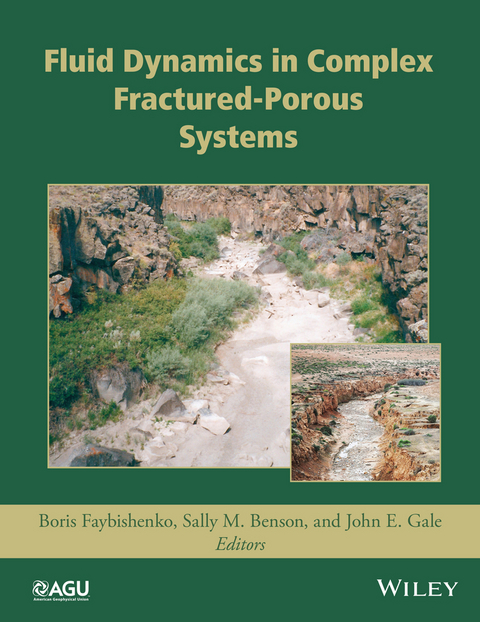
Fluid Dynamics in Complex Fractured-Porous Systems (eBook)
John Wiley & Sons (Verlag)
978-1-118-87722-7 (ISBN)
This monograph addresses fundamental and applied scientific questions and is intended to assist scientists and practitioners bridge gaps in the current scientific knowledge in the areas of theoretical fluids dynamics, field measurements, and experiments for different practical applications, Readers of this book will include researchers, engineers, and professionals within academia, Federal agencies, and industry, as well as graduate/undergraduate students involved in theoretical, experimental, and numerical modeling studies of fluid dynamics and reactive chemical transport in the unsaturated and saturated zones, including studies pertaining to petroleum and geothermal reservoirs, environmental management and remediation, mining, gas storage, and radioactive waste isolation in underground repositories,
Volume highlights include discussions of the following:
- Fundamentals of using a complex systems approach to describe flow and transport in fractured-porous media,
- Methods of Field Measurements and Experiments
- Collective behavior and emergent properties of complex fractured rock systems
- Connection to the surrounding environment
- Multi-disciplinary research for different applications
Boris Faybishenko is a Staff Scientist in the Hydrogeology Department, Earth Sciences Division of the E,O, Lawrence Berkeley National Laboratory,
John E, Gale is a consultant, advisor and senior geological engineer, Dr, Gale is a former Professor in the Department of Earth Sciences at the Memorial University of Newfoundland,
Sally M, Benson is the Director of the Global Climate and Energy Project and Professor in the Department of Energy Resources Engineering at Stanford University,
Despite of many years of studies, predicting fluid flow, heat, and chemical transport in fractured-porous media remains a challenge for scientists and engineers worldwide. This monograph is the third in a series on the dynamics of fluids and transport in fractured rock published by the American Geophysical Union (Geophysical Monograph Series, Vol. 162, 2005; and Geophysical Monograph, No. 122, 2000). This monograph is dedicated to the late Dr. Paul Witherspoon for his seminal influence on the development of ideas and methodologies and the birth of contemporary fractured rock hydrogeology, including such fundamental and applied problems as environmental remediation; exploitation of oil, gas, and geothermal resources; disposal of spent nuclear fuel; and geotechnical engineering. This monograph addresses fundamental and applied scientific questions and is intended to assist scientists and practitioners bridge gaps in the current scientific knowledge in the areas of theoretical fluids dynamics, field measurements, and experiments for different practical applications. Readers of this book will include researchers, engineers, and professionals within academia, Federal agencies, and industry, as well as graduate/undergraduate students involved in theoretical, experimental, and numerical modeling studies of fluid dynamics and reactive chemical transport in the unsaturated and saturated zones, including studies pertaining to petroleum and geothermal reservoirs, environmental management and remediation, mining, gas storage, and radioactive waste isolation in underground repositories. Volume highlights include discussions of the following: Fundamentals of using a complex systems approach to describe flow and transport in fractured-porous media. Methods of Field Measurements and Experiments Collective behavior and emergent properties of complex fractured rock systems Connection to the surrounding environment Multi-disciplinary research for different applications
Boris Faybishenko is a Staff Scientist in the Hydrogeology Department, Earth Sciences Division of the E.O. Lawrence Berkeley National Laboratory. John E. Gale is a consultant, advisor and senior geological engineer. Dr. Gale is a former Professor in the Department of Earth Sciences at the Memorial University of Newfoundland. Sally M. Benson is the Director of the Global Climate and Energy Project and Professor in the Department of Energy Resources Engineering at Stanford University.
Contributors vii
Preface ix
Introduction: Paul Witherspoon and the Birth of Contemporary Fractured Rock Hydrogeology
R. Allan Freeze, Iraj Javandel, and Shlomo P. Neuman 1
1 A Complex Systems Approach to Describing Flow and Transport in Fractured-Porous Media
Boris Faybishenko, Sally M. Benson, John E. Gale, and Fred Molz 5
Part I: Methods of Field Measurements and Experiments
2 Fracture Flow and Underground Research Laboratories for Nuclear Waste Disposal and Physics Experiments
Joseph S. Y. Wang and John A. Hudson 21
3 Permeability Structure of a Strike-Slip Fault
Kenzi Karasaki, Celia T. Onishi, and Junichi Goto 43
4 Feasibility of Long-Term Passive Monitoring of Deep Hydrogeology with Flowing Fluid Electric Conductivity Logging Method
Prabhakar Sharma, Chin-Fu Tsang, Christine Doughty, Auli Niemi, and Jacob Bensabat 53
Part II: Collective Behavior and Emergent Properties of Complex Fractured Rock Systems
5 Particle Swarms in Fractures
Eric Boomsma and Laura J. Pyrak-Nolte 65
6 The Effect of Chemical Osmosis on Oil and Gas Production from Fractured Shale Formations
Perapon Fakcharoenphol, Basak Kurtoglu, Hossein Kazemi, Sarinya Charoenwongsa, and Yu-Shu Wu 85
7 An Experimental Investigation of Stress-Dependent Permeability and Permeability Hysteresis Behavior in Rock Fractures
Da Huo and Sally M. Benson 99
8 Permeability of Partially Cemented Fractures
Michael C. Tsenn 115
9 An Emergent Conductivity Relationship for Water Flow Based on Minimized Energy Dissipation: From Landscapes to Unsaturated Soils
Hui-Hai Liu 129
10 Comparison of Simulated Flow in a Discrete Fracture Laboratory Sample Based on Measured Average and Spatially Varying Hydraulic Conductivity
Eunjeong Seok and John E. Gale 137
Part III: Connection to the Surrounding Environment
11 Fractures as Advective Conduits at the Earth-Atmosphere Interface
Maria Inés Dragila, Uri Nachshon, and Noam Weisbrod 161
12 Quantifying Water Flow and Retention in an Unsaturated Fracture-Facial Domain
John R. Nimmo and Siamak Malek-Mohammadi 169
Part IV: Multidisciplinary Research for Different Applications
13 Plutonium Transport in Soil and Plants: An Interdisciplinary Study Motivated by Lysimeter Experiments at the Savannah River Site
Fred Molz, Inci Demirkanli, Shannon Thompson, Dan Kaplan, and Brian Powell 183
14 Experimental and Modeling Studies of Episodic Air-Water Two-Phase Flow in Fractures and Fracture Networks
Thomas Wood and Hai Huang 209
15 Simulation of THM Processes in Fractured Reservoirs
Philip H. Winterfeld and Yu-Shu Wu 229
Index 243
"The topics are covered at a high level, with sufficient references to allow the reader to delve further into the subjects. The level is basic enough, meaning that while the practicing geophysicist will not benefit from the seismic characterization and microseismic chapters, the chapters on drilling and completions and other typically non-geophysical topics are very informative, making this volume a handy reference for any geophysicist involved with unconventionals and wanting to become more familiar with its engineering aspects" Dimitri Bevc, Houston, Texas on behalf of SEG's The Leading Edge
Introduction
Paul Witherspoon and the Birth of Contemporary Fractured Rock Hydrogeology
R. Allan Freeze 1 , Iraj Javandel 2 , and Shlomo P. Neuman 3
1 Surrey, British Columbia, Canada
2 Lawrence Berkeley National Laboratory, Berkeley California, USA
3 Department of Hydrology and Water Resources, University of Arizona, Tucson, Arizona, USA
ABSTRACT
Paul Witherspoon has been a seminal influence on the development of ideas and methodologies related to the hydrogeology of fractured rocks. His interest in the topic grew from his earliest studies on caprock integrity for underground gas storage, through his midcareer emphasis on the role of aquitards in hydrogeological systems, to his later work on thermohydrologic and hydromechanical couplings in geothermal systems and nuclear waste isolation.
EARLY INFLUENCES
It is possible that Paul Witherspoon’s interest in deep fractured-rock hydrogeology may have been piqued as early as his teenage years in Dormont, Pennsylvania. Paul’s father was a civil engineer who worked for a time for the Carnegie Coal Company. Paul took his first trips underground into the Carnegie coal mines with his father, where he was fascinated by the mining methods and surveying procedures used in the underground operations. A few years later, Paul’s father founded his own business, drilling for natural gas, and Paul found himself serving as a tool dresser on his father’s cable-tool rigs. There is little doubt that these early experiences led Paul to major in petroleum engineering when he entered the University of Pittsburgh in 1937. He graduated with a BS degree in 1941.
From 1941 to 1949 Paul worked in various capacities for the Phillips Petroleum Company in Oklahoma, Texas, and Kansas, but the further he advanced in his career, the more he felt the need to improve his background in mathematics, engineering, and geology. In the fall of 1949, at the age of 30, already married and a father, he left Phillips and enrolled at the University of Kansas. He graduated in 1951 with an MSc in petroleum engineering physics.
Paul’s doctoral studies were carried out in a far different manner than were most of ours. He successfully completed his program at the University of Illinois while simultaneously holding down a full-time position as head of the Petroleum Engineering Division at the Illinois State Geological Survey. His PhD was awarded in 1957. His thesis topic involved the role of clay minerals and colloidal particles on the movement of oil and water through reservoir rocks. Even at this earliest stage of his research career he seemed more interested in subsurface barriers to flow than in the more popular studies of high-permeability aquifers and reservoirs.
UNDERGROUND GAS STORAGE
While working at the Illinois Survey, Paul became involved in a project to store natural gas in an aquifer near Herscher, Illinois. Depleted gas fields had been safely converted to storage operations for many years, but this represented the first attempt to use a relatively shallow aquifer that was not a proven trap for oil and gas. Early operations had to be curtailed because of leakage through the overlying caprock. It was this experience that led Paul to begin investigating improved methodologies for assessing caprock integrity.
Paul joined the faculty in the Department of Mineral Technology at the University of California at Berkeley in 1957. There, aided by a large grant from the American Gas Association, he continued his work assessing the tightness of caprocks for underground gas storage [Witherspoon et al., 1967]. There is little question that it was these studies that set him on a lifelong quest to better understand low-permability formations.
AQUITARDS
In the early 1960s, prodded by some reorganization at the university, Paul turned his attention away from petroleum engineering toward full-time research on hydrogeological topics. His background in gas storage studies led to his early recognition of the importance of aquitards in hydrogeological systems. His work with Allan Freeze showed that the location, geometry, and continuity of low-permeability formations has a controlling influence on the nature of regional groundwater flow systems [Freeze and Witherspoon, 1966]. His work with Shlomo Neuman led to the development of improved pump-testing methodologies for complex aquifer/aquitard systems [Neuman and Witherspoon, 1968]. He and Iraj Javandel provided a very early application of finite-element modeling in hydrogeology to assess flow in multilayered aquifers [Javandel and Witherspoon, 1969]. In 1971, he organized a seminal conference at Monterrey, California, that was the first to bring attention to the issue of the role of aquitards in groundwater flow systems.
GEOTHERMAL ENERGY
In 1977, Paul moved “up on the hill” to become the first director of the new Earth Sciences Division at Lawrence Berkeley National Laboratory (LBNL). During this period, and later as leader of the Reservoir Engineering and Hydrogeology Group, Paul saw LBNL take its place as one of the world’s leading research institutes in the applied earth sciences.
In the 1970s and 1980s, there was considerable national interest in investigating alternative energy sources other than coal and petroleum. The LBNL group was involved in several projects to assess the potential of geothermal energy. The work included reservoir engineering, production engineering, geochemical and geophysical studies, and land subsidence investigations [Gringarten et al., 1975; Preuss et al., 1982].
NUCLEAR WASTE ISOLATION
Paul was well ahead of his time in realizing that a hydrological understanding of rock mass properties was going to be needed for purposes other than just withdrawing fluids from aquifers. His emphasis on the role of aquitards was a precursor to the issues that would soon arise in connection with nuclear waste isolation, geothermal energy production, and contaminant transport problems.
In the late 1970s, Paul was asked by the U.S. Energy Research and Development Agency to organize a workshop on low-permability rocks in Austin, Texas. The workshop was attended by a representative of the Swedish Nuclear Fuel Safety Program, who told Paul about their plans to carry out an underground testing program in an abandoned iron ore mine near Stripa, Sweden. The upshot was a cooperative research program between Sweden and the United States with LBNL taking the lead American role. At Stripa the joint teams developed new methods of fractured-rock characterization, and applied them to the hydrogeologic assessment of alternative waste-emplacement strategies. The Stripa studies set the standard for the investigation of nuclear waste repositories, and were among the first comprehensive studies of flow and transport in fractured rocks at depth [Witherspoon et al., 1981; Witherspoon, 2000b].
The LBNL team also played a prominent role in the assessment of rock conditions at the proposed nuclear waste disposal site at Yucca Mountain, Nevada. Starting in 1991, Paul became the prime mover in producing a series of comprehensive reviews of the developing technology in nuclear waste isolation [cf. Witherspoon and Bodvarsson, 2006]. In 1996, Paul chaired a peer review of the thermohydrologic modeling and testing program at Yucca Mountain [Witherspoon et al., 1996].
FRACTURED ROCK HYDROGEOLOGY
From his earliest work on caprock integrity, through his mid-career emphasis on aquitard hydrogeology, to his later work on geothermal energy production and nuclear waste isolation, an overarching theme in Paul’s life was to understand the physics of flow through low-permeability media. In the early work, low-permeability formations were still treated as homogeneous units rather than as discretely fractured media, but he and his students and colleagues soon moved on to treatments of discrete fracture systems, initially based on parallel plate models (influenced by the earlier work at Berkeley by David Snow [1969]), then on interconnected three-dimensional fracture networks [Long and Witherspoon, 1985], and eventually on dual porosity representations of fracture systems embedded in more traditional porous media. The paper by Witherspoon et al. [1981] on the “Validity of cubic law for fluid-flow in a deformable rock fracture” is one of the most influential papers in the field of fractured rock hydrogeology [Zimmerman, 2012]. For a summary of this intellectual journey, see Witherspoon [2000a] and Neuman [2005].
Paul and his team were among the first to recognize the many coupled interactions between fluid flow, heat flow, and the stress/strain field that will occur at geothermal and nuclear waste sites in fractured rock. They were responsible for some of the earliest treatments that integrated the thermohydrologic and hydromechanical couplings in subsurface environments [Wang et al., 1981; Tsang and Witherspoon, 1981].
Paul was one of the first hydrogeological researchers to recognize the potential of computer-based mathematical modeling in hydrogeology, but he was adamant throughout his career that it is also critical to get underground and carry out large-scale in-situ testing...
| Erscheint lt. Verlag | 15.6.2015 |
|---|---|
| Reihe/Serie | Geophysical Monograph Series |
| Geophysical Monograph Series | Geophysical Monograph Series |
| Sprache | englisch |
| Themenwelt | Naturwissenschaften ► Biologie |
| Naturwissenschaften ► Geowissenschaften ► Geologie | |
| Naturwissenschaften ► Geowissenschaften ► Geophysik | |
| Naturwissenschaften ► Physik / Astronomie ► Strömungsmechanik | |
| Technik | |
| Schlagworte | Classical & Fluid Mechanics • earth sciences • fluid dynamics, Boris Faybishenko, Sally M. Benson, John E. Gale, fractured-porous media, fluid transport, Geophysics, geology, Earth Science, Dr. Paul Witherspoon, hydrogeology, environmental remediation, oil, gas, geothermal resources, petroleum, petrogeology, nuclear field, geological engineering, geoengineering, geochemistry, mining, environmental management, radioactive waste, basin science, fracture flow, nuclear waste, geophysics, water resources • Geologie • Geologie u. Geophysik • Geology & Geophysics • Geophysics • Geophysik • Geowissenschaften • Klassische u. Strömungsmechanik • Klassische u. Strömungsmechanik • Physics • Physik |
| ISBN-10 | 1-118-87722-5 / 1118877225 |
| ISBN-13 | 978-1-118-87722-7 / 9781118877227 |
| Informationen gemäß Produktsicherheitsverordnung (GPSR) | |
| Haben Sie eine Frage zum Produkt? |
 EPUB (Adobe DRM)
Kopierschutz: Adobe-DRM
Adobe-DRM ist ein Kopierschutz, der das eBook vor Mißbrauch schützen soll. Dabei wird das eBook bereits beim Download auf Ihre persönliche Adobe-ID autorisiert. Lesen können Sie das eBook dann nur auf den Geräten, welche ebenfalls auf Ihre Adobe-ID registriert sind.
Details zum Adobe-DRM
Dateiformat: EPUB (Electronic Publication)
EPUB ist ein offener Standard für eBooks und eignet sich besonders zur Darstellung von Belletristik und Sachbüchern. Der Fließtext wird dynamisch an die Display- und Schriftgröße angepasst. Auch für mobile Lesegeräte ist EPUB daher gut geeignet.
Systemvoraussetzungen:
PC/Mac: Mit einem PC oder Mac können Sie dieses eBook lesen. Sie benötigen eine
eReader: Dieses eBook kann mit (fast) allen eBook-Readern gelesen werden. Mit dem amazon-Kindle ist es aber nicht kompatibel.
Smartphone/Tablet: Egal ob Apple oder Android, dieses eBook können Sie lesen. Sie benötigen eine
Geräteliste und zusätzliche Hinweise
Buying eBooks from abroad
For tax law reasons we can sell eBooks just within Germany and Switzerland. Regrettably we cannot fulfill eBook-orders from other countries.
aus dem Bereich