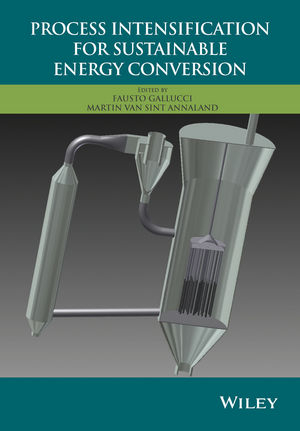
Process Intensification for Sustainable Energy Conversion (eBook)
John Wiley & Sons (Verlag)
978-1-118-44937-0 (ISBN)
Edited by
FAUSTO GALLUCCI AND MARTIN VAN SINT ANNALAND
Chemical Process Intensification group, Eindhoven University of Technology, The Netherlands
This book addresses the application of process intensification to sustainable energy production, combining two very topical subject areas. Due to the increasing process of petroleum, sustainable energy production technologies must be developed, for example bioenergy, blue energy, chemical looping combustion, concepts for CO2 capture etc. Process intensification offers significant competitive advantages, because it provides more efficient processes, leading to outstanding cost reduction, increased productivity and more environment-friendly processes.
Edited by FAUSTO GALLUCCI AND MARTIN VAN SINT ANNALAND Chemical Process Intensification group, Eindhoven University of Technology, The Netherlands
Chapter 1
Introduction
Fausto Gallucci and Martin van Sint Annaland
Eindhoven University of Technology, Chemical Process Intensification, Department of Chemical Engineering and Chemistry, Eindhoven, The Netherlands
It is expected that in the current century, the theme “energy” will become increasingly more important and will pose some serious challenges to our society and our way of living, but it may also create opportunities.
On the one hand, the combination of a rapidly growing world population and increasing energy consumption per capita requires large investments to secure sufficient energy supply at affordable prices. On the other hand, fossil fuel reserves are shrinking, while the transition toward a world economy based on energy supply via sustainable or renewable resources is still in its infancy. According to the World Energy Outlook 2013 of the International Energy Agency (IEA), the world energy demand will increase by more than 30% by 2035 (compared with 2011) and the demand for oil alone will still be more than 57% in 2035. Oil and gas reserves are increasingly concentrated in a few countries that control them through monopoly companies. The dependence of Europe on imported oil and gas is growing: we import 50% of our energy, and it will be 55% by 2035 (Bp Outlook 2035), if we do not act.
The relevance of this issue is even higher when one relates the increase in anthropogenic CO2 emissions by the use of fossil fuels to the evident changes in the Earth's climate. The International Panel on Climate Change (IPCC) has collected results of substantial research efforts to obtain a comprehensive scientific framework describing the evolution of the climate over very long time periods, the observed deviations from this behavior in recent times, the interpretation of both natural and anthropogenic causes and their effect on the increase of the greenhouse effect, the consequences of global warming in the past, present and future and possible solutions to combat further climate changes. In its 2013 Assessment Report, IPCC conclude that (Climate Change 2013: The Physical Science Basis), see Figure 1.1:
Figure 1.1 Detection and attribution signals in some elements of the climate system, at regional scales (top panels) and global scales (bottom four panels). Brown panels are land surface–temperature–time series, green panels are precipitation–time series, blue panels are ocean heat content–time series and white panels are sea ice–time series. Observations are shown on each panel in black or black and shades of grey. Blue shading is the model time series for natural forcing simulations and pink shading is the combined natural and anthropogenic forcings. The dark blue and dark red lines are the ensemble means from the model simulations. All panels show the 5–95% intervals of the natural forcing simulations and the natural and anthropogenic forcing simulations.
(Source: Extracted from the IPCC report 2013)
“From up in the stratosphere, down through the troposphere to the surface of the Earth and into the depths of the oceans there are detectable signals of change such that the assessed likelihood of a detectable, and often quantifiable, human contribution ranges from likely to extremely likely for many climate variables.”
According to IPCC, the effect of human activities on changes in the climate is very likely to have been dominating natural variations (due to, e.g., variations in solar irradiance) especially in the past 50 years. Since the beginning of the industrial revolution, the concentrations of the relevant greenhouse gases (especially carbon dioxide, methane, nitrous oxide, and halocarbons) have increased substantially and now by far exceed natural ranges encountered in the past 650,000 years [1].
On the short term, significant reductions of carbon dioxide emissions may be attained from energy savings, for example, via efficiency improvements both in power production and consumer products and as a consequence of increased public awareness. However, strong economic growth anticipated in especially the developing countries is expected to impede a net decrease in anthropogenic emissions. On the longer term, the use of fossil fuels for energy supply will need to be phased out not only to stabilize greenhouse gas concentrations but also to avoid shortages in raw materials for the production of, for example, bulk chemicals.
The transition towards a world economy based on energy supply via sustainable sources such as wind-, hydro- and solar energy, or nuclear power (of which fission still suffers from a bad public image caused by concerns over nuclear waste and proliferation, whereas fusion has so far failed to live up to its potential) is therefore expected to be a lengthy process that cannot be expected to be solely responsible for the stabilization of atmospheric greenhouse gas concentrations in this century. Rather, a combination of many of the mitigation alternatives will need to be adopted to significantly curb CO2 emissions.
In this respect, novel concepts based on process intensification can help to reduce CO2 emissions and can lead the transition towards a more sustainable energy scenario. Indeed, according to Ramshaw [2], process intensification is a strategy for making dramatic reductions in the size of a chemical plant so as to reach a given production objective. As such, applying process intensification to the energy sector can result in a dramatic decrease in the production of wastes including greenhouse gas emissions.
According to Stankiewicz and Moulijn [3], the whole field of process intensification can be classified into two main categories:
- Process-intensifying equipment:
These include novel reactors and intensive mixing, heat-transfer and mass-transfer devices, and so on.
- Process-intensifying methods:
These include new or hybrid separations, integration of reaction and separation, heat exchange, or phase transition (in multifunctional reactors), techniques using alternative energy sources (light, ultrasound, etc.) and new process-control methods (like intentional unsteady-state operation).
Clearly, as also indicated by Stankiewicz and Moulijn, there is a big overlap between the two areas. For instance, membrane reactors are an example of process-intensifying equipment (novel reactor) making use of process-intensifying methods (integration of reaction and separation).
Since the “invention” of the term process intensification, many articles and books appeared on the same topic. An interested reader is referred to the book of Reay et al. [4] for an overview of the various process intensification methods. In the present book, a selection of different, novel process intensification methods and reactors are presented and discussed with the focus on sustainable energy conversion.
In particular, in Chapter 2 the development of a new cryogenic separation technology based on dynamic operation of packed bed columns is described. When it is possible to exploit the cold available at, for example, LNG regasification stations, this new technology could be used as an efficient post-combustion CO2 capture technology. In the chapter, the technology is described to freeze-out CO2 from flue gases at atmospheric pressures. The dynamic operation and the effects of the operating conditions have been analyzed in detail using modelling and an experimental proof of principle at laboratory scale and small pilot scale is provided. Finally, a techno-economic analysis shows the great potential of the technology over other post-combustion capture processes such as amine scrubbing and membrane separation, when cold duty is available at low prices or when high CO2 capture efficiencies are required. This makes the cryogenic technology also particularly interesting as an auxiliary unit downstream of other post-combustion technologies.
Chapter 3 describes the application of membrane reactors in pre-combustion CO2 capture technologies. Different membrane reactor configurations are described, among which the fluidized bed membrane reactor configuration seems to have the most potential. In this concept, hydrogen perm-selective membranes are submerged in a fluidized suspension. Thus, mass and heat transfer coefficients are much improved compared to packed bed membrane reactor configurations (decreasing problems in heat management and concentration polarization), while maintaining a relatively large amount of catalyst combined with a relatively low pressure drop in comparison with micro-membrane reactors. The chapter also describes a hybrid concept integrating both membrane reactors and chemical looping combustion for autothermal operation with integrated CO2 capture. With this new concept, high hydrogen efficiency can be obtained at lower temperatures compared with other concepts, while the amount of membrane area required is kept to a minimum.
Chapter 4 focuses on the possibility to apply high-temperature oxygen-selective membranes in oxy-fuel power production systems. These perovskite-like or mixed ionic electronic conducting materials present an infinite perm-selectivity for oxygen compared with other gases and can thus be used to separate oxygen from air at high temperatures. The chapter describes the main features of oxygen selective membranes, their production methods and their integration in membrane (reactor) modules. The chapter also reports on the progress of research projects on oxygen selective membranes.
A different kind of...
| Erscheint lt. Verlag | 18.5.2015 |
|---|---|
| Sprache | englisch |
| Themenwelt | Naturwissenschaften ► Chemie ► Technische Chemie |
| Technik ► Elektrotechnik / Energietechnik | |
| Technik ► Umwelttechnik / Biotechnologie | |
| Schlagworte | Blue Energy • chemical engineering • chemical looping • Chemie • Chemische Verfahrenstechnik • Chemistry • CO2 capture • Energie • Energy • energy conversion • Membrane Reactors • Membranes • Nachhaltige u. Grüne Chemie • Nachhaltige u. Grüne Chemie • novel reactor concepts • Process intensification • Process Intensification & Integration • Prozessintensivierung u. -integration • Solarenergie u. Photovoltaik • Solar energy • Solar Energy & Photovoltaics • Sustainable Chemistry & Green Chemistry • Sustainable energy |
| ISBN-10 | 1-118-44937-1 / 1118449371 |
| ISBN-13 | 978-1-118-44937-0 / 9781118449370 |
| Informationen gemäß Produktsicherheitsverordnung (GPSR) | |
| Haben Sie eine Frage zum Produkt? |
 EPUB (Adobe DRM)
Kopierschutz: Adobe-DRM
Adobe-DRM ist ein Kopierschutz, der das eBook vor Mißbrauch schützen soll. Dabei wird das eBook bereits beim Download auf Ihre persönliche Adobe-ID autorisiert. Lesen können Sie das eBook dann nur auf den Geräten, welche ebenfalls auf Ihre Adobe-ID registriert sind.
Details zum Adobe-DRM
Dateiformat: EPUB (Electronic Publication)
EPUB ist ein offener Standard für eBooks und eignet sich besonders zur Darstellung von Belletristik und Sachbüchern. Der Fließtext wird dynamisch an die Display- und Schriftgröße angepasst. Auch für mobile Lesegeräte ist EPUB daher gut geeignet.
Systemvoraussetzungen:
PC/Mac: Mit einem PC oder Mac können Sie dieses eBook lesen. Sie benötigen eine
eReader: Dieses eBook kann mit (fast) allen eBook-Readern gelesen werden. Mit dem amazon-Kindle ist es aber nicht kompatibel.
Smartphone/Tablet: Egal ob Apple oder Android, dieses eBook können Sie lesen. Sie benötigen eine
Geräteliste und zusätzliche Hinweise
Buying eBooks from abroad
For tax law reasons we can sell eBooks just within Germany and Switzerland. Regrettably we cannot fulfill eBook-orders from other countries.
aus dem Bereich