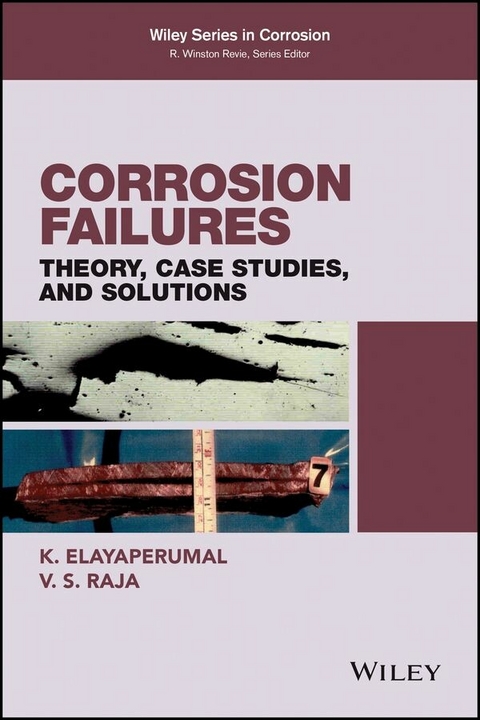
Corrosion Failures (eBook)
John Wiley & Sons (Verlag)
978-1-119-04322-5 (ISBN)
Provides corrosion basics in a lucid manner to students and working professionals and over 80 corrosion-failure analysis case studies
- Correlates Failure Analysis with Corrosion Science
- Exclusively provides corrosion-related failure analysis case histories in one place in a convenient format
- One-stop shop for both science and real time occurrence of the phenomenon of corrosion
- Full coverage of all MOC, Materials of Construction, used for process equipments
- Simple but Lucid presentation of Failure Analysis procedure
K. Elayaperumal has close to 50 years of experience in Corrosion and Metallurgical Analysis. Since 1979 he has been a Corrosion & Metallurgical Consultant extending advisory Consultancy Services in the areas of Corrosion Prevention, Materials Selection, Failure Analysis, Water treatment etc. as related to Process Industry. He is the recipient of the National Metallurgist Award instituted by Ministry of Iron and Steel, Government of India, for contribution in Corrosion Prevention and Failure Analysis and also the Life Time Achievement Award from NACE International India Chapter.
V. S. Raja is currently a professor in the Department of Metallurgical Engineering and Materials Science at the Indian Institute of Technology Bombay, Mumbai, India. He has guided about 20 doctoral and 100 master’s students in Corrosion and has been a Consultant to over 50 industries; has over 120 publications in various peer reviewed journals & books and also delivered over 100 plenary, keynote and invited talks in conferences. He is a recipient of Meritorious award by NACE international India Section and Excellence in Teaching award by IIT Bombay and a Fellow of NACE International and Indian Institute of Metals.
Provides corrosion basics in a lucid manner to students and working professionals and over 80 corrosion-failure analysis case studies Correlates Failure Analysis with Corrosion Science Exclusively provides corrosion-related failure analysis case histories in one place in a convenient format One-stop shop for both science and real time occurrence of the phenomenon of corrosion Full coverage of all MOC, Materials of Construction, used for process equipments Simple but Lucid presentation of Failure Analysis procedure
K. Elayaperumal has close to 50 years of experience in Corrosion and Metallurgical Analysis. Since 1979 he has been a Corrosion & Metallurgical Consultant extending advisory Consultancy Services in the areas of Corrosion Prevention, Materials Selection, Failure Analysis, Water treatment etc. as related to Process Industry. He is the recipient of the National Metallurgist Award instituted by Ministry of Iron and Steel, Government of India, for contribution in Corrosion Prevention and Failure Analysis and also the Life Time Achievement Award from NACE International India Chapter. V. S. Raja is currently a professor in the Department of Metallurgical Engineering and Materials Science at the Indian Institute of Technology Bombay, Mumbai, India. He has guided about 20 doctoral and 100 master's students in Corrosion and has been a Consultant to over 50 industries; has over 120 publications in various peer reviewed journals & books and also delivered over 100 plenary, keynote and invited talks in conferences. He is a recipient of Meritorious award by NACE international India Section and Excellence in Teaching award by IIT Bombay and a Fellow of NACE International and Indian Institute of Metals.
1
INTRODUCTION
1.1 THE PHENOMENON OF CORROSION
The term rusting has been in vogue long before the human kind initiated any systematic study on corrosion of metals. This term, however, refers to uniform corrosion of steels. If the metal is carbon steel and if the environment is simple humid air, the former corrodes giving “rust” as the final corrosion product, which is seen as a brownish crust/porous scale over the steel surface. The result of such a corrosion phenomenon is the general uniform loss of thickness of the metal and this type of corrosion is generally called “Uniform Corrosion” and is the most common form of corrosion accounting for a major percentage of overall metal losses. Unfortunately, the phenomenon of corrosion is spontaneous in nature supported by thermodynamics. That is to say corrosion lowers the energy of metals, ironically supplied by the mankind to produce metal from their respective ores, to transform to their natural lower energy states such as oxides, sulfides, chlorides, etc.
The environments that give rise to corrosion of metals vary from mildest humid air atmosphere which we all breath-in daily to the most aggressive highly acidic solutions and high temperature gases in which processes such as chlorination, sulfidation, etc. take place. While the mild atmospheres occur mostly under the domestic conditions, including marine atmospheres affecting coastal structures, the severe atmospheres occur among industrial processes like pickling of metals, chemical processes, power generation, oil and gas production, electronic component processing, transportation industries, etc. Among the industrial processes, the size of the metallic components involved varies from microscopic as in electronics industries to very macroscopic, such as storage and pressure vessels, cross-country piping, heat exchangers, etc.
“Corrosion Failure” is the ultimate result of corrosion. The component, structure, or equipment loses its functionality as a result of corrosion leading to grave consequences. Ultimate failure due to corrosion occurs because, among several reasons, the phenomenon of corrosion has been occurring unabated over a long period without a warning signal. Corrosion phenomenon is in general, not always, a time bound phenomenon. Failures of structures and components due to corrosion in mild atmospheres such as humid air and marine atmospheres would be of minor consequences such as premature replacement cost, temporary public discomfort, etc. On the other hand, unexpected corrosion failures of equipments in chemical process equipments, which the present book addresses, would result in major consequences such as possible leakage of corrosive fluids/vapors, very expensive replacement of equipments, heavy production losses, and at times human fatalities also.
1.2 IMPORTANCE OF CORROSION
Before giving the basics and the case studies, an attempt is made in the following section of this chapter to briefly present the existing information available on the overall costs of corrosion affecting an industrialized nation, both direct and indirect, particularly with respect to chemical process industries
1.2.1 Cost of Corrosion: Direct and Indirect
Metallic corrosion is a major loss-producing phenomenon in many sectors of a nation’s economy. This is because corrosion results in loss of metals and materials, energy, labor, etc., which would have been contributively productive otherwise for some other useful purpose. Revie and Uhlig (2008) divide the losses due to corrosion into two categories:
- Direct loss and
- Indirect loss.
Direct losses include:
- Cost of replacing corroded/failed structures/equipments/components,
- Painting and re-painting of corrosion-prone structures to prevent general atmospheric corrosion,
- Costs involved in all other protective measures, such as cathodic protection, inhibitor addition, protective coating/wrapping/cladding, galvanizing, electroplating, etc.,
- Extra cost involved in choosing corrosion-resistant alloys (CRAs) such as stainless steels, nickel base alloys, titanium, etc. in the place of carbon steels which would have been otherwise suitable from mechanical/structural points of view, and
- Cost of dehumidifying storage rooms for storing metallic components/equipments and spare parts, etc. before they are put into use.
Indirect losses are like consequential losses that add heavily, many times very heavily, to the direct losses outlined above. These indirect losses include:
- Loss-of-Production (Downtime) Cost: This factor alone, many times, is orders of magnitude higher than the direct replacement cost,
- Product loss through leaks/failures due to corrosion: This also would be very heavy if the equipment is concerned is a pressure vessel and high pressure pipeline carrying huge quantities of finished products under pressure like utility gas separated from oil, purified potable water through water mains, high pressure steam, etc.,
- Loss of efficiency in heat transfer equipments and pipelines: Accumulation of corrosion product scales on pipelines and on heat transfer surfaces reduces the pumping and heat transfer efficiency, respectively, thereby necessitating increased power to the pumps and heat exchangers,
- Contamination and hence rejection of product: Heavy metal impurities as a result of corrosion of the container equipments and transfer pipelines would result in total rejection of several batches (huge quantities) of the carefully produced (value added) chemical product,
- Over-design: Giving “corrosion allowance,” thereby using vessels with thickness much greater than that demanded by mechanical requirements amounts to over-design and adds up to huge indirect cost involved in providing excess metal for corrosion to take place.
The above direct and indirect losses are somewhat quantifiable. But loss of life due to leakage, corrosion fracture, explosion and similar unpredictable corrosion-related failures and accidents cannot be easily quantified but would result in huge compensation losses.
As far as corrosion costs in terms of money values are concerned, the most often quoted estimate is that of the 1998 US Study jointly carried out by US Department of Transportation, and the NACE, the results of which were first published in 2002 (Koch et al. 2002). As per this study report, corrosion losses suffered by Industry and by Government (Total Economy) amount to many billions of dollars annually, approximately US $276 billion in USA alone, about 3.1% of Gross Domestic Product. Out of these, loss in Industries alone amounted to $138 billion annually, as shown in the following break-ups extracted from the above study, Table 1.1.
TABLE 1.1 Summary of Industry Sector Direct Corrosion Costs Analyzed in 1998 US Study (with Permission from Federal Highway Administration, USA)
| Estimated Direct Cost of Corrosion Per Category |
| Category | $x Billion | % |
| Infrastructure (highway bridges, gas & liquid transmission pipelines, waterways and ports, hazardous materials storage, airports, railroads) | $22.6 | 16.4 |
| Utilities (gas distribution, drinking water and sewer systems, electrical utilities, telecommunications) | $47.9 | 34.7 |
| Transportation (motor vehicles, ships, aircraft, railroad cars, hazardous materials transport) | $29.7 | 21.5 |
| Production and manufacturing (oil and gas exploration and production, mining, petroleum refining, chemical, petrochemical and pharmaceutical, pulp and paper, agricultural, food processing, electronics, home appliances) | $17.6 | 12.8 |
| Government (defense, nuclear waste storage) | $20.1 | 14.6 |
| Total | $137.9 | 100 |
The figures corresponding to Production and Manufacturing from Table 1.1 amounting to $17.6 billion are shown in the break-up pie-chart form in Figure 1.1 of this chapter, again extracted from the reference Koch et al. (2002).
Figure 1.1 Annual cost of corrosion in the production and manufacturing category in US ($17.6 Billion). Koch et al. (2002) (courtesy Federal Highway Administration, USA.)
The costs shown in the above illustrations are direct costs only. The figures do not include indirect costs of production outages resulting from unexpected failures, quite common in chemical process industries. Also the figures do not include those of operation and maintenance related to corrosion only. This is an annual recurring expenditure.
One can notice that for Production and Manufacturing alone, mostly varieties of chemical processing, with which the present book is concerned, the sub total cost is $17.6 billion, 12.8% of total Industry Cost of $137.9 billion. This is an enormous figure by any standard and every attempt should be continuously made to reduce/prevent this great loss due to corrosion.
Among the overall corrosion prevention management strategies suggested include the following Koch et al. (2002):
- Dissemination of corrosion awareness information generated in various industry...
| Erscheint lt. Verlag | 12.5.2015 |
|---|---|
| Reihe/Serie | Wiley Series in Corrosion |
| Wiley Series in Corrosion | Wiley Series in Corrosion |
| Sprache | englisch |
| Themenwelt | Naturwissenschaften ► Chemie ► Physikalische Chemie |
| Technik ► Maschinenbau | |
| Schlagworte | Chemie • Chemistry • Corrosion • Corrosion Basics, Materials Selection, Corrosion Failures, Chemical Process Industries, Corrosion Control, Forms of Corrosion, Diagnosis and Recommendations • Electrochemistry • Elektrochemie • Korrosion • Maschinenbau • Maschinenbau - Entwurf • Materials Science • Materialwissenschaften • mechanical engineering • Mechanical Engineering - Design |
| ISBN-10 | 1-119-04322-0 / 1119043220 |
| ISBN-13 | 978-1-119-04322-5 / 9781119043225 |
| Informationen gemäß Produktsicherheitsverordnung (GPSR) | |
| Haben Sie eine Frage zum Produkt? |
 EPUB (Adobe DRM)
Kopierschutz: Adobe-DRM
Adobe-DRM ist ein Kopierschutz, der das eBook vor Mißbrauch schützen soll. Dabei wird das eBook bereits beim Download auf Ihre persönliche Adobe-ID autorisiert. Lesen können Sie das eBook dann nur auf den Geräten, welche ebenfalls auf Ihre Adobe-ID registriert sind.
Details zum Adobe-DRM
Dateiformat: EPUB (Electronic Publication)
EPUB ist ein offener Standard für eBooks und eignet sich besonders zur Darstellung von Belletristik und Sachbüchern. Der Fließtext wird dynamisch an die Display- und Schriftgröße angepasst. Auch für mobile Lesegeräte ist EPUB daher gut geeignet.
Systemvoraussetzungen:
PC/Mac: Mit einem PC oder Mac können Sie dieses eBook lesen. Sie benötigen eine
eReader: Dieses eBook kann mit (fast) allen eBook-Readern gelesen werden. Mit dem amazon-Kindle ist es aber nicht kompatibel.
Smartphone/Tablet: Egal ob Apple oder Android, dieses eBook können Sie lesen. Sie benötigen eine
Geräteliste und zusätzliche Hinweise
Buying eBooks from abroad
For tax law reasons we can sell eBooks just within Germany and Switzerland. Regrettably we cannot fulfill eBook-orders from other countries.
aus dem Bereich