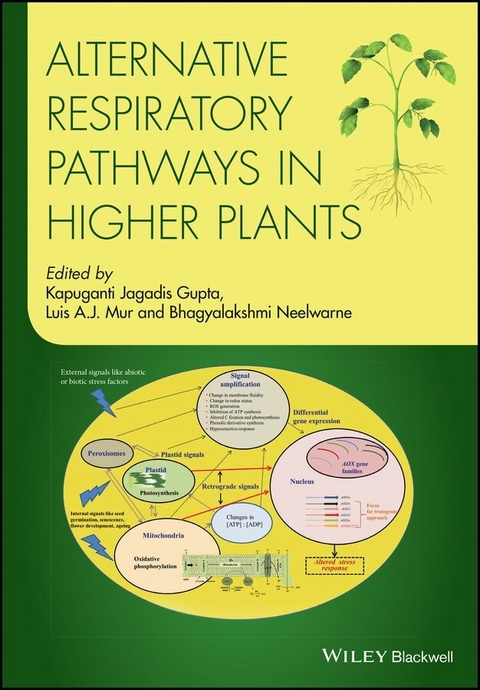
Alternative Respiratory Pathways in Higher Plants (eBook)
John Wiley & Sons (Verlag)
978-1-118-79044-1 (ISBN)
Rapid developments in molecular and systems biology techniques have allowed researchers to unravel many new mechanisms through which plant cells switch over to alternative respiratory pathways.
This book is a unique compendium of how and why higher plants evolved alternative respiratory metabolism. It offers a comprehensive review of current research in the biochemistry, physiology, classification and regulation of plant alternative respiratory pathways, from alternative oxidase diversity to functional marker development. The resource provides a broad range of perspectives on the applications of plant respiratory physiology, and suggests brand new areas of research.
Other key features:
written by an international team of reputed plant physiologists, known for their pioneering contributions to the knowledge of regular and alternative respiratory metabolism in higher plants
includes step-by-step protocols for key molecular and imaging techniques
advises on regulatory options for managing crop yields, food quality and environment for crop improvement and enhanced food security
covers special pathways which are of key relevance in agriculture, particularly in plant post-harvest commodities
Primarily for plant physiologists and plant biologists, this authoritative compendium will also be of great value to
postdoctoral researchers working on plant respiration, as well as to graduate and postgraduate students and university staff in Plant Science. It is a useful resource for corporate and private firms involved in developing functional markers for breeding programs and controlling respiration for the prevention of post-harvest losses in fruit, vegetables, cut flowers and tubers.
Dr Kapuganti Jagadis Gupta is a Scientist at Department of Plant Sciences, University of Oxford, UK and currently heading a research group at National Institute of Plant Genome Research, New Delhi, India
Dr Luis A.J. Mur is a Professor at IBERS (Institute of Biological, Environmental and Rural Sciences), Aberystwyth
University, Wales, UK.
Dr Bhagyalakshmi Neelwarne is the Chief Scientist and Professor, currently heading the Department of Plant Cell Biotechnology at Central Food Technological Research Institute, Mysore, India.
Rapid developments in molecular and systems biology techniques have allowed researchers to unravel many new mechanisms through which plant cells switch over to alternative respiratory pathways.This book is a unique compendium of how and why higher plants evolved alternative respiratory metabolism. It offers a comprehensive review of current research in the biochemistry, physiology, classification and regulation of plant alternative respiratory pathways, from alternative oxidase diversity to functional marker development. The resource provides a broad range of perspectives on the applications of plant respiratory physiology, and suggests brand new areas of research.Other key features: written by an international team of reputed plant physiologists, known for their pioneering contributions to the knowledge of regular and alternative respiratory metabolism in higher plants includes step-by-step protocols for key molecular and imaging techniques advises on regulatory options for managing crop yields, food quality and environment for crop improvement and enhanced food security covers special pathways which are of key relevance in agriculture, particularly in plant post-harvest commodities Primarily for plant physiologists and plant biologists, this authoritative compendium will also be of great value topostdoctoral researchers working on plant respiration, as well as to graduate and postgraduate students and university staff in Plant Science. It is a useful resource for corporate and private firms involved in developing functional markers for breeding programs and controlling respiration for the prevention of post-harvest losses in fruit, vegetables, cut flowers and tubers.
Dr Kapuganti Jagadis Gupta is a Scientist at Department of Plant Sciences, University of Oxford, UK and currently heading a research group at National Institute of Plant Genome Research, New Delhi, India Dr Luis A.J. Mur is a Professor at IBERS (Institute of Biological, Environmental and Rural Sciences), Aberystwyth University, Wales, UK. Dr Bhagyalakshmi Neelwarne is the Chief Scientist and Professor, currently heading the Department of Plant Cell Biotechnology at Central Food Technological Research Institute, Mysore, India.
List of contributors ix
Preface xiii
Section A: Physiology of plant respiration and involvement of alternative oxidase
1 Integrating classical and alternative respiratory pathway 3
Kapuganti J. Gupta, Bhagyalakshmi Neelwarne and Luis A.J. Mur
2 Non-coupled pathways of plant mitochondrial electron transport and the maintenance of photorespiratory flux 21
Abir U. Igamberdiev and Natalia V. Bykova
3 Taxonomic distribution of alternative oxidase in plants 43
Allison E. McDonald
4 Alternative pathways and phosphate and nitrogen nutrition 53
Anna M. Rychter and Bo|ena Szal
5 Structural elucidation of the alternative oxidase reveals insights into the catalytic cycle and regulation of activity 75
Catherine Elliott, Mary S. Albury, Luke Young, Ben May and Anthony L. Moore
6 The role of alternative respiratory proteins in nitric oxide metabolism by plant mitochondria 95
Ione Salgado and Halley Caixeta Oliveira
7 Control of mitochondrial metabolism through functional and spatial integration of mitochondria 115
Samir Sharma
8 Modes of electron transport chain function during stress: Does alternative oxidase respiration aid in balancing cellular energy metabolism during drought stress and recovery? 157
Greg C. Vanlerberghe, Jia Wang, Marina Cvetkovska and Keshav Dahal
9 Regulation of cytochrome and alternative pathways under light and osmotic stress 185
Padmanabh Dwivedi
10 Alternative respiratory pathway in ripening fruits 201
Bhagyalakshmi Neelwarne
11 Respiratory pathways in bulky tissues and storage organs 221
Wu-Sheng Liang
Section B: From AOX diversity to functional marker development
Birgit Arnholdt-Schmitt
Introduction 235
12 Exploring AOX gene diversity 239
12.1 Natural AOX gene diversity 241
Helia G. Cardoso, Amaia Nogales, Antonio Miguel Frederico, Jan T. Svensson, Elisete Santos Macedo, Vera Valadas and Birgit Arnholdt-Schmitt
12.2 AOX gene diversity in Arabidopsis ecotypes 255
Jose Helio Costa and Jan T. Svensson
12.3 Artificial intelligence for the detection of AOX functional markers 261
Paulo Quaresma, Teresa Goncalves, Salvador Abreu, Jose Helio Costa, Kaveh Mashayekhi, Birgit Arnholdt-Schmitt and Jan T. Svensson
12.4 Evolution of AOX genes across kingdoms and the challenge of classification 267
Allison E. McDonald, Jose Helio Costa, Tania Nobre, Dirce Fernandes de Melo and Birgit Arnholdt-Schmitt
13 Towards exploitation of AOX gene diversity in plant breeding 273
13.1 Functional marker development from AOX genes requires deep phenotyping and individualized diagnosis 275
Amaia Nogales, Carlos Noceda, Carla Ragonezi, Helia G. Cardoso, Maria Doroteia Campos, Antonio Miguel Frederico, Debabrata Sircar, Sarma Rajeev Kumar, Alexios Polidoros, Augusto Peixe and Birgit Arnhold-Schmitt
13.2 AOX gene diversity can affect DNA methylation and genome organization relevant for functional marker developmen, 281
Carlos Noceda, Jan T. Svensson, Amaia Nogales and Birgit Arnholdt-Schmitt
13.3 Gene technology applied for AOX functionality studies 287
Sarma Rajeev Kumar and Ramalingam Sathishkumar
14 AOX goes risk: A way to application 299
14.1 AOX diversity studies stimulate novel tool development for phenotyping: calorespirometry 301
Birgit Arnholdt-Schmitt, Lee D. Hansen, Amaia Nogales and Luz Munoz-Sanhueza
14.2 AOX gene diversity in arbuscular mycorrhizal fungi (AMF) products: a special challenge 305
Louis Mercy, Jan T. Svensson, Eva Lucic, Helia G. Cardoso, Amaia Nogales, Matthias Doring, Jens Jurgeleit, Caroline Schneider and Birgit Arnholdt-Schmitt
14.3 Can AOX gene diversity mark herbal tea quality? A proposal 311
Michail Orfanoudakis, Evangelia Sinapidou and Birgit Arnholdt-Schmitt
14.4 AOX in parasitic nematodes: a matter of lifestyle? 315
Vera Valadas, Margarida Espada, Tania Nobre, Manuel Mota and Birgit Arnholdt-Schmitt
14.5 Bacterial AOX: a provocative lack of interest! 319
Claudia Vicente, Jose Helio Costa and Birgit Arnholdt-Schmitt General conclusion, 323
References 325
Section C: Protocols
15 Technical protocol for mitochondria isolation for different studies 347
Renate Horn
16 Simultaneous isolation of root and leaf mitochondria from Arabidopsis 359
Kapuganti J. Gupta and Ralph Ewald
Index 000
CHAPTER 1
Integrating classical and alternative respiratory pathways
Kapuganti Jagadis Gupta1,*, Bhagyalakshmi Neelwarne2 and Luis A.J. Mur3
1Department of Plant Sciences, University of Oxford, Oxford, UK
2Plant Cell and Biotechnology Department, CSIR-Central Food Technological Research Institute, Mysore, India
3Institute of Biological, Environmental and Rural Science, Aberystwyth University, Aberystwyth, UK
*Current address: National Institute of Plant Genome Research, Aruna Asaf Ali Road, New Delhi, India
Introduction
Respiratory pathways are vital for plant carbon and energy metabolism, which is the main use of most assimilated carbohydrates. Most respiratory pathways are very well established, the prominent being glycolysis in cytosol and the tricarboxylic acid (TCA) cycle, which occurs in the matrix of mitochondria coupled with the electron transport chain (ETC) which functions along the inner mitochondrial membrane. Some glycolytic enzymes also associate with the mitochondrial membrane and dynamically support substrate channelling (Giegé et al., 2003; Graham et al., 2007). Despite cross-kingdom commonalities in glycolysis and the TCA cycle, the regulation of respiration is relatively poorly understood (Fernie et al., 2004) which reflects the complexity of respiratory pathways. In plants this complexity encompasses the only possibility of switching from glycolysis to fermentative metabolism but the utilization of alternative pathways in plants allows the maintenance of substrate oxidation while minimizing the production of ATP. Equally, new insights have suggested how ATP generation can be maintained under hypoxia. With this overview, this chapter will integrate such alternative respiratory pathways with components of the classical oxidative-phosphorylative pathways.
Mitochondrial electron transport generates ATP by using the reducing equivalents derived through the operation of the TCA-cycle. The classic operation of the ETC pathway involves the transport of electrons from such as NAD(P)H or succinate to oxygen via four integral membrane oxidoreductase complexes: NADH dehydrogenase (complex I), succinate dehydrogenase (complex II), cytochrome c reductase (complex III), cytochrome c oxidase (complex IV or COX), linked to a mobile electron transfer protein (cytochrome c) and ATP synthase complex (complex V). In complex V, the active extrusion of protons from the inner membrane space to the matrix leads to the generation of ATP (Boekema and Braun, 2007) (Figure 1.1). Apart from this classical operation of the ETC, mitochondrial complexes interact to form so-called super-complexes or respirosomes (Boekema and Braun, 2007). Complex I, II and IV are involved in the formation of super-complexes with different degrees and configurations. It may be that the formation of super-complexes represents a regulatory mechanism that controls the passage of electrons through the ETC (Eubel et al., 2003). Super-complex formation helps in increasing the stability of individual complexes, in the dense packing of complexes in the membrane and in fine tuning energy metabolism and ATP synthesis (Ramírez-Aguilar et al., 2011).
Figure 1.1 Overview of electron transport chain dissipatory mechanisms in plant mitochondria.
Currently most research on alternative electron transfer is focused on non-phosphorylating bypass mechanisms: a second oxidase – the alternative oxidase (AOX), an external NAD(P)H dehydrogenases in the first part of ETC, and also plant uncoupling mitochondrial proteins (PUCPs).
Alternative oxidase (AOX)
AOX is located in the inner mitochondrial membrane of all plants and fungi and a limited number of protists. AOX also appears to be present in several prokaryotes and even some animal systems (Chaudhuri and Hill, 1996; McDonald, 2008; McDonald and Vanlerberghe, 2006). Two forms of AOX are present in dicot plants (AOX1 and AOX2) while in monocots there is only one AOX (AOX1) (Considine et al., 2002; Karpova et al., 2002).
AOX are homodimeric proteins orientated towards the inner mitochondrial matrix. AOX diverts electrons from the main respiratory chain at the ubiquinone pool and mediates the four-electron reduction of oxygen to water (Figure 1.1). In comparison to electron transfer by the cytochrome chain (complex III and IV), AOX does not pump H+, therefore transfer of electrons by AOX does not create a transmembrane potential, and the decline in free energy between ubiquinol and oxygen is dissipated and mostly released as heat (Vanlerberghe et al., 1999). The diversion of electrons to the AOX pathway can reduce ATP generation by up to 60% (Rasmussen et al., 2008). The AOX ATP dissipatory pathway plays an important role when the ETC is inhibited by various stress conditions. ETC inhibition increases NADH/NAD+ and ATP/ADP ratios and as a consequence the TCA cycle could slow down. In addition to the energetic consequences of this, the number of carbon skeletons being produced will also be limited as the export of citrate supports nitrogen assimilation. Against this, AOX contributes to the maintenance of electron flow and the production of reducing equivalents to help maintain the TCA cycle. Indeed, AOX activation occurs in direct response to stress. A feature of all stress conditions is an increase in the production of reactive oxygen species (ROS): a process that can occur from the over-reduction of cytochrome components through the disruption of the ETC. In response to this, ROS or ROS-induced signals such as salicylic acid, act to induce the transcription of AOX (Vanlerberghe and McIntosh, 1997; Mackenzie and McIntosh, 1999) as also suggested from the observation that the addition of antioxidants leads to the suppression of AOX (Maxwell et al., 2002).
Oxygen, AOX and COX
Once induced by ROS, AOX may function as a negative feedback mechanism to suppress ROS production; a feature that we have named oxygen homeostasis (Gupta et al., 2009). This feedback mechanism is a consequence of large differences in O2 affinities of the classical and alternative respiratory pathways. The Km of COX is approximately 0.1 μmol but in AOX it is between 10 and 20 μmol (although the study by Millar et al., 1993 suggested a 10-fold higher AOX affinity for O2). Given these affinities, COX will maintain respiration whilst AOX reduces the O2 concentration, thereby decreasing the production of ROS inside the mitochondrion (Puntarulo and Cederbaum, 1988; Skutnik and Rychter, 2009). This is supported by the observations of Ribas-Carbo et al. (1995) who used an oxygen isotope discrimination technique to show that the inhibition of AOX by its inhibitor salicylhydroxamic acid (SHAM) did not lead to a decrease in total respiratory rates. This mechanism would be an exception to the ‘energy over flow’ model proposed by Lambers (1982), who suggested that in certain situations (e.g. excess carbohydrate), non-phosphorylating alternative pathways might contribute significantly to total respiration. Oxygen homeostasis could be of especial relevance in situations where different plant tissues are subjected to fluctuating O2 concentration due to diffusion gradients, and more so under environmental conditions such as flooding (Rolletschek et al., 2002; Bailey-Serres and Chang, 2005; Schmälzlin et al., 2005; Bailey-Serres and Voesenek, 2008; Rasmusson et al., 2008).
The electron partitioning model of Ribas-Carbo et al. (1995) suggests that COX and AOX compete for electron and electron passage but this must be influenced by the stress response of each pathway and particularly if exposed to low partial pressures of O2 (Po2). In a study undertaken by the senior author’s group, root slices of several species were incubated in a sealed cuvette and the respiratory rate of the tissue was measured until total oxygen was depleted in the vial. Until a partial pressure of 4% Po2, the decrease in respiratory rate correlated linearly with O2 concentration; however, at <4% Po2 level, the respiratory oxygen consumption rate slowed, taking a longer time to consume oxygen, indicating that a more slowly respiring plant would promote survival under the latter condition (Zabalza et al., 2009). This unique phenomenon has been named as the ‘adaptive response of plant respiration (ARPR) to hypoxia’. To determine which among the respiratory pathways could be influencing ARPR, each pathway was selectively inhibited in hydroponically grown pea using either KCN (an inhibitor for COX) or SHAM (an inhibitor for AOX). When AOX was the only electron acceptor, O2 consumption continued without any alteration until all the oxygen was depleted, but when AOX was inhibited, ARPR was still observed. Thus, the COX pathway was found to be responsible for ARPR (Zabalza et al., 2009). Clearly, ARPR is not a consequence of differentially responsive O2 affinities of the terminal oxidases (see earlier) as it occurs at Po2 above the Km of both oxidases. The decline in respiration could not be explained by a depletion of carbohydrates, as respiratory substrates, since when the same root material was immediately reused in experiments, ARPR was still observed. Moreover, oxygen diffusion through the tissue...
| Erscheint lt. Verlag | 7.5.2015 |
|---|---|
| Sprache | englisch |
| Themenwelt | Naturwissenschaften ► Biologie ► Botanik |
| Technik | |
| Schlagworte | Agriculture • Biowissenschaften • Botanik • Botanik / Biochemie • Gartenbau • horticulture • Landwirtschaft • Life Sciences • plant biochemistry • Plant respiration, Alternative oxidase, AOX, Plant metabolism, Fruit ripening, Mitochondria, TCA cycle, Electron transport chain, Climate change, Nitrogen metabolism • plant science |
| ISBN-10 | 1-118-79044-8 / 1118790448 |
| ISBN-13 | 978-1-118-79044-1 / 9781118790441 |
| Informationen gemäß Produktsicherheitsverordnung (GPSR) | |
| Haben Sie eine Frage zum Produkt? |
 EPUB (Adobe DRM)
Kopierschutz: Adobe-DRM
Adobe-DRM ist ein Kopierschutz, der das eBook vor Mißbrauch schützen soll. Dabei wird das eBook bereits beim Download auf Ihre persönliche Adobe-ID autorisiert. Lesen können Sie das eBook dann nur auf den Geräten, welche ebenfalls auf Ihre Adobe-ID registriert sind.
Details zum Adobe-DRM
Dateiformat: EPUB (Electronic Publication)
EPUB ist ein offener Standard für eBooks und eignet sich besonders zur Darstellung von Belletristik und Sachbüchern. Der Fließtext wird dynamisch an die Display- und Schriftgröße angepasst. Auch für mobile Lesegeräte ist EPUB daher gut geeignet.
Systemvoraussetzungen:
PC/Mac: Mit einem PC oder Mac können Sie dieses eBook lesen. Sie benötigen eine
eReader: Dieses eBook kann mit (fast) allen eBook-Readern gelesen werden. Mit dem amazon-Kindle ist es aber nicht kompatibel.
Smartphone/Tablet: Egal ob Apple oder Android, dieses eBook können Sie lesen. Sie benötigen eine
Geräteliste und zusätzliche Hinweise
Buying eBooks from abroad
For tax law reasons we can sell eBooks just within Germany and Switzerland. Regrettably we cannot fulfill eBook-orders from other countries.
aus dem Bereich